Flag Quiz: How Do You Guess Countries From Their Flags?
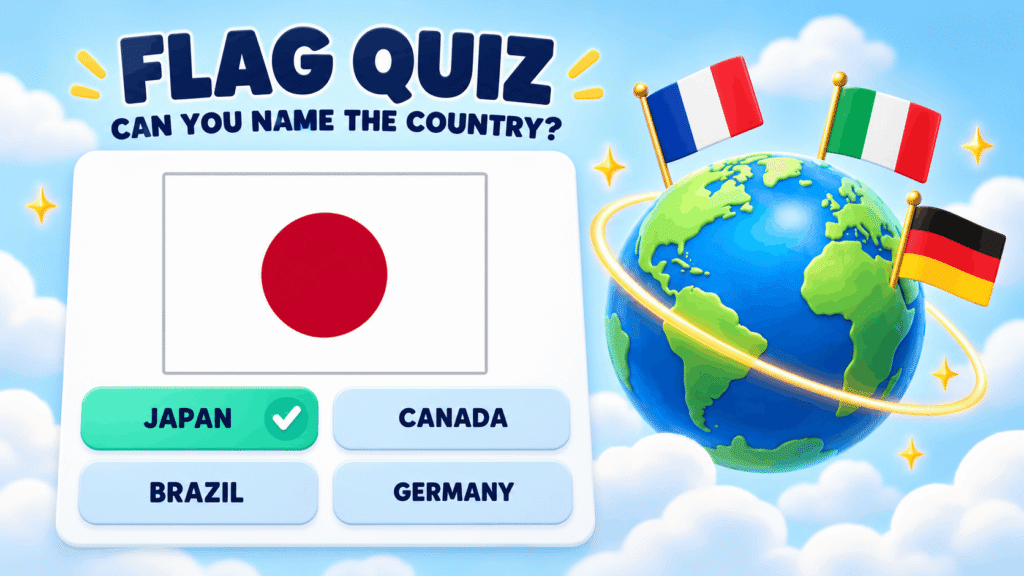
A flag quiz shows you a national flag and asks you to name the country it belongs to, usually by picking from a short list of 2, 4 or 8 choices, with full-world versions running from 195 to 197 flags.
That last number depends on who draws the line. WheelySpin stops at the 193 UN member states plus two additions, 195 in total, while some other quizzes run to 197. Neither count is wrong; they just answer “what counts as a country” differently, which matters the day you chase a perfect score.
Formats split into two families. Classic quizzes, WheelySpin’s included, hand you one flag and four answers. A flag quiz built on a picker wheel will randomly generate each quiz question with a spin and let you set the answer options to 2, 4 or 8. For browsing with no test attached, a country picker wheel simply lands on a nation and shows its flag.
In my experience, what keeps a flag web tool highly replayable is randomness rather than raw difficulty. Most players recognize Japan instantly, then freeze on the third tricolour out of Europe. Starting with Africa or Asia before going global gives returning visitors a clear next step, and a number worth posting when they challenge friends.
How Does a Wheel-Based Flag Quiz Pick Each Question?
A wheel-based flag quiz picks each question by spinning a random wheel that holds only the countries you left switched on, then reveals the landing spot in a pop-up window with possible answers underneath.
On a typical flag quiz wheel, the spin lands on a country and you hunt for the corresponding flag (or the name, depending on the guessing setting) inside a pop-up answer list. Anything you untick beforehand never comes up. That small detail turns a generic flag guessing game into a targeted drill with no setup beyond a few checkboxes.
What happens after you answer depends on the action you choose. Normal Mode leaves every country on the wheel, so the same flag can return two spins later. Elimination Mode takes each played country off the wheel, which feels more like working through a deck of cards than rolling dice.
Two habits from using wheels with groups. Typing a heading such as “Guess the Country Flag” above the wheel tells a room what’s happening before anyone asks. When students only need a random nation to research for country reports, a Country Generator Mode drops the quiz layer completely.
Wheels also aren’t the ceiling for flag content. Some quiz sites add US State Flags covering all 50 states, plus separate Territory Flags sets for places that aren’t sovereign countries.
How Do You Play a Flag Quiz Step by Step?
You play a flag quiz by choosing which part of the world to cover, studying each flag, and tapping the matching country from a short list until the set runs out.
Here’s the WheelySpin flow, which mirrors most four-choice quizzes:
- Pick Quiz or Learn. Learn shows each flag beside its country name; Quiz hides the name and tests you.
- Read the flag. Every flag sits in the same 4:3 shape, so neighbours with near-identical designs are easy to compare.
- Choose one of four. WheelySpin uses a four-option multiple-choice layout, the format most flag quizzes share.
- Confirm and continue. The correct option is highlighted, and each flag appears once per pass, so the subsequent country is always a new one.
The step most people rush is the reveal. That instant feedback is where learning sticks, because your wrong pick sits next to the right one while both are fresh. On some wheel-based quizzes the results log marks each guess with ✓ or ✗, prints the right answer beside a miss, and keeps a running score (%). In elimination play, a country is removed from the wheel the moment it’s done.
If one long run feels like too much, the Geograck approach of splitting the subject into 9 flag quizzes (a world set, six continent sets, one for US states and one for territories) is worth copying in your own practice.
Can You Limit a Flag Quiz to One Continent or Region?
Yes, most flag quizzes let you shrink the pool to a single continent, several continents, or a hand-picked list of countries.
WheelySpin lets you play the whole map or a single region, and plenty of sites build continent specific quizzes for each of the six inhabited continents. Wheel-based tools go further. They start on an All Countries default, let you tick numerous regions at once, and then let you exclude individual countries, so a wheel can hold specific continents or just a few selected nations.
Narrowing is less about making the quiz easier and more about controlling repetition. A tight list means the same pool cycles back quickly, and that repeat practice is how lookalike flags finally separate in your head. I run a slow, relaxed pass on a new set first, then speed up once the misses thin out.
A continent focus also changes how you should judge results. Some quizzes let you display your score as Numerical or Percentage, and the percentage is the fairer view when you’re working one region at a time and want to compare a short regional run with a full-world attempt.
Which Flag Quiz Mode Should You Play?
The right flag quiz mode depends on the skill you want to train: flag-to-name questions build recognition, name-to-flag questions build recall, and a mixed mode tests both in one sitting.
Wheel-based quizzes offer the first three guessing styles, and WheelySpin adds a study option:
| Mode | What appears | What you pick | Good fit |
|---|---|---|---|
| Flag prompt (flag only) | A flag | The country name | Building recognition |
| Name prompt (name only) | A country name | The flag | Recall under pressure |
| Mixed | Either, at random | Whichever is missing | Experienced players wanting a tighter challenge |
| Learn (WheelySpin) | Flag plus its name | Nothing yet | Studying before you test yourself |
On a quiz wheel, pressing CHECK ANSWER brings up two buttons. DONE keeps that country in the quiz pool; REMOVE QUESTION drops it, which is how you clear a set without repeats. Over a long round, a shareable results page can tally total correct guesses against total questions attempted.
Pace is the other dial. A wheel’s spinning duration can run from 1s to 30s, and at one second the quiz turns intense. Some 197-flag sets are billed as the hardest multiple-choice flags quiz online; I’d treat that as a claim to test, since difficulty mostly comes down to how many lookalikes share the pool.
Can You Change a Flag Quiz’s Pace and Feel?
Yes: wheel-based flag quizzes let you tune how each spin starts and looks, and timed flag quizzes often let you switch the clock off entirely.
On a quiz wheel you start a spin with the spin button, and some wheels also accept Ctrl + Enter, which matters more than it sounds when you’re running fifty questions from a keyboard. A Mystery Wheel option swaps every label for a question mark, so nobody can read the answer while it’s still turning.
Timed quizzes work the other way round. One popular 197-flag version gives you an 18:00 timer and a Give Up button, and your result lands beside an Avg Score for comparison. Prefer no pressure? Its Practice Mode makes the quiz untimed, though those plays don’t count toward challenge completion or badge progress.
A setup I like: a fast first pass in practice mode as a warm-up, then the real timed attempt once the obvious flags are out of the way.
How Do You Track and Share Your Flag Quiz Score?
Each flag quiz tracks scores differently, so the easiest way to keep and share progress is to use whichever record the site already builds for you.
WheelySpin keeps it live: the right answer lights up green, you press Next flag, and your score and best streak climb as you go. The streak is the number I watch, because one long correct run tells me more than a total padded with easy flags.
Wheel-based quizzes tend to keep a results list instead. One I’ve used shows your score percentage in the upper left corner and, in elimination play, records which countries were eliminated, building a progressive log of the session. Switching confetti off helps if celebrating every right answer gets old in a classroom.
Big public Flags of the World quizzes with global scoreboards make a decent benchmark for trivia knowledge. Look for a Forced Order setting, which makes you answer in sequence, or Random Order, which shuffles the list. Posting a result and sending it to friends turns a solo run into a rivalry.
How Can Teachers Use a Flag Quiz in Class?
Teachers can use a flag quiz as a short interactive opener, a whole-class group game, or a study block that moves through the world continent by continent.
The format suits quick sessions because each question takes seconds, and most classroom activities I’ve seen it used in follow one of these shapes:
- Lesson opener: a handful of flags before the main topic, answered on mini whiteboards.
- Big-screen group game: hit the full-screen button so the quiz gets bigger and the inputs drop out of view, then return to normal view to change settings.
- Continent rotation: North America one week, Oceania the next, South America after that, which keeps beginners from facing all 195 at once.
- Progress record: a score certificate at the end of term makes tracking progress visible to students and parents.
Switching modes matters in class. Flag-to-name practice builds visual recognition, name-to-flag builds name recall, and moving between them breaks the flat study routine of paper flashcards.
Pairing the quiz with WheelySpin’s random country generator gives each student a nation to present on. Framing a full-world run as an adventurous road trip around the globe is something younger classes tend to enjoy.
How Do You Label and Brand Your Flag Quiz Wheel?
On flag quiz wheels that support it, you add a heading and short blurb through the More menu, and the text then displays in the corner of the tool for anyone playing.
That menu often holds other housekeeping too, such as sorting inputs A to Z, which pairs with a Shuffle button when you want the order mixed again. For a wheel that doesn’t start from the same spot every time, look for a random initial angle setting, plus a spin count option under spin behaviour.
Look and feel usually live in Settings. You can change the page color, pick from colour themes, and adjust the background transparency of the wheel area. On some tools, adding your own logo or banner, a custom spin button or a background image is reserved for Premium Users.
Branding can carry through to results. Some wheels let you create a score link showing your name and totals, or download the score image for a newsletter or class page. With the Inputs section hidden, the wheel and your label are all a viewer sees.
Does a Flag Quiz Work in Full Screen?
Yes, a flag quiz wheel with a full screen view enlarges the wheel and hides the input panel, and your results stay one click away while it’s on.
It’s the setting I’d use for a team quiz on a projector, set up in this order:
- Tune the spin. Open the Settings button menu, set the spinning speed anywhere from lvl1 to lv10, choose sound on/off, and enable the manual stop button if you want a student to stop the wheel.
- Label it. Use Modify Title & Desc. so the room sees a clear title.
- Go full screen. Run five flags while teams shout answers.
- Review. Show All Results still works in full screen; open the Results Link to share, or press Clear Results before the next class.
A five-flag burst like this fits neatly at the start of a geography lesson. Keeping the wheel large means the back row reads each flag as clearly as the front.
Which Countries Are Included in a Flag Quiz?
WheelySpin’s flag quiz covers every country in the United Nations plus the Holy See and the State of Palestine, while some other quizzes work through 197 world flags.
On one popular 197-flag version, the counter starts at 0/197 and fills as you type correct names. Beyond sovereign states, some flag games stretch to US states and coats of arms. To drill below country level, a state picker wheel can choose a state, province or region inside a country; WheelySpin’s Random US State Generator covers the US side.
Before starting any set, check what the quiz chooses to include, because “all the flags” means something different on each site. The images are standardised versions of real flags, which come in many shapes.
Why Do Some Flags Look Slightly Different in Shape?
Some flags look slightly different in a flag quiz because WheelySpin draws all of them in one uniform frame so they line up side by side, even though actual proportions vary from country to country.
The trade-off is worth it. A uniform frame puts attention on what separates lookalikes: the order of stripes, the size of emblems, and small shifts between similar colors and layouts, which is exactly where European flags trip people up.
Vatican City and Palestine, the two non-UN entries WheelySpin adds, are a good test of whether the frame helps you; Vatican City’s square flag is the one I notice stretching most.
Island regions are another stress test. A North America round that mixes in Central America and the Caribbean, an Oceania round built on Pacific island countries, or an Asia round that runs out to island nations all benefit from a consistent frame that makes repeated patterns easier to sort.
Does a Flag Quiz Work Offline?
WheelySpin’s flag quiz partly works offline: once a flag has loaded it stays in your browser, so a round you’ve already started keeps going on a weak connection.
The fix is simple: open the quiz and start the set while you still have signal. Each flag is a single image, so even Nepal’s, which isn’t a rectangle, stays available once it has appeared. Nepal is a nice one to check first, since it’s easy to spot if it failed to load.
I haven’t confirmed the same caching on other flag sites. For a South American set elsewhere, a description promising everything from the Andes to the Atlantic won’t help if the page needs a live connection, and whether you play on a desktop computer or tablet, neither helps if the page never loads.