How Do You Flip a Coin Online?
To flip a coin online, open a flip tool, press the Flip button, and read the face it shows; a fair digital flip has two equally likely outcomes, heads or tails, each with a 50% chance.
I stopped carrying change years ago, so my coin tosses moved onto my phone without much thought. The first real test came when two friends couldn’t agree on who would host game night. A browser flip settled it in about two seconds, and nobody accused me of a trick throw, which has happened to me with real change more than once.
A digital flip is a different object from a pocket coin. Many tools ask the device’s built-in random number generator for a value, which removes the wobble, catch, and bounce that make a hand toss hard to judge. Many result screens add Statistics Tracking and timestamps, so you can scroll back and check what happened instead of arguing about it.
The habit itself is old. People have tossed metal coins since the 7th century BC, yet the modern version runs on desktop or mobile, asks for no registration, and reaches Apple hardware from the iPod touch to Apple Vision. One Android flipper alone has passed 50K+ downloads. Whether you need a single choice settled or want to watch a thousand flips pile up, the odds stay fixed.
When Does Flipping a Coin Make Sense?
Flipping a coin makes sense when two options are close to equal, everyone agrees to honor the result before the toss, and the cost of a wrong pick is small.
Most of my own flips are quick yes-or-no choices: where to eat, which errand comes first, whether the dog gets the long walk or the short one. Organizers of gift exchanges lean on the toss too, because a coin keeps the host from looking like they played favorites. The common thread is low stakes and two options that both feel fine.
The contrarian case is that coins have also handled decisions worth millions. From 1966-1984, the NBA drafts used a flip between the worst teams in each conference to award the first overall draft pick, until the lottery system took over in 1985. Kareem Abdul-Jabbar and Magic Johnson were among the players those tosses touched, and so was Michael Jordan.
That history says less about chance than about trust. A league could live with a coin because neither club could claim the result was rigged. A difficult choice between near-equal outcomes is exactly where an impartial toss earns its keep, and where another hour of debate usually doesn’t.
How Do You Use an Online Coin Flipper Step by Step?
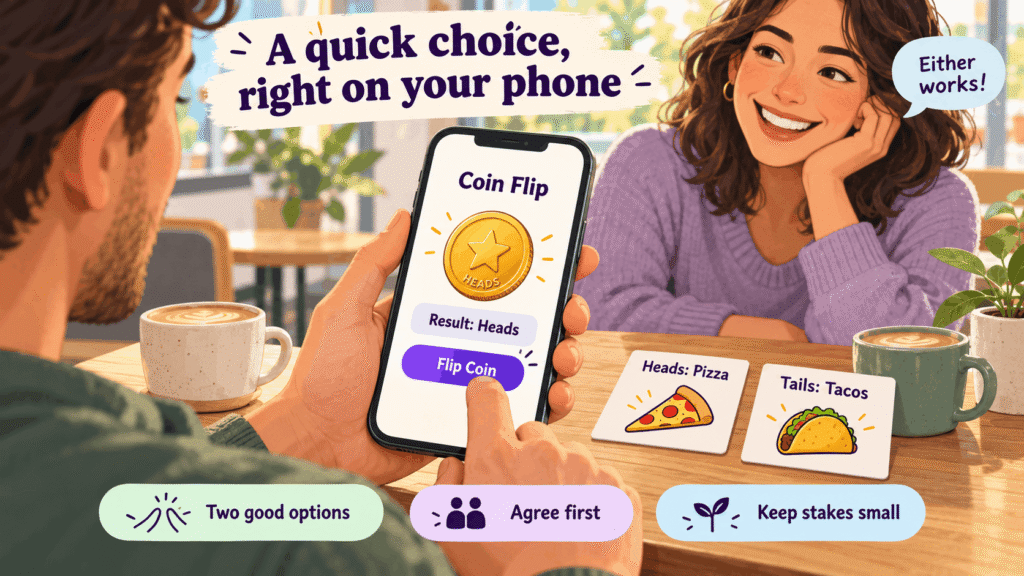
Using an online coin flipper takes one action: press the flip control, wait for the short animation to end, and read the face shown on screen.
I’ve tried a couple of dozen of these pages, and the core step never changes. What changes is how much information the page hands back afterward, so the order below moves from the toss itself to the tracking features most people never open:
- Pick a number from the coin menu if you want several coins in one press; a single coin is the default.
- Spin animation plays next, so let the coin finish turning before you read it.
- Heads and tails counts update under the coin after every toss, which saves you from keeping score in your head.
- History tab is the place to confirm the run matches what you remember.
- Auto-Flip Mode repeats the toss on its own, and you set the pace with the adjustable intervals control.
One habit worth copying: before you toss, assign each option to a side out loud, then clear the old tally. A counter carrying forty earlier flips into a fresh argument invites someone to say the coin is “due,” and that is how a simple tool turns into a second argument.
Which Coin Flip Features Are Worth Having?
The coin flip features worth having are an even 50/50 result, a visible record of past tosses, and a design that stays out of your way; everything past that is taste.
Store listings make the trade-offs easy to see. The two mobile coin flip apps I compared side by side package the same two-sided result very differently:
| Detail | Android coin flip app | iPhone and iPad coin flip app |
|---|---|---|
| Store rating | 3.4 stars from 267 reviews | 4.6 out of 5 from 3.4K ratings |
| Age rating | Rated Everyone | 4+ |
| Store category | Simulation | Utilities |
| Size, version, or update | Last updated March 17, 2026 | 78.4 MB, version 5.0.2 |
| Paid extras | Ads plus in-app purchases | Remove Ads for $3.99, U.S. Historical Coins for $2.99 |
The rating gap says more about expectations than about code. A coin can only land two ways, so reviewers end up grading polish: how clean the screen looks, how quickly the toss responds, and how often advertising interrupts it.
My own rule is simpler than any listing. If a tool hides its tally behind a menu or makes me wait through an ad to see the result, I close it, because the whole point of a flip is speed.
What Are the Real Odds of a Coin Flip?
The odds of any single coin flip are even: heads and tails each have a one-in-two chance, and no earlier result changes the next one.
Textbooks state that in a line, but the idea only sinks in when people count real tosses. Short runs throw up streaks that look meaningful, and that illusion is easiest to break with a hand tally borrowed from a children’s math activity:
- Paper and a pencil are all you need; draw two columns and mark every toss of a short first round.
- 100 times is the length of the second round, and the split usually shifts away from the first attempt.
- Multiply by 100 after dividing each side’s count by the total tosses; 3 heads in 10 flips works out to 30%.
- Conclusions come last: compare both rounds and decide whether your coin really favors one side.
Most people expect the short round to look lopsided and the long one to look even, and they are usually right. That pattern is the lesson behind all coin experiments: short runs wander, long runs settle, and neither tells you what the next toss will be.
How Old Is the Coin Toss?
The coin toss is at least two thousand years old: Roman writers described the game, and many historians trace it further back to Greek players who tossed a darkened seashell.
The last two centuries matter just as much, because that is when the toss started appearing in the founding stories of American places and machines. In 1845, Francis Pettygrove and Asa Lovejoy settled a naming dispute with a best-out-of-three toss. Pettygrove won and named the settlement after his hometown of Portland, ME, which is how Portland, Oregon got its name. The coin itself survives as the Portland Penny.
On December 14, 1903, Wilbur Wright won a toss against his brother for the first try at the controls. That attempt crashed after 3.5 seconds, and three days later Orville made the first successful flight. The coin picked the pilot for one morning, not the name the history books remember.
What strikes me in both stories is how little ceremony was involved. Two people, one coin, and a result both accepted: the same basic ritual players in the classical world would have recognized.
Why Does Flipping a Coin Reveal What You Really Want?
Flipping a coin reveals what you want because your gut reacts to the result before your reasoning does, and that flash of relief or regret shows which side you were hoping for.
Winning a toss and getting the better outcome are two separate things, and history has blunt examples. In 1969, Penny Chenery and Ogden Phipps flipped for first pick of two foals sired by Bold Ruler. Phipps won and chose the other foal. Chenery’s foal became Secretariat, who went on to win the Triple Crown.
The darker case is February 3, 1959, remembered as The Day the Music Died. Ritchie Valens won a toss against Tommy Allsup for a seat on the plane that crashed, killing Valens, Buddy Holly, and J.P. Richardson. Don McLean later wrote about that day in “American Pie.”
Neither story is about luck in the simple sense. Both show that the toss only hands you a result; how you feel about it, in the moment, is the information worth keeping.
Which Coin Flips Made History?
The coin flips that made history are the ones institutions chose to trust, from Roman courts to modern referees, election offices, and research teams.
The idea may predate coins altogether. Many historians place the origin in Ancient Greece, where players tossed a shell with one side blackened with pitch. By the time Julius Caesar endorsed the practice in 49 BC, a toss could carry real legal weight, and later institutions copied that trust:
| Arena | What the toss decides | When |
|---|---|---|
| Roman life | Criminal cases, property, and marriage | From Caesar’s endorsement onward |
| Sport | First possession or a way to break draws in football, cricket, tennis, fencing, and eSports | Today |
| Politics | Tied elections | Occasionally today |
| Research | Author order on publications, chosen by some scientists | Today |
The pattern across the table is that a coin wins wherever both parties fear the referee more than chance. A toss has no favorite team, candidate, or co-author, and that neutrality is why officials still reach for one.
Which Side of a Coin Is Heads?
Heads is usually the side that carries a ruler’s or national figure’s portrait, and when no portrait appears, collectors treat the side bearing the nation’s name as heads.
The word “heads” is a fairly modern habit. In ancient Rome the game was navia aut caput, “ship or head,” after the images struck on the coins. The British called it cross and pile, Peruvians say face or seal, and ancient China had its own version built on the same ship-and-head pairing.
Every one of those names describes the pictures on the faces, which is why the label keeps shifting across borders. Digital tools now reproduce those faces in detail. One flipper sorts its designs into currencies by country, Novelty Coins, and Antique Coins, with retired money marked Obsolete, and offers anything from the Canadian $1 Loonie and the US 10¢ Dime to the Swiss 1 Franc and the Austrian €2.
Those images came from contributors who donated coin pictures, some of them in the public domain. Flipping a real design is a small detail, but I find it settles the “which side is heads” question faster than any rule, because the portrait is right there on screen.
Can You Flip Real Currency Designs or Many Coins at Once?
Yes, some online coin flippers let you pick national currency designs and toss up to two hundred coins in one go, while simpler tools stop at ten.
For bulk tossing, one plain page uses a Number of coins dropdown that goes up to 10 coins and returns a count of coins on each side after every press. That is enough for most group games, and I rarely need more than three coins at a time.
On a phone, design choice gets more attention. One universal app for iPhone and iPad offers selectable coin designs and multiple flip windows on the tablet, so two people can toss side by side. Its paid pack adds 11 classic U.S. coin designs for anyone who wants an older look.
The same app has grown with Apple’s software. It added a Messages sticker pack for iOS 10, support for Dark Mode on iOS 13, and later a dark mode app icon. None of that changes the odds, but it explains why people keep a dedicated coin app instead of a bookmark.
What Do Coin Flip Apps Offer on Phones?
Coin flip apps offer the same two-sided result as a browser page, plus phone-friendly extras such as sound, animation, a saved record, and use without a signal.
The Android app I looked at pitches itself at settling a debate or deciding who starts a game. Its feature list reads like a checklist: realistic coin toss animations, a random result generator, a fast, simple interface, coin toss sound effects, a history of previous flips, and a small app size.
The feature I actually care about is that it works offline, with no internet connection needed. A coin that depends on a signal is a worse coin than the one in your pocket, and a basement game night is exactly where a browser tool lets you down.
The Apple-side app takes a gentler approach: you tap the screen and it handles the flipping, with no buttons to hunt for. Both apps prove that a toss can be dressed up endlessly, while the outcome underneath stays exactly as simple.
How Do Teachers Use Coin Flips to Teach Probability?
Teachers use coin flips so students can discover probability by tallying real results, then comparing short runs with long ones.
Every lesson I’ve seen starts from one claim: a fair coin gives each face a 1/2 chance, a 50% probability either way. Teaching children that claim is easy; getting them to trust it after a lopsided run is the hard part.
Children grasp Independent Events faster than adults expect. After five heads in a row, a 1 in 32 chance, many students still bet on tails, which is the Gambler’s Fallacy in miniature: the common misconception that past results shift future odds.
The Law of Large Numbers gives teachers the payoff. The Expected Value is about 50 heads in 100 flips, yet individual results vary, and a class that pools its tallies watches the combined share drift toward an even split.
Should You Flip Once or Flip Many Times?
Flip once when you need a decision and many times when you want to see how chance behaves, because a lone toss answers a question while a long series reveals a pattern.
A long series is the heart of one elementary math lesson for 1st through 4th grade, which runs 46 to 90 minutes. Students spin a nickel 50 times, record their predictions and tallies, and chart the frequency of each class result from 0 to 50 heads on graph paper or in a spreadsheet.
The lesson expects results near 25 to be common and the extremes to be rare, and it aligns with standards CCSS.Math.Content.1.MD.C.4 and 2.MD.D.10, which cover sorting data and drawing picture and bar graphs.
Between one toss and fifty sits the three-toss format. In two out of three, the face that appears only once loses, and if all three match you start again. In one out of three, that lone face wins instead, which I find handy for picking one person from a group of three.
What Is a Coin Toss?
A coin toss is a way to settle a question by throwing a coin and letting the side facing up decide the winner, and it is also known as a coin flip or heads or tails. A digital coin toss simulator reproduces the same choice between two choices on a screen. Collectors in numismatics call the two faces the obverse and reverse. The obverse usually shows a monarch or state figure, and when neither appears, the side with the country’s name is normally treated as the obverse. Because a toss works as a neutral method of random selection, people use it for everything from sports kickoffs to picking between two movies or shows.
How Do You Flip a Coin With One Tap?
On most online coin tools, one tap on the flip control tosses a coin and shows heads or tails within a second or two. One tool labels that control Flip Coin and shows the outcome announced below the coin, with an H in yellow for heads and a T in gray for tails. Its Statistics tab keeps total flips, while another page lets you reset at any time. The brief spin is cosmetic, and a more advanced service lets you toss anywhere from 1 to 200 coins per press.
Is an Online Coin Flip Fair and Truly Random?
An online coin flip is fair for everyday decisions because each side has the same chance, though most browser flips are computer-generated rather than physically random. A service that tosses virtual coins using atmospheric noise gets closer to true chance than ordinary code. One site says it has delivered even results since 2010 as the web’s original toss tool, and another promises an instant 50/50 result on every click. A hand toss into the air is harder to trust, because whoever calls it before it lands can be thrown off by a lazy flip that barely turns, and nobody can confirm the correct side came up fairly.
Can a Coin Flip Help You Make a Decision?
A coin flip can help you decide, mostly by exposing the option you were hoping for while the coin is still in the air. The idea is often called the Freudian Coin Toss, because Sigmund Freud allegedly asked people whether they felt pleased or disappointed by a toss to uncover their real preference. The Danish poet Piet Hein made the same point in his book Grooks, in a poem titled “A Psychological Tip.” I use it for yes/no decisions where I already suspect my answer and just need my reaction to confirm it. If a coin feels too quick, play rock paper scissors against the computer for a best-of-3 match.
How Does a Three-Way Coin Flip Work?
A three-way coin flip uses three tosses to pick one result out of three, which makes it useful for breaking ties and resolving disputes that a single toss would not satisfy. Groups also use it to choose which team goes first when three sides are involved. A related three-outcome bet appears in the Australian game Two Up, where a coin is flipped twice and players wager on two heads, two tails, or one of each. Rather than one toss, you let the flip decide across a short series. Planning a gender reveal party? The boy or girl spinner turns the same 50/50 guess into a game for guests.
What Is the Australian Two Up Coin Game?
The betting game from Australia is played with one coin tossed two times, and players bet on whether both results are heads, both are tails, or the two are split. People play it just for fun as well as for money, and it works only when both sides accept the payout rules before the first toss. I’ve seen friends adapt it for casual decisions and even for picking draft order in fantasy leagues. Like any coin game, the toss kicks off each round, and nothing from the last round carries into the next.
Can You See Your Past Coin Flips?
Yes, many online coin tools keep a record of your recent results along with a tally for each side. One tool lists the last 10 flips with times attached and turns totals into percentages, while another keeps a running tally that you can clear. A classic page simply shows your flip number next to a color scheme picker. Record-keeping is usually included among all features at no cost.
What Does Auto-Flip Mode Do?
Auto-flip mode tosses the coin repeatedly on a timer, so you can watch results build up without pressing anything. One tool uses a speed slider to set a 1 to 10 second interval, and each toss still plays its Animated Coin Flip before the result appears. That makes auto-flip a ready-made probability experiment, and the running counts quietly disprove the hunch that tails due next is a real thing. I leave it running when I want to show someone a pattern, rather than trusting one flip to decide anything.
Is an Online Coin Flip Free?
Yes, Wheelyspin coin flips are free and need no sign-up, and paid options appear only in apps that sell extras. One page built for gift swaps suggests a toss to decide who opens first in a White Elephant round or to break a tie between two people who want the same present, and it also suggests using a toss to settle disagreements. The free iPhone app runs on iOS 15.0 or later, on iPadOS 15.0 for tablets, and on visionOS 1.0.
Why Don’t Heads and Tails Hit Exactly 50% After Many Flips?
Heads and tails rarely hit exactly 50% because random variation keeps pulling the share slightly off center, even with a perfectly fair generator. The percentages approach 50/50 as flips increase, but a long run can still finish at 49% or 51%. Some browser tools rely on JavaScript and Math.random(), which is pseudorandom rather than physical or cryptographically secure, though that does not bias an everyday flip. Tossing at regular intervals in auto-flip makes this drift easy to watch, since the tally wobbles before it settles.