What Is a Never Have I Ever Generator and How Do You Use It?
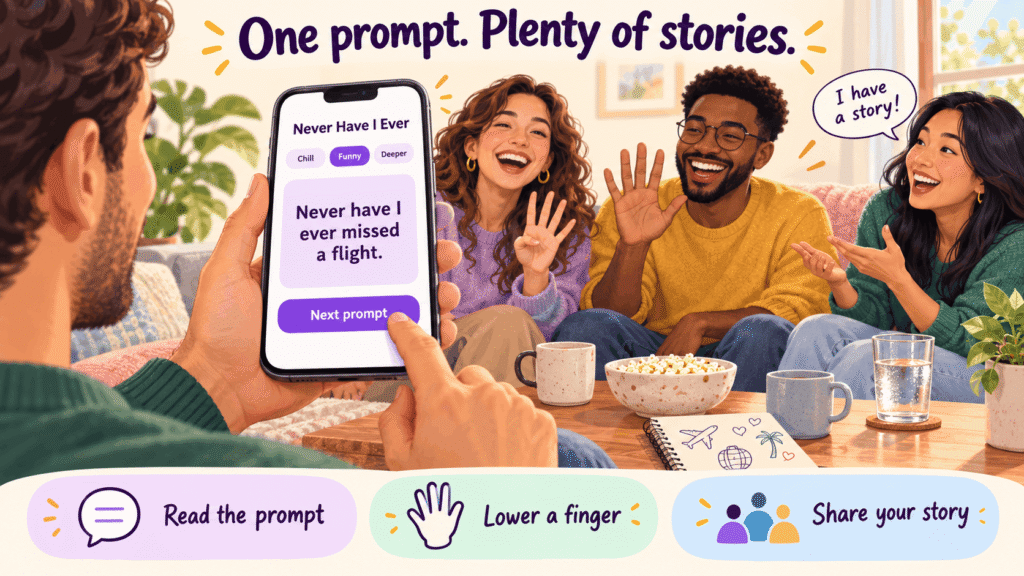
A Never Have I Ever generator is a free online tool that deals one random “Never have I ever…” statement at a time, which the group reads aloud while every player who has done that thing lowers a finger or takes a drink.
I have run this game at birthday dinners, pre games and two very loud sleepovers, and the generator changed one thing above all others: nobody stares at the ceiling trying to invent a line. Because the tool is browser-based, it loads the same way on phones, tablets and desktops, and the host just taps once for each new prompt.
The fun of the format sits in the gap between what people admit and what they would rather hide. A harmless line like “Never have I ever clapped when a plane landed” gets half the table groaning, while “sent a text to the wrong person” tends to drag out a story nobody planned to tell that night.
That gap is the reason the old drinking version and the finger down version both survive, and it is also why the game sits comfortably next to Would You Rather, Most Likely To and Two Truths and a Lie on a long party playlist. All four games run on confession and curiosity, but Never Have I Ever is the only one where the group learns something about everyone at once, from a single sentence.
How Does a Round of Never Have I Ever Actually Work?
A round of Never Have I Ever works when one player, or the generator, names something, and every person who has done that thing marks it by drinking, dropping a finger or losing a point.
Turn order matters less than people think. Either a player reads out a statement from memory, or the host taps for a random question and passes the screen along. To start the game, my group will pick a deck first and then let the tool deal without repeats, so nobody hears the same line twice in one evening.
The logic flips when no one at the table has done the thing: in the drinking version, the speaker drinks instead. That rule pushes players toward lines that will catch someone, like “lied on my CV or resume” or “missed a flight,” rather than safe ones such as “been on a plane.”
Each lowered finger is also an invitation. The quiet goal is to collect stories, and one embarrassing experience told well is worth ten silent sips. Some tables keep a point system where each “have” costs a point, so the scoring never stops the storytelling.
Pacing comes from the deck, not the clock. I start mild, escalate gradually, and only reach for the spicy ones once the giggles come easily. As a planning number, a 5-10 player game gets through 30-50 questions in a 30-45 minute game, while longer sessions or bigger groups will need closer to 80-100.
Which Rule Variations Can You Use for Never Have I Ever?
The main rule variations for Never Have I Ever change three things: how a “have” gets marked, whether a player can be knocked out, and whether a story must follow the confession.
History explains why the rules feel so loose. The original form of the game used fingers, with alcohol bolted on later by party crowds, so dropping the drinks never turns it into a watered-down copy. In some versions the group votes on whether a confession counts, debates the borderline cases, or simply reacts and moves on. For a game with the same feel, put a finger down uses statements, and whoever lowers all ten fingers first is out.
Elimination is the biggest fork. When every “have” costs a finger, the person who has lived a full life is out first, so with mixed company I open with harmless prompts such as “had a pet” or “gone skiing or snowboarding,” where an early knock-out never feels personal.
The second fork is the follow-up story. Forcing a tale after every “have” slows the pace but makes the night, and lines like “set off the fire alarm in halls,” “been to a toga party,” “snored so loudly I woke someone up,” “split my trousers in public” or “had food in my teeth during an entire conversation” almost always come with a story worth the wait.
Whatever the variant, one guardrail stays fixed for me. When the tool supplies them, the awkwardness of asking a pointed question shifts off the asker, and any player who wants out of a round can pass without explanation, no follow-up allowed.
What Group Size Works Best for Never Have I Ever?
Never Have I Ever plays best with 5-15 people, the range most hosts call the sweet spot, though the game still runs with fewer players and has no fixed upper limit.
Size changes the emotional math of the game. With a handful of people, almost every line catches somebody, and with twenty, the shy players can hide in the crowd. Matching the variant to the headcount fixes most of that, and the table below shows the pairings that have worked at my own game nights.
| Group size | Variant | Why it fits |
|---|---|---|
| Two players on a date | story time | Every “have” earns a short tale, so two people never run dry. |
| 4 to 12 players | classic ten fingers | Everyone starts with 10 fingers up, and whoever has to lose all 10 first is out. |
| Couples or teams | team mode | pairs share one hand of ten fingers and argue over each confession. |
| New colleagues | icebreaker mode | three rounds, optional sharing and no elimination keep it gentle. |
| A packed house | paddle version | Players hold “Have” and “Have Not” cards and must reveal at once. |
| Up to 3 to 30 players | points instead of fingers | Each player can earn or lose a point, so nobody sits out, which suits larger groups. |
| A restless crowd | speed rounds | rapid-fire prompts run first, then each eliminated player picks which stories to hear. |
One more trick from experience: once the room tops twenty, I run the reverse round once per game, where everyone who has not done the thing drops a finger, so the people hiding at the back finally have to move.
Why Use a Random Generator Instead of Making Up Statements?
A random generator is worth using because players no longer have to invent statements on the spot, so rounds move faster and no single person has to own an awkward line.
The usual house approach is to let each player write their own lines, and the weakness shows by round three: people repeat themselves or aim every line at one friend. Swapping in a question generator instead is the most common tweak, and the rules are loose enough that any group agreement counts as official.
A machine-picked line also removes blame. When the screen shows “had a crush on a friend’s partner,” nobody accuses the host of fishing for gossip, and the table laughs instead of bristling. My setup with a generator follows the same five steps every time:
- Pick a category: choose a deck that fits whoever is actually in the room.
- Five or ten fingers: every player raises a hand, or two, before the first card.
- Next statement: the host presses the button and will read it aloud to the group.
- Put a finger down: anyone who has done it lowers one, or takes a sip in the drinking version.
- Last player with fingers up wins: keep dealing until one hand is still standing.
The better tools also hold back a used line until the deck runs out, and then the tool reshuffles or you switch games. A few even accept a custom theme and serve lines generated around the theme, which is handy for a bachelorette or an office trip.
Which Never Have I Ever Categories Suit Your Group?
The right Never Have I Ever category depends on who is in the room: clean decks for kids and new acquaintances, light everyday decks for most groups, and adult decks only for players who have agreed to them.
I sort decks by heat rather than by label, because labels change from one site to the next while the heat level is what decides whether a dinner survives. The table below shows how sample prompts fall across three heat levels, with the kind of crowd each one suits.
| Heat level | Sample prompts | Who it suits |
|---|---|---|
| Mild | made silly faces at parents and teachers, danced in front of a mirror, wondered what it’s like to be a dog, farted in class, fallen asleep in class, gotten car sick, eaten dessert before dinner, gotten lost in my own city | Kids, families and classrooms, fine for all ages |
| Everyday | walked into a glass door, sat on wet paint, put milk in before the cereal, laughed at a joke I didn’t understand, waved back at someone who wasn’t waving at me, forgotten someone’s name while introducing them, eaten sushi, had pineapple on pizza, double-dipped a chip | Most adult groups, including coworkers |
| Bold | stalked an ex on social media, used a fake ID, been in a hot tub with strangers, danced on a table, lost my phone on a night out, done karaoke sober | Adults only, after everyone agrees |
Reflective lines sit outside that scale. Prompts such as “had a moment of perfect happiness,” “forgiven someone who never apologised” or “cut off a family member” are not racy at all, yet they hit harder than anything in the bold row, so I save them for late in the night with a small, trusted circle.
Many generators keep the adult tier as a Premium add-on for higher-intensity prompts, which works as a useful speed bump because someone has to choose it on purpose. Hosts can still skip prompts that would leave one guest targeted, and I do that more often than I expected.
What Are Some Good Never Have I Ever Questions to Start With?
Good Never Have I Ever questions to start with are short, relatable lines that most people can answer honestly without having to explain themselves.
Rather than one giant list, most generators split prompts into themed decks, and the Question Type menu plus a Number of Questions setting decide what you get and how many appear. The deck names below, with their approximate sizes from one large bank, show where good starter lines live:
- Top 20: a crowd-tested set of lines that land with almost any group.
- Clean/Icebreaker (50): built for mixed groups and first meetings, with Good Questions close behind as a gentle starter deck.
- Funny (50) and Embarrassing (45): slapstick and social slip-ups, with Gross and Entertainment decks on other generators covering similar ground.
- Spicy/Dirty (50): the spicier or darker tier for players who opt in, which one tool files simply as Dirty.
- Couples (45) and Friends (45): shared history, the kind that is quick to answer and debate.
- Work (40) and College (45): work-safe questions that steer clear of salary, relationships and personal habits and lean on hobbies instead, then campus nights.
- Travel (40), Food & Drink (40) and a separate Food deck: trips, flights and kitchen confessions.
- Deep (40), Breaking Rules and Drinking: reflection, mischief and pub nights.
- Party/Night Out (50), Party, Kids & family and Never have I ever for kids: the two ends of the age range, with one three-deck tool holding 60 statements in total.
My own opener is always from the mild end. The first five lines set the tone for the whole night, so I want early “haves” that make people grin rather than blush.
How Do You Play Never Have I Ever Without Drinking?
You play Never Have I Ever without drinking by swapping each sip for a lowered finger, a tally mark or a piece of candy, which keeps the scoring and drops the alcohol entirely.
In college versions, drinking is traditional, yet alcohol was never the engine of the game; the engine is learning about the other players. The classic rule, sip if you’ve done it, maps neatly onto dropping a finger at the table, or you can keep points on paper, and that is the version I use with non-drinking groups and anyone driving home.
School decks show how clean the game can get. One teacher-made set of 16 items, tagged G6, G7 and ELA, sits in an open-ended format with lines like “hidden food under my bed,” “licked my pet in secret,” “sung miserably in a bathroom” and “given a funny nickname to a teacher.”
The same set includes “swapped gum with someone” and “sniffed my underwear to check if it’s clean or dirty,” which got the loudest groans when I tried it with my nephew’s class. Office crowds work the same way: the alcohol-free format makes for quick team warm-ups, and with a clean deck it stays fully office-appropriate.
How Do You Host Never Have I Ever So Nobody Feels Singled Out?
The safest way to host Never Have I Ever is to open with mild questions, raise the heat slowly, and let any player sit out a prompt without giving a reason.
Players offer honesty only when nobody fears the follow-up. I tell the table up front that laughter is welcome and mocking is not, and I keep soft lines ready, like “forgotten a friend’s birthday,” “been the third wheel” or “eaten the last slice of pizza without asking,” to cool things off if a prompt lands badly.
On date nights, lines such as “forgotten our anniversary,” “used my partner’s toothbrush” or “practiced saying ‘I love you’ before actually saying it” work because both people already know half the answer, so the surprises come from the details. Shy players usually explain how it happened only after someone braver goes first, and the storytime rule makes that easier when the rules are adjusted so a story replaces a penalty.
When a tool lets you generate a card on demand, I watch faces and only tap for the next card once the moment lands. If drinks are involved, I set out low-ABV drinks, ask people to eat beforehand, keep water available, remind everyone to pace yourself, and never pressure anyone to finish a glass.
How Do You Keep a Never Have I Ever Drinking Game Safe?
A Never Have I Ever drinking game stays safe when each “have” means a small sip of something light, people eat and hydrate, and no player is ever pushed to drink.
The math is unforgiving. A typical round runs 20-60 minutes, and a guest with a colorful past takes a drink on nearly every line, while a shot per “have” is how drinking-game rounds at parties go wrong fast. I also cap the rule where nobody has done the thing and the speaker drinks, because it quietly rewards reckless lines.
The second safety layer is social. A good host will read the room, dial back the deck the moment a guest looks uncomfortable, and make it clear that players can always pass. Setting a “no judgment” rule before the first card matters more than any drink limit, since shame is what makes people overdrink to prove a point.
I keep a printed clean deck nearby too. Switching to mild prompts halfway through is less awkward than stopping the game, and the group rarely notices the change.
What Is the Quickest Way to Explain Never Have I Ever?
The quickest way to explain Never Have I Ever is this: one player says something they’ve never done, and everyone who has done it has to own up.
Have people sit in a circle with at least 3 players, and agree on one signal for a “have,” such as a raised hand or a dropped finger. Add a story tax if you want the evening to run on anecdotes rather than points. Most new players understand the whole thing after a single round.
Are Never Have I Ever Generator Questions Clean Enough for Kids?
Most Never Have I Ever generators include a clean deck that is safe for kids, while the adult tiers sit in separate decks that a host simply leaves switched off.
Look for kid-friendly questions in a deck of 60+ clean prompts, or a collection labeled party-safe prompts. Lines like “tripped and fell in the middle of a gathering,” “eaten an entire box of cookies in one sitting,” “traveled to another country” and “been in the hospital” fit family nights without a single awkward pause.
How Many Players Do You Need for Never Have I Ever?
You need just two players for Never Have I Ever, since two people is the minimum, but the game gets livelier with four or more.
A one-on-one game works well for getting to know someone, and there is no maximum at the top end. With 3-5 players, every question hits hard because nobody can hide. At 10+, or with very large groups, it helps to split into smaller ones so each circle keeps its pace.
Can You Play Never Have I Ever at Work?
Yes, Never Have I Ever works at work when the host picks clean, low-stakes prompts and leaves alcohol out of it completely.
At work events, I use lines like “fallen asleep during a meeting,” “sent an email to the wrong person” or “worked on a weekend voluntarily,” and hand out sweets instead of drinks. A deck that is intentionally party-safe and avoids anything inappropriate keeps HR happy, and sharing the story behind a “have” should always stay optional.
What Happens When the Generator Runs Out of Questions?
When a Never Have I Ever generator runs out of questions, it usually starts the same deck again from a fresh shuffle.
A tool that deals one question per click knows when the deck is exhausted, and some sites invite feedback on new categories to keep the pool growing. For longer game nights, I switch to category rounds built on one theme, mix in party questions, or end on a crowd-pleaser like “met a celebrity in person.”
How Many Never Have I Ever Questions Do You Need for One Game?
A single game of Never Have I Ever needs fewer questions than most hosts expect, because each line can spark a story that lasts several minutes.
Banks with hundreds of questions, or even 500+ questions spread across 12 categories, are more than enough for a month of parties. A deck of 60 numbered prompts in a copyable list covering everyday, innocent embarrassments, such as “pulled an all-nighter before an exam” or “fallen asleep during a movie at the cinema,” also speeds up the game for a short session.
Can You Play Never Have I Ever Without Alcohol?
Yes, Never Have I Ever plays perfectly well without alcohol, because fingers or points can stand in for every drink.
A generator also takes pressure off sober players, since the line comes from the screen rather than from a friend. A prompt like “pretending to know a song everyone else was singing” works the same way sober: whoever admits it shares the moment. Its cousin, “pretended to know a song’s lyrics and mumbled through it,” gets the same laugh without a single drink.
Is a Never Have I Ever Generator Free to Use?
Yes, most Never Have I Ever generators are free to use, and paid extras are usually limited to adult or high-heat decks.
A free random generator typically needs no download, and some add a print option so you can run the game offline from a sheet of paper. In my experience, the free clean decks cover nearly every situation outside an adults-only party.
Can a Never Have I Ever Generator Use Your Own Custom Theme?
Yes, some Never Have I Ever generators let you type a subject of your own and then write prompts from it, which makes a round feel made for your group.
A themed deck feels tailored in a way generic lists cannot. For a travel crew, I typed a trip theme and got lines close to “crossed the equator” and “slept in an airport.” Start broad, then move to stronger categories once the group warms up.
Do You Need to Sign Up or Download Anything to Play?
No, you do not need to sign up for most Never Have I Ever generators, because the tool runs in your browser with no account needed.
There is no download needed either: you open the page, click the button, and the named thing appears on screen for the group to answer. That makes it easy to start a game on any phone in under a minute. Want a quick tiebreak between your favourite results? Put them on the spin the wheel page and spin once.