What Is a Makeup Wheel and How Does It Work?
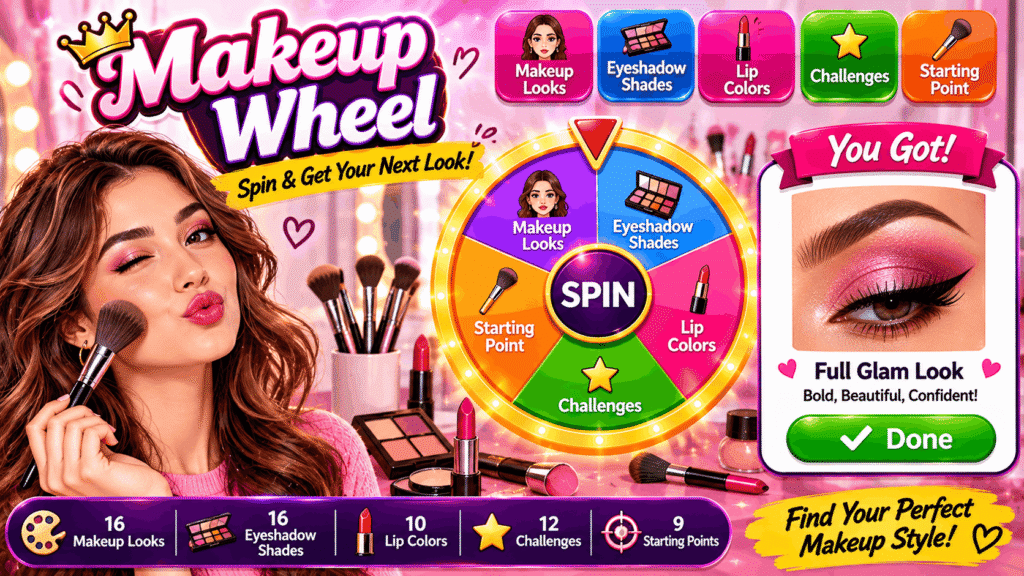
A makeup wheel is a spinner that picks your next makeup look, eyeshadow color, lip color, challenge twist or the face part to start with, so you stop deciding and start blending. Tap a list button, click Spin, and the result appears in seconds.
The five lists hold 16 looks from a Natural no-makeup look to Full glam, 16 shades of eyeshadow, 10 shades of lip color, 12 twists and nine starting points. That’s enough to refresh your everyday makeup for weeks and build confidence with a new technique each time.
Most of us repeat the same face out of habit, and the decision fatigue of getting ready keeps us in a rut. A spin hands that decision to chance, which beats boredom and gives your creativity a push without any planning.
The wheel is free, needs no sign-up, and works on mobile as well as a laptop. Beginners use it to learn one step at a time, makeup lovers use it for inspiration, and friends turn it into a sleepover game. If you want a wheel for something else, start from the main spin the wheel page and type your own options.
Why Use a Makeup Wheel?
A makeup wheel helps when you’re bored of your own face, short on time, or stuck repeating everyday makeup. It adds variety to your beauty routine, plus a spark of creativity when you’re in a rut.
Getting ready involves dozens of small choices, and each decision drains a little energy. Letting the wheel pick the eyeshadow or lips saves your energy for the fun part, and it stops the overthinking that leads to the same neutral brown every morning. Even a Job Interview face gets easier when the only question is which of three products to use.
It also builds confidence. A spin nudges you out of your comfort zone toward styles like Clean girl or Soft grunge, and that kind of experiment teaches more than another tutorial. It’s a steady source of inspiration and content prompts when your feed runs dry. For more sleepover fun, spin the truth or dare wheel next.
The wheel saves money too. It works with the products you own and the brands already in your palette, and the twist Use the shade you own least helps you declutter before anything goes expired. Spins also remove bias. Pair it with the what to wear wheel and Match your outfit becomes a two-spin plan, even under $10.
How Do You Use the Makeup Wheel?
You use the makeup wheel by choosing a list, pressing Spin or tapping the wheel, and reading the result in the pop-up.
- Tap one of the five list buttons: Makeup looks, Eyeshadow color, Lip color, Challenge twists or Face part to start with.
- Click Spin, or tap the wheel if you’re on a phone or tablet.
- Read the pop-up. On the shade lists, the slice colors match the real makeup colors, so you can find the closest one in your palette at a glance.
- Spin again if the result doesn’t suit the day, or keep it and head to the mirror.
- Add your own options in the entries box, one per line. The wheel redraws as you type, so you can edit or rename a slice in seconds.
On a small screen the controls stack under the wheel, so you never scroll sideways. For a run of spins with no repeats, tick Remove winner, and each slice drops off after it lands. Try two lists in a row: a Monochrome look followed by a lip color gives a full plan in under a minute.
Which Makeup Looks Are on the Wheel?
The Makeup looks list holds 16 looks, from a Natural no-makeup look to Full glam, so each spin points to a complete style rather than one product. Here is the full list.
| Everyday | Trend | Statement |
|---|---|---|
| Natural no-makeup look | Clean girl | Full glam |
| Soft glam | E-girl | Smoky eye |
| Sunburnt blush | Douyin makeup | Editorial graphic liner |
| Monochrome | Y2K glitter | Old Hollywood |
| 90s brown lip | Soft grunge | Goth |
| 70s disco |
The everyday column suits work or school, and the statement column suits nights out, so you can match the result to your mood. Full glam leans on Highlighter and lashes, Old Hollywood pairs winged liner with Classic red, Monochrome is a one-product challenge in disguise, and the trend looks are favorites on TikTok.
For more variety, add slices such as a Red Carpet look, a Mermaid look with coral cheeks and a turquoise liner, a Dewy skin day, faux Freckles drawn with an eyebrow pencil, Rainbow eyes, Fire and ice, or an Old look where you age yourself up. Goth and Editorial liner also work as SFX or drag starters around Halloween. For outfit themes to go with them, the DTI theme wheel has dozens of fashion prompts.
Which Eyeshadow Colors Can the Wheel Pick?
The Eyeshadow color list picks from 16 shades: Gold, Silver, Bronze, Copper, Rose gold, Emerald green, Royal blue, Teal, Purple, Hot pink, Orange, Yellow, Red, Black, Brown and Lilac.
That spread covers metallics, jewel tones, earthy browns and brights, so the result works whether your palette is shimmer-heavy or mostly matte. Teal is a tertiary color, and the list skips tricky ones like chartreuse. If you don’t own the exact shade, use the closest swatch, and remember that a swatch on screen uses RGB while pigments follow the RYB wheel, so colors shift a little in person. Bronze on the lid also pairs neatly with your usual Bronzer.
Eye color helps you wear bold results. Blue eyes look bluer with Copper, Orange or Gold, and Gold lids with blue mascara make a gentle start. Hazel eyes pick up gold and green flecks with Bronze or Purple, brown eyes suit Royal blue, and green eyes glow with Copper. A Rainbow result is easier over a yellow corrector, which evens out the lid first.
Pair brights with a Baby pink or Nude lip. For hues beyond makeup, the random color wheel shows each pick with its color code.
Which Lip Colors Are on the Wheel?
The Lip color list has 10 shades: Nude, Baby pink, Coral, Classic red, Berry, Plum, Mauve, Brick red, Peach and Deep wine. They run from soft everyday tones to dark evening shades.
Each result works with a lipstick, a tinted balm or a lip gloss, so you don’t need a specific product to follow the spin. Line first with a lipliner close to the shade for sharper edges, especially with Classic red, which is the signature of Old Hollywood and sits near vermilion on the color wheel.
Undertone matters with lips too. Berry and Plum sit near magenta and suit cool skin, while Coral and Peach suit golden undertones. Medium-olive skin is often neutral-warm, so Brick red, Mauve and a 90s brown lip look natural on it. Nude depends most on skin tone, so pick one a little deeper than your lips rather than your foundation.
Spin this list with the eyeshadow one and the pair becomes the challenge: Silver with Berry, or Rose gold with Deep wine. Blue eyeshadow with coral lips is a classic opposite-color pair, and some combinations that look odd on paper look great on the face.
What Are the Makeup Challenge Twists?
The Challenge twists list adds a rule to your next look, with 12 twists such as Use your other hand, No mirror, Only three products and a Five-minute timer. Spin it after the look, and the rule applies to the whole face.
The other twists are Fingers only, no brushes; Eyes closed for the eyeliner; A friend does one eye; Only products under $10; Use the shade you own least; Talk the whole time like a tutorial; One product per step, chosen by a friend; and Match your outfit. Filming the talking one makes an easy video series.
Some twists test a steady hand and symmetry, and some are pure laughs. Each one exposes a weak spot, so a hard twist is practice in disguise. Don’t spend time overthinking; the wheel decides, and the winner can claim a small prize, such as a new lip gloss.
Other popular challenges include Don’t lift the brush, a Blindfolded round, a one dip round, and the famous Blue foundation or Brown foundation slice. Use slice sizes as weights to make the wild ones rarer. For timed rounds, run the free online timer on a second screen so everyone sees the countdown.
Where Should You Start on Your Face?
The Face part to start with list chooses your first step from nine starting points: Base, Brows, Eyeshadow, Eyeliner, Mascara, Blush, Bronzer, Highlighter and Lips. A new starting point changes how the whole look comes together.
Most people start with Primer, a corrector for dark circles, Foundation, then Concealer and Powder. A corrector goes before concealer, and the right foundation is the shade that disappears first on your jaw. Many makeup artists do the eyes first so fallout can be wiped away before the base, then set the creme layers with translucent powder.
A blush-first day is a classic routine remix. Put the cheek color on first and you’ll need less Bronzer and Contour, and a Sunburnt blush look nearly finishes itself. A Dewy day starts better with Highlighter, since you can see where the glow lands.
Starting with Lips keeps the eyes balanced; draw the lipliner first, then choose a shadow. If the wheel picks Brows, shape them with an Eyebrow pencil before anything else, and use the same pencil for faux Freckles. Starting with Mascara is the strangest result, but it shows quickly whether you need liner at all.
How Do You Plan a Makeup Game Night?
You plan a makeup game night by choosing a theme for each round, spinning for a look and a twist, and letting judges vote on the winner. It works for a sleepover, a birthday or a quiet weekend with friends.
- Gather products everyone can share, plus brushes, sponges and wipes.
- Decide how many rounds you’ll play. Three rounds of 15 minutes is a good start, or use the Five-minute timer twist for speed.
- Spin the Makeup looks list for each theme, such as 70s disco or a Red Carpet look, then spin Challenge twists for the rule. Spin again if two rounds match.
- Take photos of every face in the same light, and let judges vote for a winner.
- Run a special effects round near Halloween: paint Frankenstein’s monster in Mint Green, Ghost Grey and Thunder Grey, with drawn neck bolts.
Remote friends can join over video chat. For an elimination round, the lowest vote drops out each time. The random pair generator splits the group into partners, so a friend does one eye for real. Add rounds from our party games list, or plan the celebration with the birthday ideas wheel.
How Does a Makeup Wheel Help Content Creators?
A makeup wheel gives content creators a ready-made format: spin on camera, react to the result, and create the look in real time. It turns a normal get-ready video into a challenge viewers watch to the end.
The surprise is the hook. Makeup lovers enjoy seeing a creator land on E-girl or Y2K glitter when they expected Soft glam, and the pop-up gives a clear reveal moment. A short reel or TikTok can show the spin, a montage and the result, while a longer video can work through one list as a series.
Use the wheel for content prompts too. Spin the looks list for the next post and the twists list for the angle, such as a Blindfolded attempt or a one dip round. Followers can act as judges and vote in the comments.
Live streamers can show the wheel in Full screen and let chat pick the list. The OBS wheel is built for overlays, so viewers see every spin as part of the broadcast. Keep a portfolio of your best results to pitch brand work later.
How Does a Makeup Wheel Build Skills?
A makeup wheel builds skills by making you practice the techniques you avoid. Each spin becomes a small lesson in a new technique, whether it’s blending a smoky eye, drawing graphic liner, or matching both eyes for symmetry.
Beginners can spin the Face part list and focus on one step for a week. Daily eyeliner builds a steady hand fast, and twists like Use your other hand, No mirror or Eyes closed sharpen control further. Don’t lift the brush teaches clean blending, and Brows teach shape. Try a shimmer lid one day and a matte one the next to feel the difference.
A makeup artist building a portfolio can recreate each look on a model and post a reel of the range. Clear photos make it easy for followers and clients to compare. Spinning also stretches your comfort zone, so your weak spot, perhaps Douyin makeup, gets regular attention.
Other ideas include a blush-first day, a one-product challenge, and a declutter check. When the wheel picks a product type, test every one you own and toss anything expired. Check labels as you go, since some people prefer fragrance free, silicone free products that are never tested on animals.
What Is the Color Wheel in Makeup?
The color wheel in makeup is the same artist’s color wheel that painters use: 12 colors in a circle that show how hues relate. Makeup artists use it to choose flattering eyeshadows, plan contrast, and handle color correcting.
The traditional wheel uses the RYB model. The three primary colors are red, yellow and blue. Mixing them gives three secondary colors, green, orange and purple, and mixing again gives six tertiary colors such as amber, vermilion, magenta, violet, teal and chartreuse. Emerald green and Teal from the eyeshadow list sit between green and blue. Some wheels use 24 steps, and screens use RGB instead.
Adjacent colors sit next to each other, while colors across the circle cancel or boost one another. A green corrector hides redness for that reason, and a green liner looks brighter beside a pink cheek. In 1872 Ewald Hering explained opponent colors, such as red against cyan, which is why opposite shades make each other pop.
The wheel’s history includes Isaac Newton’s Opticks in 1704, Moses Harris’s The Natural System of Colours in 1776, and Goethe’s Theory of Colours in 1810. The five pairings later on this page all come from these simple rules.
How Do Complementary and Analogous Colors Work on Eyes?
Complementary colors sit opposite each other on the color wheel, so they make each other brighter, while analogous colors sit side by side and look calm together. On eyes, opposites create contrast and neighbors create harmony.
The easiest use is with eye color. Blue eyes look bluer next to warm orange, copper and gold. Brown eyes stand out with purple and blue, so yellow lids with a purple liner are a great test. Hazel eyes glow with orange, gold, amber and pink, and green eyes light up with red and violet tones, plus a pink blush.
A Fire and ice result is pure contrast, with warm and cool shades side by side. On a 12 colors wheel, or a finer one with 24 steps, the opposite of your eye color is easy to find.
Contrast isn’t the only route. Stealth contrast uses a muted opposite, such as a soft red-brown on green eyes, while balanced harmony uses adjacent shades like Purple and Lilac.
Which Shades Suit Your Skin Tone and Undertone?
The shades that suit you depend more on your undertone than on your skin tone. Cool undertones lean pink, red or blue, warm undertones lean golden or yellow, and neutral ones sit in between.
To find yours, test two foundations along your jaw. The shade that disappears first is closest to your skin, and its undertone is likely yours. Very fair and deep skin tones are often neutral, while medium-olive skin is usually neutral-warm. Choose a cooler Contour shade on cool skin and a softer brown on warm skin.
Cool undertones suit plums, purples, blues, a fuchsia cheek and a Berry or Mauve lipstick. Warm undertones glow in Gold, Copper, Coral and Brick red, while Deep wine flatters deep skin. Neutral skin can wear almost anything, including earthy browns, soft greens and a 90s brown lip.
Undertone also shapes how you deal with hyperpigmentation, spots and broken capillaries, since the corrector has to sit well under foundation. If a cool result such as Silver lands on warm skin, add a Bronze crease. And if the Brown foundation twist comes up, pick a shade that’s only a little off for laughs rather than a shock.
How Does Color Correcting Work?
Color correcting uses the color wheel’s opposites to cancel discoloration before concealer. Because complementary colors neutralize each other, a thin layer of the opposite shade makes a problem area look even.
The main correctors work like this:
| Problem | Corrector shade | Why it works |
|---|---|---|
| Blue or purple dark circles | Peach or orange | Orange sits opposite blue |
| Redness and blemishes | Green | Green sits opposite red |
| Broken capillaries and spots | Yellow | Yellow softens red and purple tones |
| Hyperpigmentation | Peach or orange | Cancels brown and gray patches |
Orange is a secondary color, and it cancels blue, one of the primary colors. Use soft pink or peach on very fair skin and a deeper orange on deep skin. A green corrector should be sheer, and a yellow corrector is the gentlest choice.
Apply each corrector over Primer and before concealer, then blend the edges and build your Base on top. Theatrical artists rely on the same rules, and their kits often come in a wheel format. A monster creme wheel, for example, holds five shades in 1 oz, or 30 ml, and costs about $25.
What Is a Monster or SFX Makeup Wheel?
A monster or SFX makeup wheel is a physical palette of creme colors arranged in a circle, used for special effects, theatrical and drag makeup. It isn’t a spinner, but it often shows up in the same searches.
One well-known monster wheel holds five shades in a 1 oz, or 30 ml, creme palette: Mint Green, Thunder Grey, Ghost Grey, Red and Black. It’s designed for looks like Frankenstein’s monster, with a green-gray face, sunken eyes and painted neck bolts, and it costs around $25. Thunder Grey is the shade for deep hollows and an Old look.
You apply creme colors with a brush or a sponge, then set them with translucent powder so they last under stage lights. Many are fragrance free, silicone free and never tested on animals, which matters for sensitive skin.
A spinner and a palette work well together around Halloween. Spin for a Goth or Editorial graphic liner look, then push it into monster territory with the creme colors. If you still need a character, the Halloween costume picker will choose one in a click.
Which Color Pairings Should You Try First?
The five pairings below use the color wheel to create looks that feel fresh but wearable. Each relies on contrast or harmony, so they’re a good way to test the theory.
- Yellow lids with a purple liner, a classic complementary pair that makes both colors pop.
- A green liner with a pink blush, which balances red and green across the face. A fuchsia blush works for cool skin.
- Blue eyeshadow with coral lips, an orange-and-blue contrast that looks bright in summer.
- Gold lids with blue mascara, a subtle way to wear color if you’re nervous about bright shadow.
- Coral cheeks with a turquoise liner, which keeps the face warm and the eyes cool, like a Mermaid look.
You can recreate these with the wheel. Spin the eyeshadow list until you get Yellow, Royal blue, Gold or Hot pink, then spin the lip list and swatch the partner on your hand. Two analogous shades make a softer version. Stealth contrast and balanced harmony are the quieter options when a bold pair feels like too much.
Which Wheel Settings Change Your Results?
The settings that change your results most are Add entries, Remove winner and Slice sizes, because they decide what can land and how often. The rest are about convenience.
| Setting | What it does | When to use it |
|---|---|---|
| Add entries | Type your own looks or shades | Custom lists from products you own |
| Remove winner | Takes the winning slice off, like an elimination round | A run of spins without repeats |
| Shuffle | Mixes the order of the slices | After adding many entries |
| Slice sizes | Makes one slice bigger than another | Giving weights to safe options |
| Full screen | Fills the screen with the wheel | Game nights, OBS and streams |
Slice sizes work like weights. To make Blue foundation rarer, keep its slice small and the everyday slices large. The slice colors on the shade lists match real makeup colors, so the wheel doubles as a color reference. You could even list brands with 46 options if your collection is that big.
Streamers can key the overlay onto a green screen so viewers see the wheel beside the camera. Without any changes, every slice has an equal chance, with no hidden algorithm; the randomness audit explains how that’s tested.
Can You Add Your Own Makeup Looks?
Yes, you can add your own makeup looks by typing them into the entries box, one per line. The wheel redraws instantly, and you can edit, rename or delete any slice before the next spin.
This is the best way to make the wheel personal. Use Add entries for the shades in your own palette, custom looks you’ve seen online, or products you want to finish first. Some wheels offer a brands list with 46 options, but a list built from your own collection is far more useful, because every result is something you can wear today.
Mix your entries with the defaults or replace them completely. After a big edit, press Shuffle so similar slices don’t sit next to each other. To save your list, keep the page open or copy it into a note and paste it back next time.
Custom lists also make great themed rounds. Type the six looks for a party, or the products in a travel bag, and spin from that alone. No sign-up is needed for any of it.
Does the Makeup Wheel Work on Phones?
Yes, the makeup wheel works on a phone, tablet or laptop. On mobile, the controls stack under the wheel, so you never have to scroll sideways, and you can tap the wheel with one hand while holding a brush in the other.
That matters at the vanity, where your hands are often busy and the counter is crowded. Prop the phone against the mirror, tap, and read the pop-up without stopping. On a tablet held sideways or a laptop, the wheel and the entries box sit side by side, which makes it easier to edit a list mid-session.
For group play, cast the screen to a TV or use Full screen on a laptop, so everyone sees the slice land at the same moment. The page loads quickly and runs in any modern browser, so you can open it in the bathroom, at a friend’s house, or backstage before a show.
Is Every Makeup Spin Fair?
Yes, every spin is fair. The wheel uses your browser’s crypto.getRandomValues function, so each slice has an equal chance and no hidden algorithm favors one result.
That means your favorite look has the same odds as the one you dread, unless you change the slice sizes yourself. Removing human bias is the whole point: when a friend picks your challenge, say Fingers only, they might go easy on you, but the wheel won’t.
You can see how the spins are checked on the randomness audit page.
Fair odds also mean streaks happen. Landing on Goth twice in a row is normal with real chance, not a fault. If repeats bother you, turn on Remove winner, and each slice drops off until the whole list has had its turn. For a game night, that keeps the rounds varied and stops anyone arguing that the wheel is rigged. It’s the same fair draw as pulling names from a hat, only faster.
Who Made the First Makeup?
The Ancient Egyptians made some of the earliest known makeup, using minerals such as copper and lead ore to color and line the eyes thousands of years ago. Makeup has been part of daily life and ceremony ever since.
The color theory that guides today’s palettes is much newer. Isaac Newton bent the spectrum into a circle in Opticks in 1704, Moses Harris printed a color wheel in The Natural System of Colours in 1776, and Goethe described the emotional side of color in his Theory of Colours in 1810. Ewald Hering’s work on opponent colors followed in 1872.
That long history has always been about experimenting with what’s on hand, which is exactly what a spin invites you to do. Each result connects you to the same urge that led people to grind minerals into pigment: to try something new on your own face.