D&D Stat Roller: How Do You Roll Ability Scores Online?
A D&D stat roller is a free online tool that rolls four six-sided dice for each of your character’s stats, keeps the three highest, and repeats that six times, giving you a full array of scores ranging from 3 to 18 in a single click.
I have run a lot of session zeros, and the dice are rarely the slow part of character creation. The arguments are. One player wants to reroll a weak set, another arrives with a house rule from an old group, and somebody always forgets to add the other three after setting the low die aside.
A good roller settles the mechanics in plain view, with every die on screen, so the table spends its energy on the character instead of on the arithmetic. The sections below start from what the numbers do at the table and then work back to the dice, the notation, and the edge cases that rarely get explained.
How Does the 4d6 Drop Lowest Method Work?
The 4d6 drop lowest method works by rolling four d6, discarding the smallest die, and summing the rest for each score, and every sum then maps to a modifier that you add during play.
Most players stop reading at the roll total, but the game rarely uses the raw number. It uses the modifier, calculated as (score − 10) ÷ 2, rounded down. That is why a 14 and a 15 play the same in most situations, and why I tell newer players to read the modifier column before they get attached to an odd number.
The table below shows how all ability scores convert, from the floor of a 3 to the ceiling of an 18.
| Score | Modifier |
|---|---|
| 3 | −4 |
| 4–5 | −3 |
| 6–7 | −2 |
| 8–9 | −1 |
| 10–11 | +0 |
| 12–13 | +1 |
| 14–15 | +2 |
| 16–17 | +3 |
| 18 | +4 |
A one-click Roll Stats preset runs the whole process for all six scores at once. In my experience, the odd numbers only start to matter once something later adds a single point and pushes a score over the next bracket line.
What Does Each of the Six Ability Scores Actually Measure?
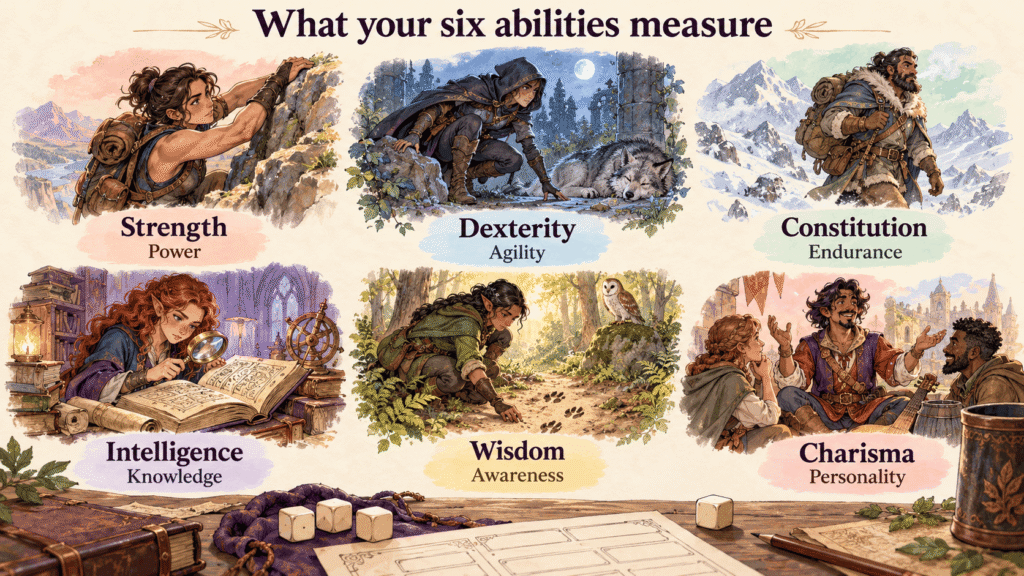
Each of the six ability scores measures one broad kind of capability, and the clearest way to see what a score covers in Dungeons & Dragons is to look at the skills it powers.
The muscle score has a single skill, Athletics. The nimble score carries three: Acrobatics, Sleight of Hand and Stealth. At my tables that nimble score gets fought over more than any other, because it touches sneaking, tumbling and quick fingers all at once.
The study score is the busiest on paper, with Arcana, History, Investigation, Nature and Religion. The perceptive score runs Animal Handling, Medicine and Survival, plus two more skills that share their names with its own description. The social score covers Deception, Intimidation, Performance and Persuasion.
One score has no skills at all. The staying-power score never appears on a skill line, and players who only read the skill sheet tend to undervalue it. I have watched more than one party regret dumping it.
What Modifier Does Each Ability Score Give You?
Each ability score gives a modifier equal to the score minus 10, halved and rounded toward the lower whole number, so a 12 or 13 gives +1 while an 8 or 9 gives −1.
Seen through the odds, the typical modifier is more modest than most people expect. The average 4d6 result is 12.24, the median is 12 and the mode is 13, so the usual rolled score sits in +1 territory. The three likeliest totals are 13 at 13.3%, 12 at 12.9% and 14 at 12.3%, which means a +1 or +2 is what most single rolls hand you.
On the low end, a score of 8 or lower turns up roughly one time in ten, so a −1 somewhere in a set of six is ordinary. I don’t treat it as a disaster when it lands on a score the character barely uses.
The modifier is the number you carry into ability checks, attack rolls and saving throws. When I copy a fresh set onto a free character sheet, I write the modifier larger than the score, and with an online roller I type it into the modifier field so the tool adds it for me.
What Are the Real Odds Behind Rolled Stats?
The odds behind rolled stats depend on the method: dropping the lowest of four d6 lifts the average well above straight three-dice rolling, and every alternative trades some of that randomness for predictability.
Rolling odds only make sense next to the alternatives, so here is how the common approaches compare on the figures each one is known for.
| Method | Average or budget | What it means at the table |
|---|---|---|
| 3d6 in order | 10.5 average | A 15 or better shows up 9.3% of the time |
| 4d6 drop lowest with reroll 1s | 13.43 average | A 15 or better rises from 23.1% to 35.2% |
| Standard array | Fixed 15, 14, 13, 12, 10, 8 | The same six numbers for everyone |
| Point buy | 27 points | Scores capped at 15 before bonuses |
The classic method at the top is the harshest of the four. I once watched a table of new players roll it and end up with a fighter whose best score was a 13, which made for a funny session and a frustrating campaign.
For a quick campaign or a one-shot, I lean toward the fixed numbers. Nobody spends twenty minutes rerolling, and the game starts on time.
Which Other Ways Can You Generate Ability Scores?
Besides rolling, D&D players can generate ability scores from a fixed list of six numbers or by spending a set budget of points, and both options exist mainly to remove the variance that rolling creates.
That variance is easy to measure. Four d6 produce 1,296 possible outcomes, and the spread around the average has a standard deviation of 2.85, so two characters rolled at the same table can sit several points apart on every score.
The extremes behave differently from each other. A 3 is the rarest total, appearing 1/1296 of the time, while an 18 comes up about 1.6% of the time per score. A roller that lets you compare your rolls against the full distribution ends most arguments about cursed dice.
Most D&D 5e stat tools list the fixed options next to the roller. Rolling itself follows the standard rules of 4d6 drop lowest, so any variation your group prefers has to be applied by hand.
Should You Reroll 1s When Rolling Stats?
Rerolling ones is a table house rule rather than part of the core method, and it suits groups that want stronger characters and accept a bigger gap from players using fixed numbers.
The rule changes which kept dice survive. Any 1 in the dice pool gets rolled again before the lowest is dropped, so the totals creep upward and very low scores almost disappear. The dice are no more weighted than before, because only the worst face is removed from the first pass.
I have seen Dungeon Masters allow the rule for players but never for NPCs, which keeps villains on the ordinary curve. That is a fair choice, but weigh it against the fixed budget, where every score starts at 8 and racial bonuses are added afterwards.
The budget approach guarantees that every character starts equal, and the fixed list lets numbers be assigned as you like without any luck involved. Rerolling ones keeps the excitement of the dice and accepts the imbalance.
Which Skills Belong to Each Ability Score?
Skills belong to five of the six ability scores: strength, dexterity, intelligence, wisdom and charisma each feed one or more skills, while constitution feeds none.
Reading the skill list through each ability’s description helps you place your best roll. Physical power drives the lone muscle skill, while agility and coordination cover the three quick-handed, sneaky ones. Logic, reasoning and memory sit behind the five scholarly skills, so a high roll there pays off in libraries and ruins.
The perceptive score is described as perception and insight, and those two words are also skills in their own right, which is why that score carries five skills. The social score is described as force of personality, which explains how lying, threatening, performing and persuading all run from one number.
The sixth score is the outlier. Its description is endurance and toughness, and no skill uses it, so I value it for keeping a character alive rather than for anything on the skill sheet.
What Can an Online Stat Roller Do Beyond Rolling?
An online stat roller can do more than produce six numbers: the better tools let you assign each result to an ability, keep a record of the session, and run everything from the keyboard.
Assigning scores is the part where order matters, so this is how I run it with a group:
- Roll the full set with one tap, or press a single die button when you only need one die.
- Dropdown menus under each result let you choose which ability receives that number.
- Tab moves between inputs, the arrow keys pick an ability, and Enter opens the menu.
- Type notation instead when a player needs something unusual, such as a single replacement roll.
Beyond that, most features are conveniences. Graphs of your results and downloads of the set help when a DM wants proof of an honest roll. I also check for no sign-up and no ads, because a pop-up during session zero kills the mood.
Heavier tools should fall back to standard rolls on older devices. In my experience the well-built ones do, and the roll arrives just as fast without the animation.
Which Die Handles Which Job at the Table?
Each die in a set has a typical job: the twenty-sided die decides whether you succeed, the smaller dice set how much damage or healing happens, and a paired set of tens handles percentages.
Stat rolling uses only the six-sider, which surprises people who buy a complete set just for character creation. Once play begins, the twenty-sider takes over. Initiative and death saves both start there, and two d20s come out whenever a situation grants a better or worse chance.
Percentile rolls pair a percentile d10 with an ordinary ten-sider to produce 1d100, a result from 1 to 100. I keep a dedicated pair in a different color so nobody argues about which die is the tens.
A good roller also lets you mix dice types in one string, such as 2d6+1d8+3. That kind of mixed roll shows up when a weapon hit stacks a bonus effect on top, and typing it once beats adding three piles of dice by hand.
How Do You Read Dice Notation?
Dice notation reads left to right as how many dice, which die, any keep rule, and any flat bonus, so a string like 1d8+2 means one eight-sided die plus two.
Stat rolling is the cleanest teaching example, because it uses every part of the grammar except the bonus. Once a player can read the stat string, the rest of the game’s strings stop looking like code.
- Dice count: the number before the “d” says how many dice to throw.
- Sides: the number after the “d” names the die, so d6 is a six-sider and d20 is the twenty-sider.
- Kh or kl: these letters mean keep the higher results or keep the lower results, followed by how many to keep.
- Flat modifier: a trailing plus or minus adds a fixed number, such as a +5 bonus.
Weapon damage is where notation turns into habit. Shortswords roll a single six-sider and a pike rolls a ten-sider, so those strings stay short until spells and class features stack extra dice on top.
How Do You Roll D&D Dice Online?
You roll D&D dice online by choosing the dice you need, setting any modifier, and pressing the roll control, after which the tool shows each die and the sum.
Presets and one-click buttons cover the common jobs, so a magic missile volley or a round of healing potions takes one press instead of a handful of dice. Most tools need no account and keep your last 20 rolls on your own device.
When a DM wants to check a result, copy a link to the roll and paste it into the group chat. A 3D mode toggle adds animated dice, and some character rollers show a running counter of how many characters the tool has produced.
How Do Advantage and Disadvantage Work in 5e?
In 5e, a favorable situation has you roll a pair of d20s and use the better result, while an unfavorable situation has you roll the pair and use the worse one.
In notation, the favorable case is 2d20kh1 and the unfavorable case is 2d20kl1, a keep-highest or keep-lowest rule applied to two dice. A good roller shows the dropped die, which matters because a natural 20 only counts when it lands on the die you keep.
Whether a character fights with rapiers or fires heavy crossbows, the favorable attack string reads 2d20kh1+5 once a +5 attack bonus is added.
What Does 4d6 Drop Lowest Mean?
4d6 drop lowest means rolling four six-sided dice, ignoring the smallest result, and totaling the remaining three to produce one ability score.
In custom notation the method is written 4d6kh3, which reads as keep the highest three, and a stat roller repeats it once for each of the six abilities.
Don’t confuse it with 4d6+2, which adds all four dice and then two more. That string is a damage-style roll, not a stat roll, and a single mistyped character turns one into the other. I still let players roll physical dice for stats when they ask, because watching the low die get pushed aside is half the fun.
Which Dice Do You Need to Play D&D?
D&D uses seven polyhedral dice: a d4, a d6, a d8, a d10, a d12, a d20, and a second ten-sider for percentiles.
The small dice are mostly weapon dice. Daggers roll the four-sider, longswords the eight-sider and greataxes the twelve-sider. The eight-sider also sets hit dice for most classes, while the barbarian gets the twelve.
The d100 is not a separate shape. It is the pair of ten-siders read together, one as tens and one as units, which is why a set feels complete with only seven pieces. For a first purchase, I suggest one color per player so stray dice always find their owner.
How Do You Read a String Like 2d20kh1+5?
A string like 2d20kh1+5 means rolling two twenty-sided dice, keeping the higher one, and adding five, which is an attack made with advantage and a +5 bonus.
Swap the kh for kl and the same attack is made at disadvantage. Longer strings follow the same grammar. Sneak attack and fireball both pile up six-siders, so their strings grow with level while the reading rules stay identical.
I tape a notation cheat sheet inside my DM screen. Newer players glance at it twice and then never need it again. Reading the letters first and the numbers second is the habit that makes it stick.
Is an Online Dice Roller Really Random?
An online dice roller is random when it draws each result from the browser’s built-in generator, which gives all faces the same odds with nothing tilting the outcome.
In 3D modes the dice are physics-simulated and thrown on screen, and the faces they land on are the results, so the animation is the roll itself rather than decoration.
Randomness matters for routine checks, but it matters most for the swingy tables: wild magic surges, loot tables, resurrection rolls and general DM chaos. Your roll history stays on your device, and a delete all data setting wipes it if you share a computer.
Is There a 3D Animated Dice Roller?
Yes, 3D animated dice rollers exist, and they use WebGL to draw dice that tumble and settle before the result counts.
The 3D view gives every face an equal chance, exactly like a flat roller, so the choice is about feel rather than fairness. Devices set to reduced motion skip the animation, and the chosen dice color is remembered between visits.
If you prefer plain screens, a simple rolling animation, a fullscreen mode for projecting at the table, and Unicode dice characters in downloads are enough. For session zero I value simplicity and ease of use over spectacle.
Can You Roll Daggerheart Duality Dice Online?
Yes, some online rollers include a Daggerheart panel that rolls the Hope die and the Fear die together as two d12s, plus your modifier.
Each roll comes out either with Hope or with Fear, and matching dice count as a critical success, following the Daggerheart SRD. These duality dice draw from the same random number generator as every other roll in the tool.
You won’t find them in a standard set of seven dice, so a pair of differently colored twelve-siders is the cheap physical alternative. I mark one with a dot so the table never argues over which die is which.