How Does a Random Recipe Generator Decide What You Eat Tonight?
A random recipe generator decides what you eat by letting a smart algorithm pick a cuisine, a main ingredient, a cooking method or a finished dish for you, often filtered by diet and time, so the choice stops being yours to agonize over. To choose an ingredient, spin the fruit wheel and build a smoothie or dessert around it.
That answer covers two very different machines. One kind hands you a combination of three words and expects you to fill in the rest; the other hands you full recipes with quantities and steps. I’ve used both on weeknights, and the gap between them matters more than any promise about every cuisine under the sun.
The second split is about inputs. Some tools pull from a fixed library, while others start from the ingredients you have and return an instant suggestion built around them. If your real problem is a half-empty crisper drawer, that second type earns its place far faster.
What both types share is the outcome: you stop scrolling and land on a single dish. Handing your dinner fate to a button sounds lazy, yet after years of feeding a family I find the hard part is rarely technique. The hard part is choosing, and a generator removes exactly that step.
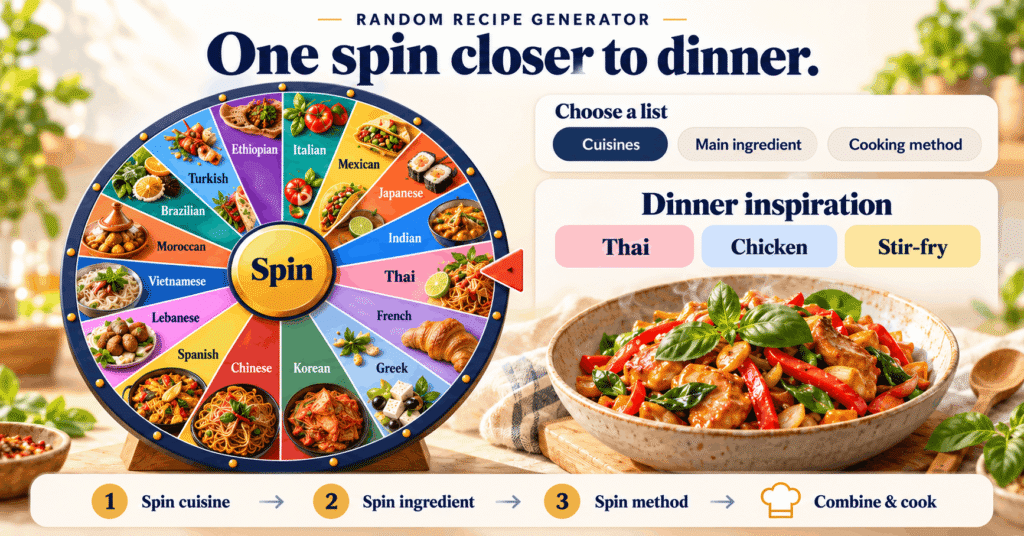
How Do You Use a Random Recipe Generator Step by Step?
A random recipe generator is used by spinning one list for cuisine, one for the core food and one for technique, then finding or improvising a meal that unites the three results.
Most households rotate the same five meals, and a three-part draw breaks that loop with almost no effort. The well-known sample result is Thai, salmon and sheet pan, which already reads like a Tuesday dinner. Here is the order I follow:
- Randomize the cuisine list first, picking from 40+ cuisines where the tool carries that range.
- List of ingredients comes next: switch to the protein-and-produce list and spin it once.
- Build on those two results by spinning the technique list, which settles oven, pan or pot.
- Instructions come last: look up a published version that joins every result, or improvise on your own.
Customizing the lists is where the three-spin method gets personal. A good tool lets you edit any list, and the changes are saved in your browser, so a trimmed roster without the dishes your kids refuse survives the next visit.
My one rule is never to re-spin the first result. Accepting the cuisine draw is what pushes a home cook out of habit, while re-rolling until the screen shows something familiar defeats the whole exercise.
How Do You Turn a Random Meal Pick Into a Kitchen Game?
A random meal pick becomes a kitchen game when you swap the ingredient list for whatever is already in your pantry and cook the result with no shopping allowed.
The point is to burn through leftovers before they turn. Two carrots, half a tin of chickpeas and a wedge of feta become the spinning options, and the draw decides which one leads dinner. That simple trick cuts food waste, helps you save money, and trims grocery bills in weeks when the budget is tight. My version runs in three moves:
- From scratch, type in only the items you can physically see on your shelves and in the crisper.
- Staring blankly at an odd pairing is allowed for one minute; after that, the knife comes out.
- Make one up when no published meal fits the draw, because improvising is the actual game.
Not every round ends well. Some nights produce a disaster, some a forgettable bowl, and once a Chicken Tikka riff on leftover yogurt beat our usual takeout. A Bulgogi Beef lettuce wrap built from a forgotten flank steak became a regular the same way, and no cookbook taught me that pairing.
The only house rule is patience. If you have given up on a strange pairing before tasting it, you lose the round and wash the pans.
Can a Generator Build a Meal From the Food Already in Your Kitchen?
Yes, an ingredient-based generator builds a meal from the food already in your kitchen: you list what sits in the fridge, and the AI writes a dish around those own items instead of pulling one from a fixed library.
Think of the AI approach as the ingredient dump run backwards. Older tools made you reverse-engineer a random dish from what you owned, while the AI version starts from your shelves and works outward. One service caps this at 3 free AI recipes a day, next to a library of 450+ tested recipes.
Trust is the real question with generated food. The stronger services pair AI assistance with human review, checking accurate quantities and timings before anything reaches you, and they lean on dishes proven in real kitchens. I would not follow an unchecked AI bake, though a stir-fry is far more forgiving.
Once the plan exists, the cooking screen matters. A stay-awake mode keeps the screen on and your work hands-free, and step-by-step guides stop flour-covered fingers from tapping the phone every two minutes.
Which Food Categories Can You Filter a Random Pick By?
Random picks can usually be narrowed by eating style, cuisine, preparation time and skill level, so the result fits the cook as well as the craving.
Filters fix the oddest complaint about choosing food: a lack of options is never the problem, too many is. Narrowing by time alone turns a sprawling archive into a handful of quick recipe ideas. The listed times below show how wide that range runs, from a no-heat salad to an all-afternoon braise.
| Dish | Listed time |
|---|---|
| Fluffy Yogurt Pancakes | 20 min |
| Budget Lentil Dal | 25 min |
| Classic Pork and Cabbage Dumplings (Jiaozi) | 10-15 min per batch |
| Chili Oil Noodles | 8 min |
| Dense Bean Salad | 0 min |
| Turkish Simit | 25 min |
| Classic Naan Bread | 10-15 min, batched |
| Mushroom Masala | 25 min |
| Tacos al Pastor | 15-20 min |
| Classic Scrambled Eggs | 5 min |
| Classic Grilled Cheese Sandwich | 5 min |
| Chana Masala | 25 min |
| Fresh Tabbouleh Salad | 15 min, plus bulgur soaking |
| Mediterranean Lamb Chops | 8-12 min |
| Classic French Cassoulet | 3.5-4 hours of slow cooking |
| Simple Chicken and Vegetable Lo Mein | 15 min |
| Classic Palak Paneer | 25 min |
Skill is the filter most people ignore. Dumplings, simit, naan and tacos all carry a Medium difficulty tag on their cards, and in my kitchen those four on a weeknight usually mean eating at nine.
Which Random Dishes Are Trending Right Now?
The dishes trending on random meal tools right now are fast, everyday comfort plates such as pancakes, dal, dumplings and noodles, and every one on the current trending list finishes within 25 minutes.
Trending lists say more about mood than taste. While every food blog pushes weekend projects, people still reach for what a busy weeknight allows, and the endless scroll collapses into a dozen humble plates. That pattern is also why category labels exist, letting a dietary preference shape the draw before it happens. These are the labels I see most often:
| Category | Tag on the filter |
|---|---|
| Vegan | Plant-based delights |
| Quick Meals | Ready in 30 minutes |
| Italian | Pasta and more |
| Vegetarian | Meat-free meals |
| Mexican | Spicy and flavorful |
| Healthy | Under 400 calories |
| Asian | Eastern flavors |
| Easy | Beginner-friendly |
Trending dishes also feed meal inspiration in a quieter way. A favourite dish that keeps resurfacing tells you what your household actually enjoys, and I copy those repeat winners onto my personal spin list.
What Do the Daily Food and Drink Specials Look Like?
Daily specials pair one featured meal with one featured drink, refreshed each day, so a visitor who hates choosing gets a whole menu decision in a single glance.
The drink half is the part people underrate. Behind a single daily pour sits a library of 200+ drink recipes, including 100 non-alcoholic options, and the same tool offers unlimited free picks when one suggestion isn’t enough. Cocktail fans and mocktail drinkers draw from that same shelf, which suits any occasion from a birthday to a dry month.
Rotation is what makes specials useful. The cuisine tags on trending cards already span Chinese, Indian and American plates, and I want that spread from a rotating special, with refreshing drinks that match the plate rather than fight it.
The work behind each daily pick matters too. An in-house food team writes the guides and editors check every recipe before it goes live, which counts for more on a pick you didn’t choose yourself.
Can a Random Generator Suggest Drinks as Well as Meals?
Yes, some random generators suggest drinks as well as meals by rotating a featured beverage daily beside a featured plate.
The featured beverage on the day I checked was a Cherry Limeade, listed as the Drink of the Day with 5-minute prep, a $3.50 cost and 0% ABV. That last detail matters to me, because a drink draw that ignores kids and drivers is useless at a family table.
Pairing is the clever part. The matching Food of the Day was Risotto alla Milanese, which serves 2 and takes 25-30 minutes, so the glass is poured long before the rice is ready.
A tart lime-and-cherry glass beside a rich, slow-stirred risotto is a sensible contrast. That kind of pairing is what I’d want any drink feature to aim for, even when the choice itself is left to chance, and it beats a drink picker that knows nothing about dinner.
What If You Still Can’t Settle on One Meal?
If you still can’t settle on one meal, hand the decision to someone else in the house or to a different kind of draw, because more scrolling rarely produces an answer.
Some tools are openly sarcastic about this. They frame randomness as a way to outsource your decision-making to a broken algorithm, aimed at anyone too lazy to open a book, and one jokes that planning is for people with hobbies. The joke lands because the result is arbitrary by design, and that is the feature.
My household plays dinner roulette instead. One person spins, the significant other cooks the result, and the loser has to eat it, a challenge that sounds impractical until you notice nobody argues about dinner anymore.
If the first two draws both get vetoed, spin a third time and treat that one as final. Good luck keeping a straight face when that third result is the dish you vetoed first.
Who Writes and Checks the Recipes a Generator Serves?
The recipes a generator serves are written by people, by AI, or by AI followed by human editors, and the better services say plainly which path each recipe took.
That disclosure matters because an AI-powered draft can look polished while hiding a wrong oven temperature. The services I trust most present themselves as a daily source of in-depth help rather than a slot machine, and they publish cooking times and nutritional info beside each result so you can sanity-check the numbers.
Generated suggestions are usually pitched as personalized, built from smart recipes that promise zero waste. That eco-friendly angle is fair, since using what you already bought is good for the planet and for the household budget alike.
Simpler wheel tools skip the writing entirely. They are free to use, hand you a cuisine, an ingredient and a technique, and leave you to search for a version that joins all three. For a confident home cook that split of labour is fine; for a beginner, a checked, written method is the safer bet.
Does a Random Recipe Generator Hand You a Complete Recipe?
A random recipe generator hands you a complete recipe only when it is a library or AI type, while three-list wheel tools give you an idea rather than a method.
Library sites curate hundreds of recipes and attach cooking guides, with an editorial team checking nutrition before publication. That checking is why I reach for them on nights when I need numbers I can trust.
Wheel tools are lighter: no sign-up, no installation, and results come from a secure built-in random function, with a fairness test published for anyone curious. They hand over three words and step aside.
If you want to plan your meals like a functional adult, the library type wins. If you only need a nudge out of a rut, the idea type is quicker and leaves the creative part with you.
Can You Add Your Own Cuisines to the Generator?
Yes, most list-based generators let you add your own cuisines, and the edits stay on the device where you made them.
Adding your own entries is much more useful than it sounds. I replace cuisines my family never eats with regional ones we love, and on ingredient-led tools you simply type them in rather than picking from preset groups. Every edit is a small lesson in what your household really eats.
Customizing also helps people who struggle to commit. When the list holds only meals you would happily make, any draw is a win, and you are far less tempted to let a chain restaurant owned by a multi-billion dollar corporation decide dinner instead.
My own cuisine list started at eight entries and now sits at fourteen, trimmed and refilled over a year of weeknights. That slow editing, more than the spin itself, is what turned the tool from a novelty into a habit.