What Is a JJK Wheel and What Does It Pick for You?
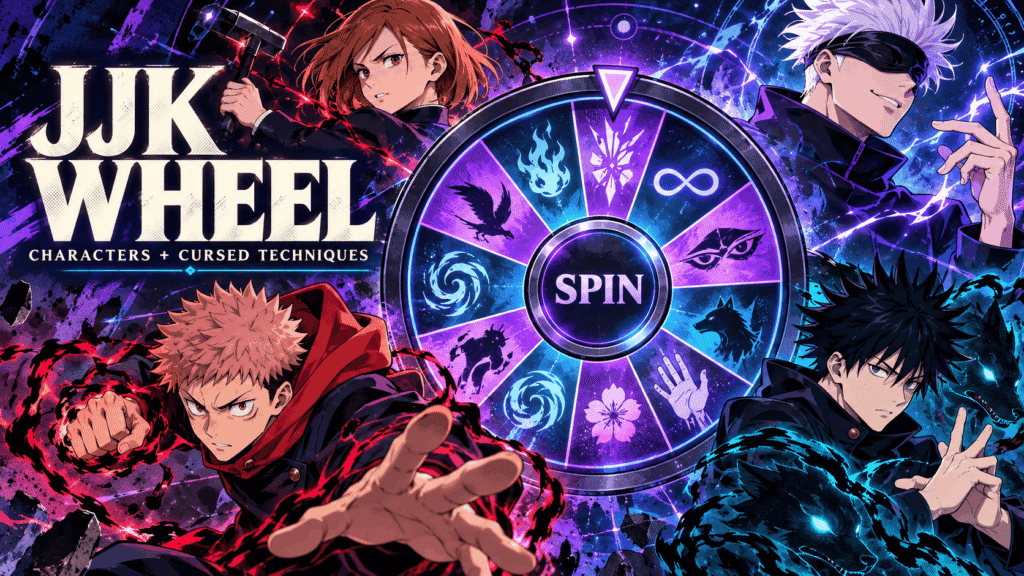
A JJK wheel is a spinner filled with Jujutsu Kaisen characters, cursed techniques, or both, and one spin picks a single entry at random so you get a sorcerer, an ability, or a pairing of the two without choosing it yourself. Every version I have used is fan-made, and they split into two camps: cast wheels and power wheels.
The cast wheels are simple name lists. The power wheels are where the real fun sits, because their slices mix techniques and traits that run from quirky to ominous, and each slice reads like a tiny character sheet. I built three OCs that way before I ever touched a cast list.
The move I keep coming back to is to Spin both lists. A name lands on one wheel and a random technique lands on the other, and suddenly you are answering the What if question fans argue about for hours: what happens when a quiet first-year inherits a kit built for a monster?
How Do You Spin a JJK Wheel for a Character or a Technique?
You spin a JJK wheel by picking the list you want, spinning once, and treating the slice it stops on as the answer for your drawing, story, or match. When you Can’t decide between two favourites, that is the exact moment to let the wheel do the work.
- Default set check: open the wheel and read the whole list before spinning, so you know whether it holds characters, techniques, or pictures.
- Edit the list: cut anyone you have not reached in the story yet and add missing names, one per line.
- Randomly assign a name: spin the character side once and accept the result without a reroll.
- Next ability: spin the technique side for a power and write both results down together.
- Result link: copy the link so everyone in the chat sees the same outcome you did.
I put the list check first because of one large wheel I tried, whose entries were screenshot filenames instead of names, so I could not tell who had won until the image loaded. Even the plainest teaching version, whose Template type is simply spin the wheel, works the same way: you spin to see which item comes up next, and the order of these steps keeps that result honest.
Which Jujutsu Kaisen Characters Can a JJK Wheel Land On?
A JJK wheel can land on any Jujutsu Kaisen character its maker typed in, and across the lists I checked, plus the characters the technique slices mention, that adds up to 45 different names, from Tokyo first-years to curses and early side characters. The biggest fan wheel holds 109 options, the classic cast list has 31 slices, and a shared classroom set tagged 5-9 кл. and Английский carries 21 items.
The groups below are my own sorting of every name that appears across those lists:
| Group (my sorting) | Names found on the lists |
|---|---|
| Tokyo Jujutsu High students | Itadori Yuji, Fushiguro Megumi, Kugisaki Nobara, Zenin Maki, Inumaki Toge, Panda, Okkotsu Yuta, Hakari |
| Tokyo staff and allied sorcerers | Yaga Masamichi, Gojo Satoru, Ijichi Kiyotaka, Ieiri Shoko, Nitta Akari, Nanami Kento, Mei Mei, Yuki Tsukumo, Takuma Ino, Miguel |
| Kyoto Jujutsu High | Gakuganji Yoshinobu, Iori Utahime, Zenin Mai, Muta Kokichi, Mechamaru, Miwa Kasumi, Kamo Noritoshi, Todo Aoi, Nishimiya Momo |
| Curses and curse users | Sukuna, Mahito, Jogo, Hanami, Dagon, Geto, Pseudo-Geto, Choso, Uraume, Rika |
| Zenin clan and outsiders | Toji, Naoya Zenin, Kashimo, Takaba |
| Early-arc side characters | Takada-chan, Sasaki Setsuko, Iguchi Takeshi, Yoshino Junpei |
Names change shape from list to list. The cast list writes family names first, the classroom set uses short forms like Gojo or Yuji, and the 109-entry wheel sits inside a general Random spin wheels category with pictures instead of text. If all you want is a random Jujutsu Kaisen character for a quick prompt, the 31-slice cast list is the cleanest of the three to start from.
Which Cursed Techniques and Traits Sit on a JJK Wheel?
A JJK wheel’s technique side holds a mix of canon cursed techniques, invented powers, and body changes, and most slices carry a short note on what the power does or what it costs you. One description promises pros, cons, and quirks on every result, plus dozens more powers beyond the famous ones, and on that page the only instruction is to spin.
Here is every technique and trait slice I found, grouped by what it actually gives you:
| Slice family | Slices on the wheel | Pros, cons, or quirks written on the slice |
|---|---|---|
| Eyes and infinity | Limitless and Six Eyes, Six Eyes, Limitless, Six eyes only, Limitless alone, BROOM, Skull Broom, Blanket teleportation, Black Bird, Sky manipulation | Several bolt the eyes onto a weaker kit, which changes how strong the slice really is |
| Sorcerer techniques | Ten Shadows, Boogie Woogie, Cursed Speech, Projection Sorcery, Straw Doll, Copy technique, Puppet, Hakari technique, Kashimo technique, Miwa technique, Judgement, Auspicious Beast Summon, Blood Manipulation, Doll technique | one is pure swapping; another says you could be THE lawyer; Copy comes without its partner curse |
| Curse and villain techniques | Shrine, Idle Transfiguration, Disaster Tides, Disaster Flames, Curse Spirit Manipulation, Ice manipulation, Hanami technique, Smallpox Deity, Curse corpses | One curse slice lists Cleave, Dismantle and Fuga; another grants twice a certain curse’s IQ; one slice just says “I dunno what to say about this” |
| Body changes | Camouflage, Haste, Vein, Number, Core, Brain, Computation, Granite, Bomb body parts, Hair manipulation, Cloning technique | Hide your presence; more damage, more speed; turn into animal parts or plant parts; ice based attacks up to a blizzard; energy fields, flight and X-ray vision; energy attacks; enter someone’s body; a joke about Madara hair |
| Elements and creatures | Zap, Honeybee curse, Poisonous gas, Cockroach curse, Scorpion technique, Sound amplification, Gravity system, Energy discharge, Rot technique, Brainrot, Corruption, Void Manipulation, Shun Shun Rikka, G War Staff, Sparks of Black | Electricity shot like a glaive; honey that controls bees; a scorpion tail; cursed energy on par with the strongest; a 10 meter rot field, 2 in a row; a Divergent Fist |
| Survival tricks | Activist, Ghost, Trick or Treat, Vampire, Overdose, Receipt, Transfer, Combustion, Iron Rock, Iron Rock Golems | Auto dodge 5 times; another fails after 6 or more times; a 50% chance to revive; a cup of blood for 1 hour; stronger the more drunk you get but you can’t fall unconscious; techniques moved into cursed tools; combine any two techniques; the dead raised as golems |
| Bloodlines, vessels, domains | Heavenly Restricted, Construction, Star Plasma Vessel, Hasaba girls, Ratio, NOTHING???, Inverse, Maximum | One building slice is weak with a brother but fine if you are born alone; the vessel is from the Heian era; the empty slice hides immense domain expansion, domain amplification, veil knowledge and anti-domain techs; several add an open domain or a maximum technique |
The slice text is messy, full of shorthand and typos, and I cleaned the spellings in my own copy before using it. A few slices also hint at a character’s true potential, which is why I read the notes column before trusting any slice name.
How Do You Customize a JJK Wheel for RP or Writing?
You customize a JJK wheel for tabletop campaigns or fan writing by trimming the slices to match your story’s rules, then deciding which results should be rare and which should never repeat. Three controls do almost all of that work: editing, weights, and a switch that drops each winner.
Start with Edit items. A campaign set before the main story has a different power level and tone from a late-war game, and on a wheel of 74 slices a result granting 20 finger strength next to one promising 19 finger or 15f energy will flatten every other player at the table.
Next come weights. I would rather adjust odds on world-enders than delete them, because a rare jackpot keeps a group excited, and I always pair a strong power with a drawback spin so nobody walks away untouchable.
Last, a shared writing project needs every author to leave with a different power. Turn on the mode where the winner is removed from the circle after each spin, and run this whole pass before your session zero so the rules are settled before anyone rolls.
What Are Good Ways to Use a JJK Wheel in a Session or Fan Project?
A JJK wheel works well anywhere a random result forces a choice you then have to explain, such as an RP character build, a fan story premise, or a fighter you must play. The randomness is the point; the explanation is where the fun comes from.
For tabletop-style roleplay, I give each player one power spin and one flaw spin. The flaw spin is where a slice leaving you born with a brother, or a combo slice that does not stack, earns its place, because an RP or writing group usually cares more about weakness than strength.
Writers get a different payoff. When I need fan-fiction ideas, I assign unique abilities to each lead and spread the rest across a cast, which turns a blank page into three or four short stories with built-in tension.
Artists and gamers use it more casually. Art clubs pull drawing prompts from it, study groups run JJK trivia off each spin, and fighting games players treat it as a lock-in for fan games and ranked practice alike.
What Features Should a Good JJK Wheel Have?
A good JJK wheel should let you weight slices, remove winners, run more than one wheel at once, and prove its randomness, since those four cover every use the pages I checked describe. These are the features I check before I trust a site:
- Simultaneous Multi-Wheel: run up to six wheels at once, such as one for a person and one for a dare, or a character and a technique side by side.
- True Randomness (RNG): results drawn from a browser-native cryptographic random number generator, with no server-side rigging on the result.
- Weighted Choice: tilt slices the way giveaway hosts set up tiered prizes and rare drops.
- Unique picks: a remove-the-winner mode, so every result is unique within one round.
- OBS Streamer Mode: a one-click green screen background that works with Streamlabs for live spins.
Streaming and multi-wheel support matter less than they look for solo use. For a two-list character-plus-power spin, though, running the wheels together saves a lot of copy and paste.
Can You Run a Jujutsu Kaisen Wheel as a Class Activity?
Yes, a Jujutsu Kaisen wheel can run as a class activity, and at least one shared teaching version already exists for middle-school English lessons. In my experience, an anime theme gets quiet students talking faster than a textbook list does.
The format that works best for me is a Quiz night style round. I Press Spin on the projector, and students name the school or grade of whoever lands, which turns a simple quiz into a speaking exercise.
Tools built for classrooms and other random pickers usually need no sign-up or installation, which matters on locked school laptops. Check the list first, though, because a cast list that includes names from later arcs can ruin the story for students who haven’t caught up.
Is a JJK Wheel an Official Jujutsu Kaisen Tool?
No, a JJK wheel is not an official Jujutsu Kaisen tool; the versions online are fan projects built on general wheel sites. Most are made with a free online wheel maker or a free online generator that hosts custom wheels for every other hobby, too.
That origin shows in the features. The same flexible spinner that holds your cursed techniques is sold as a name wheel, a food wheel, or a raffle wheel, and it is pitched as better than basic spinners for decisions, games, and fun.
I treat every fan wheel as a draft. The lists are typed by fans from memory, so names, spellings and power notes can be off, and checking them against the anime or manga takes only a few minutes.
Does a JJK Wheel Contain Spoilers?
Yes, some JJK wheels contain spoilers, because their character lists include names from late in the story. Since these wheels have no connection to the series or its publishers, nobody screens them for spoiler-free lists.
The image-based wheel shows how lists grow over time. Its screenshot entries are dated from 2024-01-04 through 2026-01-26, with batches added on 2024-04-26, 2025-09-13, 2025-09-15 and 2025-11-18, so newer arcs keep arriving as the story moves on.
Another list loads by script, which means you cannot preview it without spinning, and one technique page shows an update stamp of October 28, 2026. My rule is simple: if you are behind, read the full list before the first spin.
What Is a JJK Wheel Used For?
A JJK wheel is used to hand a creative or game choice to chance, most often picking a character to draw, a power for an RP build, or a fighter for your next game. Some fans also use it for giveaways or other quick decisions inside fan servers.
For artists, the Drawing prompt idea is the simplest: Sketch whoever comes up, no rerolls. For gamers, the Game pick rule says you play whoever lands in your next match.
Writers get the most from it. Spinning separately for a protagonist and an antagonist builds conflict before a single line is written. I also use it on game nights and for everyday decisions like who picks the next episode.
Can You Edit the Items on a JJK Wheel?
Yes, you can edit the items on most JJK wheels by changing, deleting, or adding entries in the list box before you spin. On wheels that ask you to Choose Characters or Cursed techniques, each list is edited on its own.
Sites that promise fast editing and clear rules let me fix a full set in about a minute. That speed matters, because some slices arrive incomplete or with typos in character names.
After any change, reshuffle and go again to make sure the new entries show up on the circle. I keep a clean copy of my edited list in a notes file, just in case a site resets it.
How Do Weights Work on a JJK Wheel?
Weights on a JJK wheel change how much of the circle each slice takes, so a higher weight makes a slice come up more often and a lower weight makes it rarer. You adjust weights per item, which makes a slice more or less likely to win without changing the rest of the list.
Weights let you keep certain outcomes rare without removing them. The common trick is to weight down world-breaking slices and the strongest options, which keeps power levels closer together and helps narrow the power range across the table.
Weights do not break fairness. A site using a secure random generator still gives fair results, and one even links a fairness test to a public randomness audit page.
What Does Elimination Mode Do on a JJK Wheel?
Elimination Mode on a JJK wheel removes each winning slice after it is picked, so the same character or technique cannot come up twice in one round. It is the setting I use most for group builds.
Without it, you get a random result on every spin, and you can Tap spin as many times as you like, so the wheel may land on one at random that it already gave someone else.
With it on, you can roll once per player and know no two players share a power. Setup is done in seconds, and I reset the full list at the start of each new session.
Can You Share a Customized JJK Wheel with Your Group?
Yes, you can share a customized JJK wheel with your group by using the site’s Share Links option to generate a link, then sending that link to everyone. When you build your roster first and then share the URL, the whole table plays by the same ruleset.
Saving works in two layers. Auto-Save & Sync keeps the wheel in Local Storage on the same device, so it survives a closed tab but not a new laptop.
For anything bigger, use Import / Export. It saves the whole wheel as JSON backups that you can restore later, which is how I keep my cleaned character and technique lists safe between sessions.