How Does a Hogwarts House Sorter Decide Your House?
A Hogwarts house sorter decides your house in one of two ways: a question-based quiz scores your answers against the values each founder prized, while a spin-wheel sorter draws Gryffindor, Hufflepuff, Ravenclaw or Slytherin at random with equal odds.
I have run both versions on the same book-club night, and they solve different problems. The question route reads your decision-making patterns across a string of prompts, so it suits anyone who wants a verdict worth arguing about. The wheel route ignores character entirely, which is exactly why it settles quiz games and seating plans without anyone feeling judged.
Canon gives the question method its logic. The hat is described as an enchanted piece of headwear holding the consciousness of all four founders, and fan builders try to copy that with a psychological hybrid model that weighs answers, then offers a Final Choice between the two closest houses. That last step mirrors the books, where the hat listens to your choice instead of overruling it.
No fan sorter speaks for the official Harry Potter universe, and I say so before anyone gets attached to a result. A random fan tool is upfront about being luck, while a comprehensive questionnaire that delivers Instant Results is upfront about being an interpretation. Knowing which one you opened saves a lot of sulking when somebody who expected green gets yellow.
What Are the Four Hogwarts Houses and Who Belongs in Each?
The four Hogwarts houses are Gryffindor, Hufflepuff, Ravenclaw and Slytherin, and each one is named after one of the four powerful wizards who built the school.
The houses were never meant as labels to hide behind. The original plan was to nurture particular abilities and personalities, which is why each house kept different requirements for entry and why the traits each house is known for still drive every modern quiz. A house works more like a training culture than a personality badge.
A hardcore fan tends to treat the house as part of their magical identity, and that is where trouble starts. Every house carries a misconception that outsiders repeat, and the reality in the books is messier. Gryffindor produced a traitor, Slytherin produced a headmaster who died protecting students, and the stereotypes rarely survive a reread.
Picture the Gryffindor tower room the way fans describe it: a circular, cozy space with a squashy armchair pulled up to a roaring fireplace, and a scent of woodsmoke hanging in the warm room. Fans call that setting inspiring, and it explains why the house reads as bold and social. Walk into any fan meetup and you see the same split, with house banners on the walls and an atmosphere that turns rivalry into a sport.
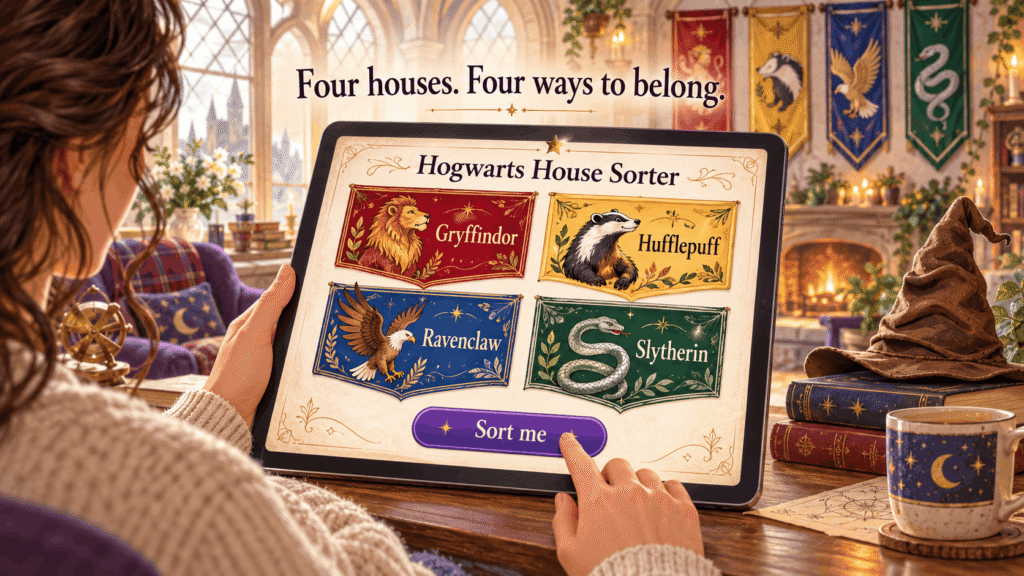
Who Founded the Hogwarts Houses and What Did Each Founder Want?
Hogwarts was founded by four witches and wizards, and each founder admitted students who matched one quality they valued above all others.
The founder of Gryffindor wanted the brave, the daring, students with nerve and a taste for chivalry. The founder of Hufflepuff accepted the loyal, valued hard work and fair play, and is remembered as the most just of the four. Ravenclaw’s founder looked for intelligence, sharp wit and a real love of learning, while Slytherin’s founder picked out cunning and ambition, students ready to use any means to reach their goals.
The four also solved the succession problem. Gryffindor’s magical hat, henceforward known as the Sorting Hat, was left to decide placements once they were gone, and it has sorted students for a thousand years. A yearly ceremony still places the new pupils, and the hat’s song works as the prelude to every first-year’s evening.
Each house also has an element, a pair of colours and a list of notable members that fans quote constantly. The table below pulls those details together, including where each common room sits.
| House | Colours | Element | Common room | Members fans cite |
|---|---|---|---|---|
| Gryffindor | Scarlet and gold | Fire | Seventh Floor, Gryffindor Tower | Hermione Granger, Ron Weasley, Albus Dumbledore |
| Hufflepuff | Yellow and black | Earth | Basement, near the kitchens | Newt Scamander, Cedric Diggory, Nymphadora Tonks, Pomona Sprout |
| Ravenclaw | Blue and bronze | Air | West Tower | Luna Lovegood, Cho Chang, Filius Flitwick, Gilderoy Lockhart |
| Slytherin | Green and silver | Water | Dungeons, beneath the Black Lake | Severus Snape, Draco Malfoy, Tom Riddle, Lord Voldemort |
Tom Riddle and Lord Voldemort appear together on purpose; they are one person, and fan quizzes list both names to cover both eras. The element column comes from fan sites rather than the books, so I treat it as flavour, not canon.
How Does the Sorting Hat Actually Choose a House?
The Sorting Hat chooses a house by weighing a student’s qualities against what the four founders wanted, then giving real weight to what the student asks for.
The hat carries four separate briefs. Godric Gryffindor sought out the bold, Rowena Ravenclaw chose students for their wit and learning, Salazar Slytherin selected students for cunning and drive, and Helga Hufflepuff took all the rest. That last rule matters more than people think, because it made one house a home for anyone the other three would turn away.
Fans call the four the greatest witches and wizards of the age, and the hat preserves their vision long after the people themselves were gone. When it sits on a first-year, there is nothing hidden in your head that it cannot see, which is the claim every fan quiz quietly borrows.
What fascinates me is how little the hat relies on a checklist. The books show it arguing with Harry and weighing his plea, something no fixed questionnaire can do. That is why I treat the hat’s verdict as a read on the essence of your character rather than a score, and why any quiz is at best an imitation of a conversation.
How Do You Use a Hogwarts House Sorter or Take the House Quiz?
You use a Hogwarts house sorter by spinning the wheel once for a random house, or by clicking start on a quiz, answering every question, and reading the house it assigns.
The wheel version takes seconds. Most wheel tools and random pickers run off a secure random generator built into the browser, ask for no sign-up, and have nothing to install, so they work on a projector in classrooms or on a phone at parties. The result is pure luck with a one-in-four chance per house, which makes every house equally likely on every spin.
The quiz version is slower and rewards effort. You hit Begin the Sorting or a similar button and work through 20+ carefully crafted questions, which takes 2-5 minutes depending on thinking about each question. Taking your time pays off; I have watched friends rush, steer every answer toward Slytherin, and then complain the result felt hollow.
Treat it as more than a simple test and answer thoughtfully. Good quizzes add House Descriptions at the end, and a Mobile Friendly layout means you can finish on a phone on the bus. Read the full write-up before reacting, because the reasoning is often more useful than the house name.
What Makes One House Quiz More Accurate Than Another?
A house quiz is more accurate when its questions probe values and choices from several angles instead of asking you to pick a favourite colour or character.
I judge accuracy by asking what each question measures. A question about a favourite animal measures taste, while a question about what you would sacrifice to win measures core values, and the hat cared about those. A quiz that is highly accurate mixes scenario prompts with self-rating so the algorithm analyzes your responses from more than one direction and one odd answer cannot swing the verdict.
The second test is how the quiz handles a close call. Builders who answer carefully to that problem end with a choice between the top two houses, which keeps the user in play the way the hat did with Harry. It echoes the line that your choices show what you truly are, more than your abilities do, and a genuine Hogwarts sorting should respect it.
Practical features matter too. A quiz that offers detailed explanations, reads your personality traits in context, and names the house that best matches your character gets finished more often. A house assignment without reasons is a coin flip with extra steps, and a quiz that lets you share your quiz results with a reason attached starts better conversations.
How Do You Sort a Party or Class Into Four Even Houses?
You sort a party or class into four even houses by loading a wheel with every house repeated an equal number of times and removing each house slot as it is drawn.
A plain four-slot wheel gives 25% each, so with a crowd you almost always end up with lopsided teams. Turning on removal changes the maths: each spin uses up a slot, and once every slot is gone, every house has the same headcount. The method is suitable for children as young as early primary, because nobody has to read a question.
- Press Spin only after you have added each house as many times as you have players per team.
- Remove the winner must be ticked, so a drawn slot leaves the wheel and cannot repeat.
- Split a group by letting each person spin exactly once, in any order you like.
- Form teams from the results, then see your house names on tags or tables.
After the draw, I hang paper tapestries in house colours, put silver lamps or fairy lights on the Slytherin table, and hand out toasted marshmallows to the winners. Players post the line-up on social media, compare results with friends from other tables, and challenge them to a rematch, which makes it a fun way to open any trivia night.
What Are the Hogwarts Common Rooms Like for Each House?
The Hogwarts common rooms mirror each house’s character: Gryffindor’s sits high in a tower by a fire, Slytherin’s lies under the lake, Ravenclaw’s is a bright tower room with mountain views, and Hufflepuff’s is a round room underground near the food.
Fans read the rooms as personality tests built into the castle. A room high in a tower suggests a house that wants to be seen, while a room under water suggests privacy and a long game. Each room is tuned to a magical personality, and the Hogwarts Sorting Experience on the official site leans on that idea by letting sorted students tour their house.
I find common rooms the easiest way to help a doubtful friend accept a result. It is quite common for the room to land before the label does: someone who resents Hufflepuff hears about a home that smells of baking and finds the true nature of the house was never “soft”. The surprise usually turns into recognition of aspects of yourself you hadn’t considered.
The rooms date back to the school’s founding over a thousand years ago, and fans read them as the four builders’ combined ideals set in stone, the place where their spirits live on. That detail tells a newcomer more about each house than any trait list.
Which Hogwarts House Stereotypes Are Wrong?
The popular Hogwarts house clichés are wrong because each one takes a house’s strength and describes only its worst version.
Gryffindors get painted as show-offs, yet the house’s real mark is to stand up for what is right, and being courageous means acting while scared. Slytherins get painted as villains, when the house values leadership, resourcefulness and being ambitious, and its best members are determined, strategic and resourceful in ways that build something lasting.
Hufflepuffs suffer the softest insult, as if kindness were their only skill. The house is dedicated, values loyalty, fairness and dedication, and its famous members include some of the toughest people in the books. Ravenclaws are assumed to be cold, but the house prizes creativity, being creative, and the kind of wisdom that a quick-minded, knowledge-loving and intelligent student earns by questioning everything.
I have sorted enough groups to notice people reject the house whose cartoon version they dislike. Show them the full picture, with real knowledge of what each house values, and most become willing to accept their result.
What Can You Explore After You Know Your House?
After you know your house, you can explore related fan quizzes such as Patronus, wand and character matches, plus house-themed extras like letters and portraits.
Most fan quiz hubs stack several personality tests together. A common pattern pairs a house quiz with Patronus meanings, wand results and character matches, so one session builds a whole wizard profile. One site lists 1M+ quiz takers worldwide for its house quiz alone, which shows how sticky the format is.
My favourite extra is a virtual flyover of the school. Ravenclaws in particular love it, since their tower is a spacious, airy room with arched windows framing the mountains, bookshelves of old books, and reading nooks that smell of mountain air. Fans call it peaceful and intellectual, and seeing it makes the house click for people.
A popular-media sorting article published on February 2, 2017 and updated on June 16, 2026 offers another take: its quiz returns a percentage for each house, such as 80% Ravenclaw and 20% Hufflepuff or 80% Gryffindor and 20% Slytherin. I find that split more truthful than a single verdict, since most people are a blend.
How Accurate Are Hogwarts House Quiz Results?
Hogwarts house quiz results are only as accurate as the questions behind them, and no fan quiz carries the authority of the hat itself.
The quiz that gave me the most accurate read asked what I would protect, risk and give up. Questions that touch all aspects of your personality, from bravery to being fair, beat a short colour-and-animal questionnaire every time I compare them.
The Authentic Questions label some sites use means the prompts are written around the official Harry Potter books and the authentic characteristics of each house. That helps results reflect canon, but a quiz is still a mirror, not a ruling.
Can I Retake the Hogwarts House Quiz?
Yes, most fan house quizzes can be retaken, while the official ceremony let returning old students try the Sorting Hat again one time only.
The official redo came with a magical makeover for 2026 that kept the same questions but gave the page a refreshed look and feel. Fan quizzes are completely free, often Free Forever with no registration, so you can press Start Quiz again whenever you like.
My advice is to be true to yourself on the first attempt and stay honest about your priorities. A retake helps when you rushed or when your views change over time, but chasing a house until you get it teaches you nothing.
What If I Get a House I Didn’t Expect or Don’t Agree With?
Getting a house you didn’t expect is normal, and the best response is to read about that house before deciding the quiz got it wrong.
I have seen this play out many times: a friend gets Hufflepuff, protests, then reads about the round design, the wooden beams, copper accents and the smell of fresh bread and apple pie, and quietly admits it fits. Fans describe that room as welcoming, nurturing and earthy, a sanctuary where the magic of belonging is easy to feel.
Reading about your house often shifts your initial reaction more than a retake does. If you still disagree, remember that some quizzes let you choose between two houses at the end, and the hat itself honors what a student asks for.
How Long Does a Hogwarts House Quiz Take?
A Hogwarts house quiz usually takes a few minutes, with one fan site promising results in about 2 minutes and longer hybrid quizzes running past that.
Length depends on the number of questions and how carefully you answer. A wheel takes seconds; a scenario-based quiz takes longer, and I find answers improve when people slow down rather than racing friends to the result screen.
Side quizzes add time too. A Wand Quiz, which one hub says over 25K+ fans have taken, asks extra questions to settle your wand wood, core and flexibility, so budget a little more if you plan to do the full set. You can run any of them on a desktop, tablet or mobile phone.
Are House Quiz Questions Based on the Books or the Movies?
House quiz questions are mostly based on the books, because the house values, the founders and the hat’s reasoning are spelled out in the text far more than on screen.
Fan quizzes cite J.K. Rowling as the source of the values they test, and most state they are unofficial and not affiliated with Warner Bros. The official ceremony itself was written by the author and first appeared on Pottermore, the site formerly known by that name before it became the official home of the Wizarding World.
The films add atmosphere but little sorting logic. If a quiz leans on scenes rather than values, I take its result less seriously.
Can I Share My Hogwarts House Result on Social Media?
Yes, most house quizzes let you share your result, and comparing houses with friends is where the conversation starts.
The Share Results button on most fan quizzes posts a short card with your house and a line on the essence of each house. I add a screenshot of the full write-up, so friends see how my result compares to others in my circle, and the group chat turns into a debate about who was mis-sorted.
Polls spread the same way. One Showdown poll on Hogwarts professors reported that 26% of players picked Hagrid, and that result travelled further than any single sorting. Sharing is how friendships are forged around a fandom and how dreams are shared about which house you would have joined.
Is a Hogwarts House Sorter Wheel the Official Sorting Quiz?
No, a Hogwarts house sorter wheel is a random fan creation and not the official sorting quiz, which lives on the franchise’s own site.
The official version is the official Sorting Ceremony, reached through a Get Sorted Now button and billed as the next best thing to attending Hogwarts. A wheel offers luck, and the official ceremony offers the author’s own questions rather than a fan’s reading of the books or movies. I use the wheel for fan nights and group games, and send anyone who wants a serious answer to the official ceremony.
The difference shows up in the result screen. A wheel names a house and stops there, while the official ceremony frames its verdict in the language of the founders. Both are fun, but only one carries the author’s questions.
Is Each House Equally Likely on a Sorting Wheel?
Yes, each house has the same odds on a standard four-slot sorting wheel, so every spin gives Gryffindor, Hufflepuff, Ravenclaw and Slytherin an identical share.
Those odds hold for every spin because the draw does not remember earlier results. A run of three Slytherins in a row is not a broken wheel, just ordinary chance. If you want a balanced group instead of balanced odds, take a group of 12, list each house three times, make sure everyone spins once, and you finish with four even teams of three.
I explain the odds out loud before a class spins, because children often assume a wheel is “due” to land on a house it has skipped. Showing them that each spin starts fresh is a small maths lesson hidden inside a fan game.
How Is a Hybrid Sorting Quiz Different From Other House Quizzes?
A hybrid sorting quiz stands apart from other house quizzes by mixing personality-style scoring with a final user choice, instead of relying on a single tally of answers.
One fan-made builder calls many online quizzes superficial and aims for a sorting that feels complex, profound and respectful of the source material. The pitch is an authentic experience and a journey, with the user’s final pick described as its most important feature.
The builder borrows three ideas from the hat: Founder’s Wisdom, the claim that it Sees Your Potential, and the promise that it delves into your potential rather than counting answers. The same hub runs a Dorm Quiz, an MBTI Chart and a Patronus Test. I judge such claims by the questions, and a quiz that reads like a personality assessment of values, not tastes, earns my trust faster than one promising what makes you unique.
Why Do Some Quizzes Let You Choose Between Two Houses?
Some quizzes let you pick between your two closest houses because the Sorting Hat itself weighed a student’s wishes when two houses fit equally well.
The idea comes straight from the books, where the hat considers Slytherin for Harry and places him in Gryffindor after he pushes back. A quiz that ends with a choice copies the Respects Choice principle and the hat’s habit of treating a personal decision as evidence.
Slytherin’s case is easy to picture: a low-ceilinged room with greenish light, high-backed chairs, underwater windows, dark wood paneling and a smell of lake water and polished wood. Fans call it elegant, mysterious and sophisticated, and seeing it next to Gryffindor’s tower makes the two-house choice feel earned instead of imposed.
What Makes a Good Gryffindor, Ravenclaw, Hufflepuff, or Slytherin?
A good member of any Hogwarts house is someone who lives out that house’s central value at its best rather than its cartoon version.
A good Gryffindor shows courage and stays chivalrous, and real Gryffindors are brave even when afraid, not reckless heroes. A good Hufflepuff pairs patience with being patient and inclusive, closer to hardworking friends than people who are merely nice.
A good Ravenclaw is wise and drives innovation, and none of the Ravenclaws I know are detached intellectuals. A good Slytherin is among the resourceful leaders chasing achievement and legacy, not dark wizards.
The point I keep returning to is that every house has its heroes. What matters is how a person chooses to embody its values, which is a question of habit more than birth.
Can Your Hogwarts House Change Over Time?
Your Hogwarts house in canon stays fixed after the sorting, but a fan quiz result can shift as your priorities shift.
The hat looks past surface traits toward true character and listens to the student’s inner voice, and both of those can mature. I took one quiz at sixteen and again in my thirties and got two separate houses, which tells me more about growing up than about the quiz.
Most fan quizzes let you retake as many times as you want, so tracking your result across the years is easy. The catch is that the comparison only means something if you keep answering honestly the first time each round, instead of steering toward the house you hope for. Treat each result as a snapshot of the person who answered that day.
Is a Hogwarts House Quiz Suitable for Children?
Yes, most Hogwarts house quizzes work well for children, since the questions centre on values like bravery, loyalty and curiosity rather than mature themes.
I have run the wheel with a class of nine-year-olds and the quiz with teens, and both went smoothly, with no hidden costs to worry about. Kids who finish early drift to the side quizzes: the Patronus Quiz (one hub counts 50K+ takers), the Character Quiz (35K+) and the Quidditch Quiz (10K+), where you chase the Golden Snitch.
The same hubs offer lists of spells, house memes and a 3D flight over the school. A parent should still check any site’s ads and sharing settings before handing over a device.
Do House Sorting Quizzes Store Your Results?
Some house sorting quizzes store results so you can compare with friends later, while simple wheel sorters keep no data at all because the draw runs inside your browser.
The extras are where storage matters most. An AI acceptance letter or a house portrait of you in house robes usually needs a photo upload, so read the privacy note before you hand one over.
For plain quizzes, I check whether a result is saved to an account or only kept in the page for sharing. If a site asks for an email before showing your house, that is a sign it keeps more than your answers. When in doubt, I use the wheel version for groups, since it records nothing and nobody has to sign in.