When you’ve weighed the options and still can’t choose, hand it to chance. These tools settle everyday decisions in seconds, from yes or no to what to wear.
- Yes or No WheelA 50/50 answer, with an optional maybe.
- Decision Maker WheelType your options and let the wheel decide.
- Magic 8 BallAsk a question and shake for one of 20 classic answers.
- Random Movie PickerSpin for a genre, a classic or a film from your watchlist.
- What to Wear WheelSpin for an outfit style, a main color or shoes.
- Chore WheelShare out housework fairly, one spin per person.
- Disney Movie PickerSpin for a Disney or Pixar movie to watch tonight.
- Boy or Girl WheelSpin boy or girl for gender reveal games and characters.
- Random Horror Movie GeneratorSpin for a horror movie to watch tonight.
What Are Decision Maker Tools, and Which One Should You Use?
Decision maker tools are structured methods, such as a weighted decision matrix, a coin flip, the 10-10-10 rule or a decision-rights framework like RAPID, that turn a hard choice into explicit options, criteria and owners, so you can weigh what matters and commit to an answer you can explain.
I came to these tools the slow way, after a year of keeping pro/con lists that never settled anything. A two-column list gives every reason the same weight, so the loudest worry usually wins. What changed my results was noticing that the right tool depends on how many options sit on the table and whether the choice is truly binary.
For a high-stakes choice across several factors, a scored grid beats instinct. Between two roughly equal options, a quick flip exposes your gut reaction in seconds. And for a choice that feels frightening today, asking how it will look in 10 minutes, 10 months and 10 years often shows that the fear belongs to this week, not this decade.
Organizations hit the same wall at a larger scale. A board can stall for months because nobody knows who holds final authority, which is why role charts like RACI sit alongside scoring software built on multi-criteria decision analysis. Each tool drags the hidden parts of a choice, its alternatives, weights and decision-makers, into the open where people can argue about them honestly.
How Does a Decision-Making Tool Walk You Through a Choice?
A decision maker tool walks you through a choice by making you frame the decision, list the options, set what matters, score each option and then test the answer before you act on it.
Most thinking tools follow that skeleton. A scoring grid asks for weighted criteria up front, while a reasoning calculator asks for each pro, each con and the counterargument you would raise against yourself, then folds them into one number on a 100-point scale. The order matters, because scoring before weighting lets the most exciting option rig the result:
- Go/no go or ranking: decide whether you are judging one option or comparing several.
- Attributes: write down the factors every option will be judged on, and weight them before any scoring.
- Time horizons: score each option for how it plays out next month and in a few years.
- Trusted input: show the draft to one person who will push back.
- Action plan: turn the winner into a first step with a date on it.
Teams can run the same steps with each member scoring privately first, which keeps groupthink out of early ratings and shows where consensus already exists. A tool that never asks whether you would adjust course when facts change has done half its job.
Good frameworks don’t just solve problems; they help you understand systems, such as why the same argument resurfaces in every planning meeting. Boys Town used a decision-rights tool to split calls between its headquarters and local sites, and Aspire Public Schools used it to build organizational capacity for healthy growth.
Which Decision Maker Tools and Frameworks Are Worth Knowing?
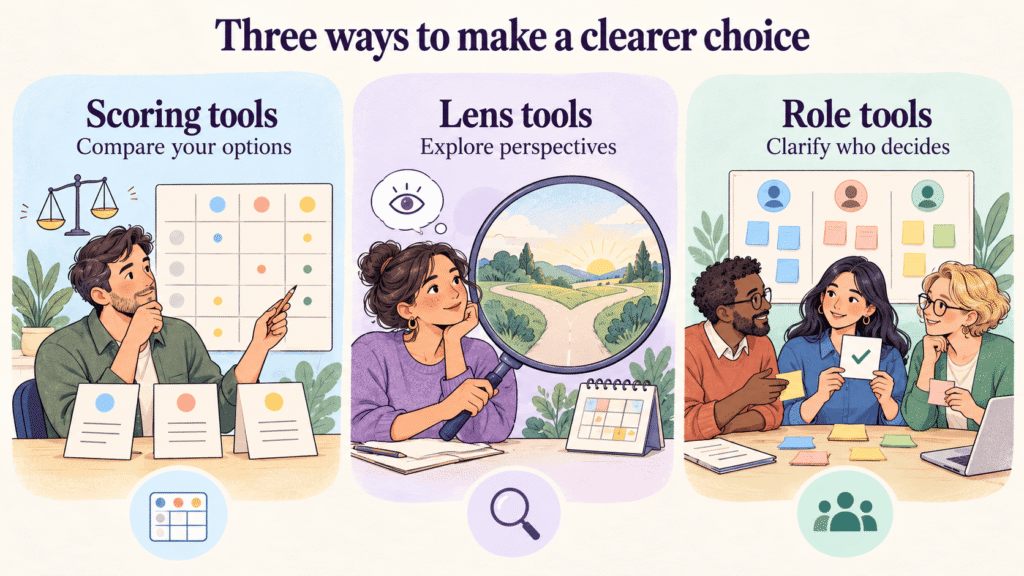
The decision Maker tools worth knowing fall into three families: scoring tools that rank options, lens tools that change how you see a choice, and role tools that settle who decides.
Scoring tools earn their place in multi-attribute decision-making, the kind where a job, a city and a salary all pull in different directions. Rating every option on the same decision matrices keeps the comparison honest, and the method sits in an analytical tradition associated with Keeney and Raiffa. These grids make trade-offs visible instead of letting them hide inside a feeling.
Lens tools care less about arithmetic. Some push you to look past the next quarter toward short- and long-term outcomes; others slow you down when intense moods or a looming deadline push you to act. A few are built for speed, for teams that have to move on partial facts and adjust roles as the picture changes. Much of the decision-science behind them is about catching yourself mid-mistake.
Role tools answer a different question: not what to choose, but who owns which part of the choice. Their names are acronyms, and nonprofit leaders use them often because boards, staff, funders and every other stakeholder want a say. Each letter names one of the roles, and in my experience these charts prevent more conflict than any scoring sheet I have built.
Why Use a Decision Maker Tool Instead of Your Gut?
A decision Maker tool beats your gut when a choice has several moving parts, because the tool exposes the bias and noise that instinct hides and leaves a record others can check.
Gut feel handles the small calls I make every day. It struggles with the rare big ones, the critical decisions where a mistake costs a year, because instinct quietly overweights whatever happened last week. A written process turns a hunch into one of the defensible decisions a board or partner can actually question.
In organizations the gain is mostly about ownership. The Nonprofit Management Tools and Trends Report 2015 collected data on how nonprofits run their decision processes, and the Harvard Business Review article Who Has the D? from 2006 tied clear decision roles to stronger organizational performance. Each decision-rights framework gives every person one letter, and the table shows how the common ones split the work.
| Framework | What the letters stand for | Number of roles |
|---|---|---|
| RAPID | Recommender, Approve, Perform, Input, Decide (the A can veto; the D commits the organization) | 5 |
| ASICK | Accountable, Support, Inform, Consult, Okay | 5 |
| CAIRO | Consulted, Approves, Informed, Responsible, Out of loop | 5 |
| IMRN | Input, Make, Ratify, Notify | 4 |
| LACTI | Lead, Accountable, Consult, Tasked, Informed | 5 |
| REDI | Responsibility, Execution, Decision-Making, Influence | 4 |
| RACI | Responsible, Accountable, Consulted, Informed | 4 |
The letters matter less than the habit. Once a team writes down who drives a decision and who only advises, the reply-all threads get shorter and the same debate stops coming back every quarter.
How Do You Pick the Right Decision maker Tool for Your Problem?
Pick a decision maker tool by matching it to what the problem lacks: a scoring grid when many options and factors compete, a quick gut test when the facts are already in, and a perspective or role framework when the confusion is about viewpoint or ownership.
I ask one blunt question first: is this a knowledge problem or a courage problem? When I already have enough information and still flip-flop, more analysis is procrastination. Choices that feel too hard and ones that seem too simple both deserve a tool, just not the same tool, and the table maps common situations to the one that fits.
| Situation | Tool | Why it fits |
|---|---|---|
| Many options, several factors | Decision matrix | Scores every option against multiple factors so no single detail dominates |
| A to-do list where everything feels urgent | Eisenhower Matrix | Sorts tasks by importance and urgency |
| A backlog of possible projects | Impact-Effort Matrix | Weighs payoff against the effort required |
| A team stuck in one viewpoint | Six Thinking Hats | Rotates the group through different perspectives |
| A choice with ripple effects | Second-order thinking | Traces the long-term consequences of each path |
| An argument built on assumptions | Ladder of inference | Stops you jumping to conclusions and keeps you anchored in reality |
| A choice between values, not facts | Hard choice model | Clarifies what kind of decision you are making |
| A fast-moving situation | OODA loop | Lets you act on incomplete data |
| Unclear cause and effect | Cynefin framework | Matches the situation to an appropriate response |
| A product release on a deadline | Speed vs. quality (confidence determines the trade-off) | Sets how much polish building products needs |
The variable people underrate is how hard a choice is to undo. A choice you can take back next month deserves a five-minute tool, while one you cannot take back deserves the full grid, so I check reversibility before picking anything. Reaching for the heavyweight grid on a trivial question is exactly how analysis paralysis starts.
Where Do Organizations Use Decision Maker Software?
Organizations use decision maker software wherever they must rank many competing options against the same standards, from hiring and budgeting to medicine and science.
The pattern is volume. One manager can weigh three job offers in their head, but nobody fairly compares hundreds of applications without a shared rubric, so the software turns that rubric into explicitly scored factors. Most platforms let you create a model from an example or build one from scratch, tailor it in stages, and read results through graphical and analytical tools.
In public services the stakes rise. Healthcare systems use scoring to rank who is treated first, which is where the claim that prioritization can save lives comes from. Inside companies the same logic covers prioritizing projects, a five-year strategy, new partnerships and staffing, and some packages pair it with conjoint analysis to test which features people value.
Group scoring is where software earns its keep, because it keeps colleagues, experts and members of the public on one scale. A finance team hunting for good-value upgrades within a budget runs the same exercise with money as the main criterion, and the hoped-for payoff is better profitability.
Should You Use a Short or Extended A.I. Decision maker Calculator?
Choose the quick version of an A.I.-assisted decision calculator when you want a fast read on one option, and the longer version when you want to see how the A.I. conversation shifts your own thinking.
Both versions have you chat with an A.I., analyze your case for and against the option, and finish with an overall reasoning score. The quick version puts the conversation first. The longer one asks you to rate your case on both sides of the conversation, because reading A.I. summaries first can tilt a person’s view without them noticing.
After the score, both versions ask about your confidence and satisfaction so you can judge whether you need more information before acting, and both hand out decision tips, with more of them in the longer one. The designers are clear that the tools advise rather than dictate.
My own rule is simple: if I would be uncomfortable explaining the choice to a friend next week, I take the longer route. The extra rating round is where I usually catch the point where a chatbot talked me into something.
Which Case Studies and Reading Show Decision Roles Working?
The clearest evidence that decision roles work comes from nonprofits that rewrote who decides what, such as a youth-services organization that split calls between its national office and local campuses, and a charter school network that clarified roles while it expanded.
Both stories share a pattern I have seen in much smaller teams: the trouble was never a shortage of smart people, it was bottlenecks where everyone waited for a sign-off nobody owned. Clear rights put authority and accountability with a single decision-maker, limit participants to those who are needed, and raise transparency and role clarity about who does what. The unstructured alternative tends to reward whoever talks loudest, which is rarely efficient.
The standard rollout path is deliberately small. Leaders introduce the concept and the chosen tool, diagnose the few decisions causing the most pain, pilot the tool on them, redesign who plays which part, and assess the results before any wider rollout. Parts get reassigned as the organization evolves, and someone has to step back regularly to review the whole system.
The same reading keeps returning to the people who carry out a decision once it is made. A role chart that skips them looks tidy and fails in practice.
What Are Decision Maker Tools Actually Used For?
Decision-making tools are used to rank, prioritize or choose between options, whether the decision is one-off or repeated, and to build agreement among the people it affects. Typical uses run from supplier proposals and job candidates to research grant applications and places on restricted courses. The same structure helps a group focus on what matters when budgets are tight and reach agreement faster. Because each step can be auditable, and the process fair and inclusive, the people affected can see why a choice was made. Larger organizations often fold this work into organizational effectiveness diagnostics and talent assessment. At home, the same idea settles smaller choices: the random movie picker ends the movie-night debate, and the chore wheel shares out housework fairly.
Are There Free Decision Maker Tools Online?
Yes, several decision making tools cost nothing and run in a browser with no-signup, including scoring grids, coin flips and time-horizon tools, while paid platforms usually start with a trial. A browser grid is plenty for comparing apartments or choosing a project, and research-based reasoning calculators skip registration and never ask for names. Paid platforms add scalable group features such as a survey of any size, which only matters once many people score together. For a solo choice, the best option is usually the simplest tool that fits.
When Should You Flip a Coin Instead of Using a Decision Matrix?
Flip a coin when you are torn between two choices and already know the facts, and use a decision matrix when several options and factors need scoring. The flip works through the relief or disappointment you feel when it lands, which is why I use it on back-and-forth dilemmas and treat it as one of my gut checks, not a verdict. A matrix suits complex decisions where missing information and stated confidence levels matter. One free version allows six options and eight criteria, each weighted 1 to 5, and returns a ranked result showing which criterion decided it. For a quick 50/50, you can flip a coin online and notice how the result makes you feel.
What Is Multi-Criteria Decision Analysis (MCDA)?
MCDA is a method for decision maker that require weighing several criteria together across many options, with each option scored against standards whose importance is set in advance. MCDA is built for complex choices and shows up in public value for money reviews, investment portfolios, research funding, infrastructure plans and assessments of new technologies. Group versions often start with a noise audit of people’s intuitive rankings and a test of inter-rater reliability before anyone agrees on importance. Published uses range from flood risk management and organized-crime policing to rheumatology disease classification and breeding traits in plants and animals.
What If You Have More Than Two Options?
With more than two options, either score each option separately with a one-option reasoning tool, or rate every option on the same factors in a single grid. The grid route belongs to MCDM, a sub-discipline of operations research grounded in economics, psychology and mathematics, and a free version is enough for most personal choices. Running options one at a time protects against anchoring bias, while a shared grid exposes status quo bias when the current path keeps winning by default. Selection panels use the grid approach for scholarships, patients waiting for care and clinical trials. For a fast pick from a short list, type the options into the decision maker wheel and spin.
How Does Pro, Con, Counter Reasoning Analysis Score a Decision?
This reasoning method scores one option by combining your main reasons for and against it, your rebuttals to those reasons and how the option compares with others into a single number. The method treats your reasoning as data and lets people rate their reasons on validated scales rather than just listing them. The designers suggest you compare scores across options, starting with the one you have thought about most. Early testing reported that the measures predicted choices across relocating, staying in a job, buying and relationship decisions.
Why Won’t General A.I. Just Make the Decision for You?
General-purpose chatbots usually avoid a direct verdict on personal choices because no single theory of choice is best, they don’t collect your reasoning, and their makers build in limits. That gap is what James D. Westaby’s Pro, Con, Counter Reasoning Analysis, also called PCCR or Triple Reasoning Analysis, tries to close by combining primary and comparative reasoning into a summary score. The approach draws on behavioral reasoning theory and on deliberate reasoning studied in work going back to Kahneman and Tversky. A chatbot that simply agrees with you can feed optimism bias and wishful thinking, so check its accuracy like any other source.
Which Cognitive Biases Distort Decisions?
Common cognitive traps that distort decisions include the sunk cost fallacy, the framing effect, the halo effect and primacy and recency effects. The Dunning-Kruger effect inflates confidence built on thin knowledge, and the bystander effect explains why nobody in a meeting raises the obvious problem. These traps are a core subject of behavioral economics. Structured tools counter loss aversion and recency bias by forcing every option through the same questions, and they turn risk aversion into a visible weight rather than a mood.
Which Situations Make Good Decisions Harder?
Decisions get harder in situations that rush or narrow your thinking, such as sudden deadlines, strong emotion or a group that values agreement over getting it right. Those conditions feed confirmation bias, over-confidence bias and authority bias, because nobody has time to look for facts that cut the other way. Negative information bias makes one bad review loom larger than ten good ones, and the availability heuristic pushes memorable stories ahead of plain numbers. The representativeness heuristic and implicit bias shape who gets picked when a panel judges people quickly.
What Habits Make Your Decisions Better Over Time?
The habits that improve decisions over time are setting your own deadline, matching effort to how undoable a choice is, and judging outcomes over years rather than days. Choose before time pressure chooses for you, move fast on choices that are reversible, and give irreversible ones a pause and a chance to sleep on it. The 10-10-10 view helps most when short-term fear drives the choice, because short-term discomfort often fades while a long-term perspective stays clear. Much of my own regret has come from choices I never looked at again, and building in inclusion helps many groups reach more equitable outcomes.
What Kinds of Decisions Can a Decision Calculator Handle?
An A.I. Decision Calculator can handle any important personal or work decision that comes down to one option you are weighing, from a career move to a big purchase or a family choice. A calculator like this shines on questions without objectively correct answers; for something like the shortest route, ordinary software is better. The shortened version takes 5 to 10 minutes, while the extended one takes 15 to 20 minutes, allows breaks and rates your thinking before and after the A.I. chat. Early testing reported predictive validity and statistically significant gains in satisfaction, and the stated aim is more clarity, not a guaranteed outcome.
The theory appeared in Organizational Behavior and Human Decision Processes in 2005 and was extended in Psychological Inquiry in 2025. Pair the score with a probabilistic mindset, talk it through with your network, and count small progress as part of the payoff.
Are Online Decision Maker Tools Private and Secure?
Many online decision maker tools are built with privacy in mind, but check whether a tool asks who you are and how its provider secures stored data before typing anything personal. Research calculators are meant for adults 18 or over and are not a crisis service: call 911 in an emergency or 988 for crisis counseling, seek professional help, and see the American Psychological Association help center.
Commercial chatbots carry guardrails set by their developers, yet answers from mainstream A.I. platforms on personal questions are inconsistent, and researchers raise ethical concerns about for-profit bots that skip critical questions. If a company asks employees to score options, it should say whether the data is for research purposes or a live decision, and some research teams are building new bot versions with these risks in mind.
Can You Use a Decision Maker Tool Without a Computer or A.I.?
Yes, nearly every decision framework, from a scoring grid to a role chart, can be run by hand, and offline versions of some research-based calculators are being developed. Going offline keeps answers private and confidential by default, since there is no identifying information to store, though I still make team exercises voluntary and explain how scores will be used, much like informed consent.
Working by hand also stops general A.I. from handing you average pros and cons drawn from web data and quietly picking one of many psychological models for you. Families weighing a school choice often do better at a kitchen table, where a hand-drawn grid stops one vivid detail from dominating; if the problem is missing nerve, set time limits instead. Keep the sheet, because revisiting decisions later is how past decisions teach you and how your longer decision paths become visible. Offline tools carry no cost and no advertising, while a paid platform may list pricing openly and offer a 15-day free trial with an onboarding call, and researchers have called for future research comparing one-option and multi-option methods.
Can You Get Custom Decision Software and Training?
Yes, some providers build custom software, integrations and bespoke systems, from architecture advice and development services to fully run platforms, and back them with training. Free step-by-step video tutorials on YouTube and in a resource center, plus a support team, help new users get up to speed. Enterprise buyers should ask about SOC 2 Type 2 audits, data encrypted in transit and at rest, hosting that meets ISO 27001, HIPAA and FedRAMP, and confidentiality contracts. Research calculators are moving the other way, toward paper, flip-chart and word-processor versions for people who would rather not type their reasoning anywhere.