What Is a Boy or Girl Wheel and How Does It Work?
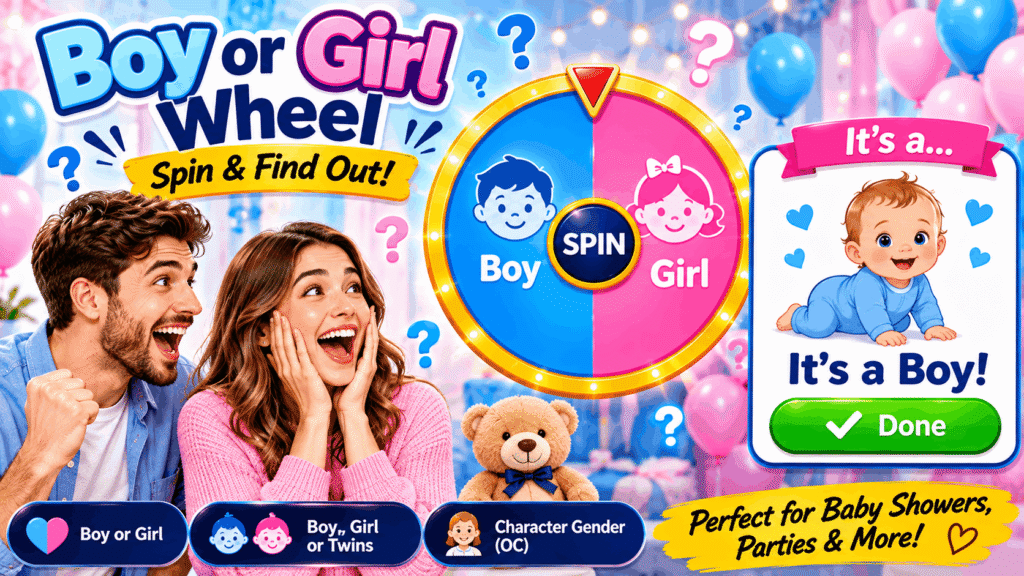
A boy or girl wheel is a two-outcome spinner that lands on Boy or Girl at random, so you can run a guessing game, pick a character’s gender, or settle a 50/50 choice in seconds. Click Spin, and the pop-up announces “It’s a Boy” or “It’s a Girl.”
Most people use it at a baby shower or gender reveal party, where guests spin to make their predictions before the real answer comes out. Writers use it when writing an original character, and teachers use it for English lessons with young learners. Whatever the reason, it takes the decision out of your hands.
The page has three ready-made lists: Boy or girl, Boy, girl or twins, and Character gender (OC). Each slice is colored, with blue for Boy and pink for Girl, so the result is easy to read from across a room.
The wheel is free, fair, safe for any party and fully editable. There’s no sign-up and no download, and it works on phones, tablets and a TV. For a wheel about something else entirely, start from the main spin the wheel page and type your own options.
Why Use a Boy or Girl Wheel?
A boy or girl wheel turns a simple guess into a shared moment of suspense. Instead of guests shouting answers, everyone waits for the slice to land, and the room reacts together.
It’s a strong icebreaker at a baby shower, because guests who don’t know each other end up on a team within minutes. It sits happily beside classics like the ring test, so it fits into a longer line-up of party games. Spinning also makes good content for a family video.
It helps with indecision too. A writer stuck on a new character, or a teacher choosing which drama group performs first, can hand the choice to chance. That stops the overthinking and keeps things moving, whether at a party or in the classroom.
Finally, a wheel is fair. Every slice has equal odds, so there’s no bias and nobody can accuse the host of choosing; the randomness audit shows how the spins are checked. For a quicker two-way answer, the coin flip gives heads or tails with one tap.
How Do You Spin the Boy or Girl Wheel?
You spin the boy or girl wheel by picking a list, pressing Spin or tapping the wheel, and reading the result in the pop-up. The result appears in seconds.
- Tap a list button: Boy or girl, Boy, girl or twins, or Character gender (OC).
- Click Spin, or tap the wheel on a phone.
- Watch the slices slow down and read the pop-up, which starts with “It’s a.”
- Spin once more for the next guest, the next character, or a best-of-three.
- To change the options, type your own entries in the box under the wheel.
On a phone the controls stack under the wheel, so you never have to scroll sideways. The spin length slider runs from 2 to 60 seconds, so keep it short to keep a party moving, or stretch it out for the big reveal.
If you’re playing with a group, put the screen where everyone can see it and spin once per guest. Teachers can let students take turns tapping, and writers can spin once per character and note each result as they go.
Which Lists Are on the Wheel?
The wheel has three lists, and each one has six slices that alternate between options, so the colors spread evenly around the circle.
| List | Slices | Best for |
|---|---|---|
| Boy or girl | 3 Boy, 3 Girl | Gender reveal guesses and 50/50 choices |
| Boy, girl or twins | 2 Boy, 2 Girl, 2 Twins | Baby shower predictions with a twist |
| Character gender (OC) | 2 Boy, 2 Girl, 2 Non-binary | Writers, artists and roleplay |
Boy slices are blue, Girl slices are pink, Twins slices are yellow and Non-binary slices are purple. The colors follow the pink and blue tradition of most baby parties, and the English labels double as a simple vocabulary game for preschool kids.
Because each option holds the same share of the circle, Twins comes up about one in three spins on the twins list, which is far more often than in real life. Treat it as a fun bonus round rather than a forecast.
Want more? Make a custom list. You can edit the slices to cover hair color, eye color, species or clothing style, or add a Surprise option for the parents.
How Do You Play a Gender Reveal Guessing Game?
You play a gender reveal guessing game by spinning once for each guest, recording the result, and keeping a running tally of Team Boy versus Team Girl. When everyone has spun, the parents share the real answer.
- Write down every guest by name, and agree on the turn order.
- Hand the phone around, or let the host spin for each guest. Spin again if a guest wants best of three.
- Record each result as a score for Team Boy or Team Girl, the modern version of Team Pink versus Team Blue.
- Read the final tally aloud, then move on to the real reveal.
- Give a small prize, such as a jar of M&M candies, to everyone whose spin matched.
The game settles things even when the group disagrees, because the wheel made each guess. Add side bets, such as asking guests whether the mom is carrying high or carrying low. Keep a written history of results, since a tally on paper is easier to read than memory.
To mix in classic games, hand out clothespins for a round of Don’t say baby. To set the order, draw names with the random name picker.
Which Gender Reveal Party Games Go With the Wheel?
Plenty of party games pair well with the wheel, from trivia rounds to taste tests. These are the easiest to mix with a spin.
- He or she trivia, Family Feud style: two teams answer baby questions, and the last one reveals the answer with balloons.
- Scavenger hunt: hide clues around the venue, with the final clue holding the reveal.
- Balloon darts: guests pop balloons filled with pink or blue paint.
- Don’t say boy or girl: based on the Don’t say baby game, guests lose clothespins every time they say a banned word.
- M&M guessing: guests estimate how many pink and blue candies are in a jar.
- Baked goods and bib decorating: guests decorate cupcakes or bibs in the color they predict.
Others include a musical guessing game, a silly string fight, a baby food taste test, seed paper trivia, and a piñata full of colored candy. To hide an activity under each slice, name the slices after games. Spin to pick the next game, and the result decides who leads. A good prize keeps the laughs going. For more ideas, see our party games list.
How Do You Host a Virtual Gender Reveal?
You host a virtual gender reveal by sharing the wheel on a video call, spinning for each remote guest, and then showing the real answer live. Family who can’t travel still feel part of the excitement.
Start the call, share your screen, and spin once per person in a set turn order. Viewers see the slice land at the same moment, and the live reactions are part of the fun. A laptop connected to a TV works well if some guests are in the room and others are on mobile.
Other virtual tricks include a group poll, Family Feud style trivia over the call, a shared countdown, and a secret keeper who mails pink or blue smoke bombs to set off on camera. One couple even revealed the answer with fireworks inside Animal Crossing. A gender guardian can run the whole call for you, which keeps the parents in suspense too.
Keep the tally of Team Boy and Team Girl on screen, and mail a sweet and salty snack box so remote guests can vote on the mom’s cravings. Test the Wi-Fi first, since a frozen screen at the key second is what guests remember.
Can the Wheel Predict Your Baby’s Sex?
No, the wheel can’t predict your baby’s sex. It’s a game of chance with two outcomes, and every result is a coin toss. Popular old wives’ tales, from morning sickness to a fetal heart rate above 140 beats per minute, aren’t reliable either.
Human guesses aren’t much better. With only two outcomes, a guest who guesses at random is right about half the time, so a lucky streak proves very little. Even skin and hair changes say more about hormones than about the baby.
The accurate options are medical. NIPT, a prenatal blood test, looks at fragments of fetal DNA from about 10 to 12 weeks and can show sex alongside genetic screening. An anatomy ultrasound, usually at 18 to 20 weeks, can often show sex too, though the baby’s position can hide the answer. That’s why most reveals happen in the second trimester. Amniocentesis and chorionic villus sampling can also show sex, but they’re done for medical reasons. Your doctor or midwife can explain which option fits your pregnancy.
Some people prefer the term sex reveal, since a scan shows sex, not gender. The wheel is just for fun while you wait.
Which Old Wives’ Tales Do Guests Bet On?
Guests love old wives’ tales, and they make a fun side game next to the wheel, even though none of them is reliable. Here are the classic ones and what each claims.
| Tale | Says Girl | Says Boy |
|---|---|---|
| Carrying position | Carrying high | Carrying low |
| Cravings | Sweet foods | Salty or savory foods |
| Morning sickness | Severe | Mild |
| Ring test | Ring on a string swings in circles | Swings back and forth |
| Skin and hair | Breakouts, dull hair | Glowing skin |
| Fetal heart rate | Above 140 beats per minute | Below 140 beats per minute |
Each tale has a plain explanation. Bump shape comes from muscle tone and the baby’s position, cravings come from hormones, and the ring test is just hand movement. When one of them seems to work, it’s usually luck, since any guess between two outcomes is right about half the time.
Pair the tales with a baby food taste test, and ask guests to pick a tale before they spin. Only NIPT, an ultrasound, amniocentesis or chorionic villus sampling can give a real answer.
Are Boys and Girls Really 50/50?
Not quite. The natural human sex ratio at birth is about 105 boys per 100 girls, so roughly 51% of babies are boys. A fair wheel with equal odds is close to real life, but not identical, and a 50% split is simply the fairest choice for a game.
Sex is set at conception by chromosomes: XX for a girl and XY for a boy. A test that reads fetal DNA looks for that difference, while the Chinese gender calendar has no scientific evidence behind it.
Scientists have studied the ratio for centuries. John Arbuthnot looked at birth records in 1710, found more boys every year, and used an early p-value to show it wasn’t chance. Later, Pierre-Simon Laplace studied hundreds of thousands of births and confirmed the same small excess of boys. In probability terms, each birth is like a coin toss with slightly uneven odds.
The ratio is written as 1.05, and estimates range from about 1.03 to 1.07. Tools built on crypto.getRandomValues keep every slice equal instead, with no bias toward either side.
How Do Writers Use a Boy or Girl Wheel for OCs?
Writers and artists use a boy or girl wheel to decide an OC’s gender quickly, so they can beat indecision and start drawing or writing. It’s a common first step when creating an original character.
Pick the Character gender (OC) list, which includes Boy, Girl and Non-binary, and spin once per character. Many writers spin a whole batch for a new story, so the cast isn’t shaped by habit. Turn on Remove winner, which works like an elimination mode, if you want each option to come up once before repeats.
The wheel suits roleplay, character assignments for a group project, and storytelling games, where a random start sparks ideas you wouldn’t have chosen. It even makes a quick lesson in planning a cast. Worldbuilders can rename the slices to fit a setting, or use slice sizes as weights to match the ratios of a fantasy world.
After the gender, keep going: hair color, eye color, species and clothing style. The random fictional character generator builds a full character in one click, and the random name generator gives them a name to match.
How Do Teachers Use It in Class?
Teachers use a boy or girl wheel to pick teams, start lessons, and practice vocabulary. It’s fast, visual, and every student can see the result.
In preschool and early English lessons, it helps children learn the words boy and girl, and pronouns like he and she. Spin, and ask the class to say a sentence about the result, such as “It’s a girl, and she is happy.” A musical guessing game or a quick trivia round works well afterwards.
For classroom games, spin to decide which side answers first or to set up teams for a quiz. In drama, it works for character assignments and storytelling, so students play roles they wouldn’t pick themselves. Paste a class list from a CSV file into the entries box to spin names too.
It’s an easy icebreaker that stops any overthinking about who goes first. Use the OC list, with its purple Non-binary slices, when you want to include everyone and avoid stereotypes. If you need groups of a set size, the random team generator splits the class by name, and the wheel can then decide which team starts.
How Did Gender Reveal Parties Start?
Gender reveal parties started in the United States in the late 2000s. An early example came in 2008, when Jenna Karvunidis shared a cake reveal on her blog, and the idea spread from there as a new kind of celebration.
Reveal videos appeared on YouTube in 2008 and 2009, and by 2011 they were a major trend; today the same clips fill TikTok and other social media. Parties usually follow the 20 weeks scan, and many couples ask a gender guardian or secret keeper to hold the result until the party, which often ends with a countdown.
Classic reveal methods include cutting a cake with a colored center, popping balloons, confetti, colored smoke, a piñata and silly string. Guests also run a scavenger hunt, decorate cupcakes or try bib decorating, and games split the room into Team Pink and Team Blue.
As the trend grew, some reveals became bigger and riskier, which the safety section below covers. Test timing, 10 to 12 weeks for NIPT and 18 to 20 weeks for a scan, now shapes when most parties happen.
How Do You Keep a Gender Reveal Safe and Kind?
You keep a gender reveal safe by skipping explosives and fire, and kind by keeping the focus on the baby rather than stereotypes. A wheel is one of the safest ways to add suspense.
Some reveals have gone badly wrong. In 2017 the Sawmill Fire in Arizona started when blue powder was mixed with Tannerite. In 2020 a pyrotechnic device started the El Dorado Fire near Yucaipa, California, and a firefighter died. Fireworks, smoke bombs and colored smoke outdoors all need care, while balloon darts and seed paper games carry no such risk.
Kindness matters too. Critics say the parties can push stereotypes, and that they assume every baby fits two boxes, even though intersex births occur in about 1 in 4,500 to 5,500. Jenna Karvunidis, whose 2008 cake reveal helped start the trend, later said she regretted it.
A wheel avoids both problems. It’s safe indoors, it costs nothing, and you can add a Surprise slice or the Non-binary option if your family wants a softer game.
Which Wheel Settings Should You Use?
The settings that matter most are Add entries, Remove winner and Slice sizes, because they decide what can land and how often. The rest are about convenience.
| Setting | What it does | When to use it |
|---|---|---|
| Add entries | Type your own slices | Adding Twins, triplets or names |
| Remove winner | Takes the winning slice off, like an elimination mode | Spinning a batch of characters without repeats |
| Shuffle | Mixes the order of the slices | After adding many entries |
| Slice sizes | Makes one slice bigger than another | Giving weights to an option |
| Full screen | Fills the screen with the wheel | Parties, TVs and streams |
Because the wheel is editable, you can paste a whole character sheet or worldbuilding list as slices. The wheel also has sound effects, confetti, a 2 to 60 second spin length, share links and a results list, and streamers can add it as an overlay through OBS or Streamlabs for a livestream, keyed over a green screen while chat watches.
For a yes-or-no style question instead of boy or girl, the yes or no wheel works the same way.
How Do Streamers Use a Boy or Girl Wheel?
Streamers and creators use a boy or girl wheel for audience games, character polls and social media content. A spin on camera gives viewers something to react to, much like the live reactions on a family video call.
On a livestream, show the wheel in Full screen and let chat guess before each spin. Viewers who guess right can earn a point on a running score, and the results make a simple game that lasts the whole stream. VTubers and artists often spin for a new OC live, using chat’s guesses as art prompts. Game streams can borrow the Animal Crossing reveal idea too.
For a cleaner look, the OBS wheel adds the wheel as an overlay on top of your camera feed. Some streamers use a green screen background or Streamlabs to place it where they want, and the Embed page gives you code to put a wheel on your own site.
Short clips work too. A TikTok of a parent-to-be spinning the wheel, followed by the real reveal, is easy content that people love to share.
Is the Boy or Girl Wheel Random?
Yes, the wheel is random. It uses your browser’s crypto.getRandomValues function, so each slice has equal odds and no hidden bias. On the Boy or girl list, that means a 50% chance for each.
Real births are close to that but not identical, as the 50/50 section above explains, so treat the wheel as a fair game rather than a forecast.
On the twins list, Twins, Boy and Girl each have a one in three chance, because each holds two of the six alternate slices. If the group disagrees about the odds, change the slice sizes to suit your game. You can see how the spins are checked on the randomness audit page. Streaks do happen with real chance, so landing on Girl three times in a row is normal, not a fault.
Can You Add Twins or Non-Binary?
Yes. Twins and Non-binary already have their own lists of six slices each, and you can add anything else, such as triplets or a Surprise slice. Use Add entries to type your own options, one per line, and the wheel redraws instantly. Rename a slice, press Shuffle to mix the order, and your custom version is ready.
The Twins slices are yellow, so they stand out from the pink and blue. The Non-binary option suits writers who want a varied cast, and families who want a game that includes everyone, including friends who use other pronouns.
For number-based games, such as guessing the birth weight or the due date, the random number generator picks a number in any range. Use it alongside the wheel for a second round of guesses at the party, and give the closest guess a prize.
Does It Work on Phones and TVs?
Yes, the wheel works on mobile, tablet, laptop and TV in any modern browser. On a phone, the controls stack under the wheel, so you never have to scroll sideways, and you can tap to spin.
For a party, open it on a laptop connected to the TV and use Full screen, so every guest sees the slice land at the same moment. For remote family, share the screen on a video call, or send the link so each person can spin on their own phone. Either way, check the Wi-Fi before the big moment.
The page loads quickly, needs nothing installed, and is kind to older devices, so grandparents can join without help. Pass a tablet around the room for a hands-on game, or keep one phone with the host if guests prefer to watch.
In a classroom, a projector or smart board does the same job as a TV. Open the page, choose the list, and let students take turns spinning from the front of the room.
Is the Boy or Girl Wheel Free?
Yes, it’s completely free. There’s no account, no sign-up, no download, no watermarks and no spin limits, so you can spin for every guest at the party, every character in your story, or every student in your class.
That makes it easy to use again for the next baby shower or a new story. If you only need a quick two-way answer, a coin flip works the same way, and the wheel is always here when you want the colors and the suspense.
It runs in any modern browser, so there’s nothing to install and nothing to update. Open it on a phone at the party, a laptop at home, or a tablet in class, and it works the same way every time. Bookmark the page on every device you use so it’s ready for the next reveal, the next writing session, or the next quick decision between two choices. For other everyday choices, browse all our decision tools.