What Is a Chore Wheel and How Does It Divide Household Jobs Fairly?
A chore wheel is a spinning or rotating chart that hands each person in a home a job, either by chance or by a fixed rotation, so the question of who cleans what gets settled by a visible rule instead of a debate.
The real target of a chore wheel is not dirt but the perception of unfairness. Go Spin Wheel puts the problem plainly: human memory is biased, so each of us recalls our own scrubbing and forgets everyone else’s. A wheel that can track who does what swaps that fuzzy recollection for a record, and most of the friction drains out of the room once the record exists.
The format comes in more shapes than people assume. spin the wheel loads twelve chore slices before you type a thing, Habyts sorts its presets by a child’s age, and Reward Charts 4 Kids offers a paper version you assemble from cardstock and a split pin. Even The Office used one: in Season 9, Pam builds a chore wheel when the building’s cleaners stop coming.
After a few years of running wheels in my own house, the payoff I notice is never perfection. The payoff is that small life skills get practiced by whoever lands on them, adults included, and nobody has to play referee.
Why Does Leaving Chores to Chance Actually Reduce Fights?
Leaving chores to chance reduces fights because a random draw strips favoritism out of the decision, and suspected favoritism, more than workload, is what keeps arguing alive in shared homes.
GoSpinWheel goes as far as calling household chores the #1 source of domestic disputes among couples and families, and it pins the blame on the missing transparent system rather than on laziness. Treat that ranking as the site’s framing, not a measured figure. Still, anyone who has divided housework by hand knows the accusations that follow a hand-picked schedule.
The sitcom record shows what happens without real chance. In the episode Roy’s Wedding, the cleaning crew is away for a month and Dwight won’t pay for a substitute, so Pam’s first wheel shifts names daily and nobody spins it. Her coworkers grumbled until she rebuilt it around luck.
Digital spinners make the fairness claim checkable. GoSpinWheel advertises True Randomness, with an RNG built on the browser’s crypto.getRandomValues() call, so results are cryptographically random. Real randomness still throws streaks and clusters that even out over time, and households often misread those as rigging. Making the spin optional, or letting it quietly assign tasks by gender, brings the old suspicion straight back.
Which Chores Belong on a Chore Wheel?
The chores that belong on a chore wheel are repeatable jobs with a clear finish line, such as dishes, trash, bathrooms, laundry, and floors, plus a handful of slower monthly tasks.
A spinner that randomly assigns work only feels fair when every segment costs roughly the same effort, so time per job matters more than the job’s name. Wheelyspin guide gives these estimates:
| Chore | Time per session | How often |
| Dishes | 15–30 minutes | daily after meals |
| Vacuuming | 20–40 minutes | weekly, more with pets or kids |
| Trash run | 5–10 minutes | 2–3 times per week |
| Bathroom | 30–45 minutes | weekly |
| Laundry | 2–3 hours, mostly waiting | 1–2 times per week |
| Mopping | 20–30 minutes | weekly or bi-weekly |
| Kitchen | 30–45 minutes | daily quick clean, weekly deep clean |
| Bed-making | 3–5 minutes | daily |
| Water Plants | 10–15 minutes | 1–2 times per week |
| Feed Pets | 5–10 minutes | 1–2 times daily |
| Wiping surfaces | 15–20 minutes | daily or every other day |
| Organize Closet | 1–2 hours | monthly or seasonally |
| Wash Windows | 30–60 minutes | monthly or seasonally |
| Clean Fridge | 30–45 minutes | monthly |
| Dusting | 20–30 minutes | weekly |
Laundry is the row that fools people. Laundry should count as one job covering the detergent dose, mesh bags for delicates, turning graphic tees inside out, and clearing the lint trap, while the dishwasher job ends only when the machine is unloaded.
Pam’s office wheel carried 11 chores, including Mug Duty, Clean Kitchenette, Sweep Entrance, Empty Trash, Dust Office Machines, Replace Lights, Clean Restrooms, and Clean Breakroom. Homes with a yard can add rake leaves, pull weeds, and trim hedges, and pet owners should give feeding its own segment.
How Do You Fill a Chore Wheel With Your Own Tasks or Presets?
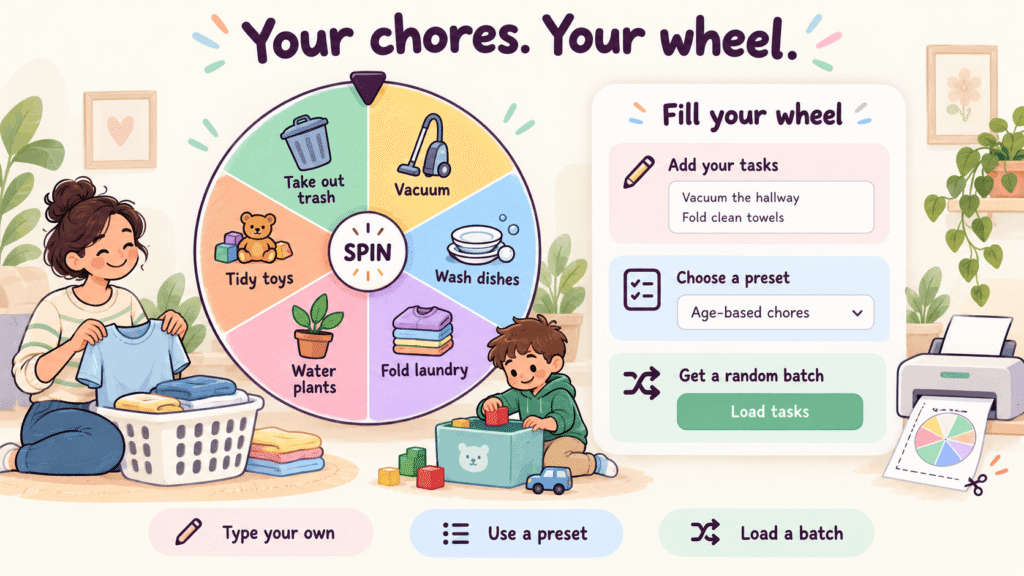
Filling a chore wheel comes down to three routes: type your own entries, load a ready-made age or reward set, or let the tool pull a random batch for you.
GoSpinWheel calls itself a household task randomizer and ships with 15 default tasks, which is the fastest start but rarely a perfect fit. One parenting site splits its presets into Chores Ages 4-5, Chores Ages 6-7, Chores Ages 8-9, Chores Ages 10-12, and Chores Ages 13-15. Those bands make a sensible first draft, though I still edit them for the actual kids in the house.
Writing your own entries is where wheels succeed or fail. A vague entry invites a two-minute pass, while “vacuum high-traffic areas first,” “mop from the farthest corner toward the door,” “rehang shirts on matching hangers,” and “check expiration dates, wipe the door gasket, add turntables, and leave open baking soda inside” leave nothing to dispute. I also rewrite entries by season: spring brings decluttering, summer brings outdoor jobs, fall brings leaves, and winter brings entryway mud.
Paper wheels follow the same logic. A printable maker from a reward-chart site lets you type tasks into a text box, press enter to stack a second task in one section, add a person with the “A” (add text) icon, and delete one with the small x. You download the file from the chore wheel maker, and a home printer and scissors finish the job.
How Do You Do Each Common Chore Properly?
Doing each common chore properly means working top to bottom, dry before wet, and finishing the closing steps most people skip, such as emptying, refilling, and putting supplies back.
Order matters more than effort. Dust furniture before anyone vacuums and sweep before you Mop floors, or the mop just pushes grit around. Working from high to low also keeps dust mites and pet dander from settling back onto surfaces you just cleaned.
Kitchen jobs are where I see the most half-finished work. Clean Kitchen should include the stove and sink, while Clean microwave and Clean oven deserve their own segments because they need soaking time. Wipe counters and Clean Table are quick jobs, but counters collect allergens and crumbs fastest, so pair them with Set Table for whoever eats first.
Bathrooms reward patience, and a three-step order keeps Clean Bathroom from dragging on:
- Spray the toilet, tub, and sink, then do something else while the product works.
- Scrub each surface, with regular disinfecting of handles to limit illness in homes with young children.
- Finish by sweeping the floor and emptying the bin.
Sitcom fans remember the Tiny Wheel, whose single space read Toilets, a fair joke about how people rank the job.
Wash Dishes should end with an empty drain and, if the bin is full, a Take out Trash run, and Change sheets fits best on a laundry day. Reward Charts 4 Kids’ spinner has a Pick a Chore mode and a Match mode for pairing a job with a person directly.
Which Chore Wheel System Fits Your Household?
The right chore wheel system depends on who lives with you: families with young kids suit a daily spin, house-sharers suit a weekly spin, couples suit bundled tasks, and competitive homes suit a scoring setup.
For roommates, the wheel works only on top of a roommate agreement settled before moving in. Spin Wheel’s checklist covers cleaning standards, shared vs. individual supplies, and guest and party cleanup. Weekly 10-minute house meetings and a habit to text when chores are done keep the agreement alive, and a little appreciation in that group chat goes further than reminders.
Couples and partners run into a different snag: uneven workloads. Reward Charts 4 Kids handles this on paper by letting one name appear more than once, with templates for 4, 5, or 6 people and a family name printed in the middle. In my house, one segment says Iron shirts because only one of us owns shirts that need it.
Larger groups benefit from the digital extras.Spin Wheel offers Share Links so everyone sees the same wheel, Auto-Save & Sync to Local Storage on one device, and Import / Export in JSON format, and its Simultaneous Multi-Wheel feature spins up to 6 wheels at once.
The sitcom wheel shows the paper alternative: its inner circle moved each day so office workers got fresh jobs, though it took trial and error to stop the same person feeling targeted repeatedly.
How Can a Chore Wheel Teach Kids to Help at Home?
A chore wheel teaches kids to help at home by turning household maintenance into a shared, predictable routine instead of a favor they do for one adult.
WheelySpin point is that children should learn responsibility for the home is not gender-specific or “Mom’s job.” I have watched a seven-year-old accept Check the Mail or Wash pet bowls with zero protest simply because the wheel, not a parent, chose it. A Daily Spinner works well here: spin each morning or after dinner, finish within 2 hours, and let parents supervise rather than redo the work.
Presets lower the setup effort. Habyts offers Preset Chores & Rewards as curated lists, including All Rewards and All Chores sets, while Reward Charts 4 Kids lets children earn stars and has a Pick a Kid mode. Those rewards matter less than consistency, in my experience.
Bed-making is the easiest early win. Make Beds takes minutes, and a tidy bedskirt can wait until later. GoSpinWheel links the habit to better sleep, a brighter morning mood, and higher productivity, and it counts chores as light-to-moderate activity, which serves physical health as well as mental health.
Older children can graduate to Help with Laundry, Clean Living Room, Sort mail, Clean Backyard, and eventually Mow lawn, each one a step toward real independence.
How Do You Make a Printable Chore Wheel at Home?
You make a printable chore wheel at home by downloading a two-circle template, printing both circles, cutting them out, and pinning the small names circle on top of the big tasks circle so it can turn.
- Download the version that fits your group. Reward Charts 4 Kids offers an instant download, and couples can use the four-person template and type each name twice.
- Fill in names on the small circle and tasks on the big one, then print both on stiff stock.
- Cut, pierce, and fasten the two circles at their middles so the top one spins freely.
The template turns a stressful process into a family craft, and the assembly itself becomes a small ritual. Plan to rotate weekly for a fair split. Our Sunday spinning sessions started as logistics and turned into bonding, and finishing the build gave the kids a real sense of accomplishment.
Apartment wheels need different segments: balcony, hallway, sort recycling, and the mail area. Big houses add upstairs and downstairs bathrooms and a guest room.
For perspective on what a good wheel is worth, two sitcom prop wheels sold on eBay for $1,526.00 after 49 bids. Yours costs one sheet of stock and a fastener, plus a Spin Again rule for anyone who lands on a job they did yesterday.
How Do Roommates Keep Chore Sharing From Turning Sour?
Roommates keep chore sharing from turning sour by fixing the rules and the check-in rhythm in advance, so the wheel’s results are never up for debate.
Go Spin Wheel’s Weekly Assignments system suits shared flats: one Sunday evening spin sets the whole week, the schedule goes on the fridge, and a Friday check-in catches slips. That setup builds accountability and cuts last-minute conflicts, and it ends the negotiation fatigue of trades like “I’ll do dishes if you do trash.”
A result has to be non-negotiable to work. Once the spin is an obligation everyone signed up for, even dull jobs feel less burdensome. I have seen a house argue for twenty minutes over the recycling bin, the bag liners, whether to double-bag wet waste, and who drags the bin to the curb. A spin settles that in seconds.
Clutter is the other source of tension, and food left out in a shared kitchen invites bug and rodent infestations. Clutter is tied in WheelySpin text to cortisol, the stress hormone, and shared spaces amplify both anxiety and overwhelm. Small daily wins build momentum.
When someone slips, specific praise for what they did finish, a habit to praise effort, and the effort to model a good attitude usually work better than a lecture, as long as the house agrees on its values.
How Do You Customize a Chore Wheel for Pets, Yards, and Seasons?
You customize a chore wheel by swapping its segments to match the work your home actually generates, then choosing a spin rhythm that fits how that work piles up.
Some homes don’t need a schedule at all. WheelySpin Emergency Spin has no set day: anyone announces “chore wheel time” when a mess appears, which prevents buildup and gets the job done right away. Couples who hate pure chance can use a Task Bundle instead, with a morning bundle and an evening bundle spun once a day for a balanced workload.
Ages change the menu too. Wheelyspin suggests Ages 3–5 put away toys and wipe spills, Ages 6–8 fold towels and sweep with a child-size broom, and Ages 9–12 handle bigger jobs and pack own lunch. Ages 13+ can take on everything, including meal prep and errands.
When you run out of ideas, Habyts gives three entry points: Create Your Own, presets, or Random Chores, which serves up helpful chores if you need inspiration. I use the random set once a quarter to catch jobs my own list keeps forgetting, such as emptying drainage trays and watering with room-temperature water.
Paper wheels customize just as easily. You poke a hole through each disc with the back of a fastener, then join the two circles with a paper fastener so the center circle of names turns over the larger wheel of tasks. One reader of Reward Charts 4 Kids reported both discs printing at the same size, and the site says that problem is fixed. If two people want the same chore, settle it with heads or tails.
Does a Clean Home Really Affect Stress and Health?
A clean home affects stress and health, according to WheelySpin summary, which links regular cleaning to lower stress, fewer allergy triggers, and fewer pests, although the site cites no specific studies.
The physical side is easiest to see. Wiping high-touch surfaces like light switches and door handles with a microfiber cloth, dusting from ceiling fans down to baseboards with microfiber rather than a feather duster, and keeping pet chores like walk dog, litter box, and groom on rotation all cut down on what floats around a room. Food left out invites ants, and seasonal jobs like air filters, the heater filter, and the humidifier keep air cleaner. Bathrooms need you to ventilate.
The emotional side shows up as less resentment. A wheel makes dull work bearable because it becomes part of a shared household culture rather than a burden one person carries.
Competitive homes can lean into scoring. Go Spin Wheel’s Point System gives a bathroom 5 points and watering plants 1 point. At month’s end the lowest scorer takes a big chore or the highest scorer wins a prize, and the tally resets monthly.
What Features Should a Digital Chore Wheel Spinner Have?
A digital chore wheel spinner should have editable entries, fair randomness, adjustable odds, and a way to save the wheel, because those four features decide whether a household keeps using it.
The simplest tools pitch themselves broadly. One site sells itself as a free online wheel maker for games, giveaways, and quick choices, with custom spin wheels meant for everyday decisions, and its tagline says “Let the wheel do the work.” A fuller editor adds tabs for Style, Sound, and Timing, plus CSV import, Generate with AI, and Save to cloud.
Odds matter more than looks. One spinner’s FAQ suggests editing weight values, for example weight 3 for adults and weight 1 for kids, which gives grown-ups a higher chance of landing the tougher jobs. I would also want a setting that removes each winner after a spin, so nobody gets drawn twice in one round.
Fun spaces keep people spinning. The sitcom’s final wheel had 12 spaces, mixing Bankrupt, Creed’s Choice, Go Home Now, Manager for an Hour, Stanley Gets Your Lunch, Warehouse Vacation, and Punch in the Gut. Swap a couple of chore segments for small perks like those, and the spin stops feeling like a sentence.
What Was the Famous Sitcom Chore Wheel at Dunder Mifflin?
The famous sitcom chore wheel at Dunder Mifflin was a homemade office rota built by the branch administrator when the janitorial service paused, and it evolved from a strict job list into a prize wheel.
The first version was all work and no luck. Its segments read like a real break-room checklist, the kind where someone has to scrub stovetop grates, wipe the backsplash, use a degreaser, deal with pots and pans, and steam the microwave with lemon water. Even the window job would call for a squeegee, a white vinegar mix, newspaper for a streak-free finish, and ideally cloudy days. Staff saw it as a list of unpleasant tasks and kept complaining.
The rebuilt wheel became a game of chance. Instead of jobs, most spaces handed out perks or pranks, which turned the rota into a fun game and gave the writers plenty of gag ideas. Only a tiny side wheel still held the bathroom job, presumably the one requiring an overnight toilet cleaner and a spray left to let sit 5 minutes.
The episode works as a lesson for real homes. Rewards beat lectures, but a prize wheel can pull focus away from the work itself. Streamers borrow the same format through Wheelyspin OBS Streamer Mode, a green screen background, and Streamlabs support for live audiences.
What If the Wheel Keeps Landing on One Person Again and Again?
When a wheel keeps landing on one person, turn on Elimination Mode so each person is drawn once before anyone repeats, which guarantees unique winners each round. Uneven runs are normal with true randomness, and households can also allow trades, letting two people swap jobs by agreement. Assume good intent first, and use “I feel” statements rather than accusations. WheelySpin Weighted Choice setting, built for tiered prizes, can rebalance odds if one person truly needs a lighter load.
What If a Household Member Can’t Manage a Certain Chore?
When a household member can’t manage a certain chore, take that chore off their wheel or let them trade it with someone who can. A child or an older relative shouldn’t be climbing for holiday decoration or hauling outdoor furniture, so adults absorb those harder tasks. Make sure everyone is picked once for something they can handle. If a roommate is simply not pulling weight, GoSpinWheel suggests a private chat, then a mediator such as a mutual friend or an RA, with written consequences as a last resort.
Should Kids’ Chore Wheel Tasks Be Tied to Allowance?
Whether kids’ chore wheel tasks should be tied to allowance is a judgment call, and GoSpinWheel notes that opinions genuinely split. Some parents prefer non-cash rewards like screen time or a dessert choice, or borrow spaces from the sitcom wheel such as Candy Bar and Ten Bucks, with No Internet as the joke penalty. Others motivate with timer races, dance parties, and chore bingo cards. Never use chores as punishment, and give difficult tasks a bigger payout if money is involved.
Can You Rig a Chore Wheel So Grown-Ups Get the Tougher Jobs?
Yes, you can rig a chore wheel so grown-ups get the tougher jobs by adjusting the wheel’s weights, or by keeping a separate wheel for heavy seasonal work. Put deep carpet cleaning, gutter cleaning, snow removal, grill maintenance, and pool care on the grown-up wheel. Because experts disagree even on basics like allowance, keep the rule simple: remove tasks that exceed a child’s abilities or anyone’s physically safe limits, and agree on consequences for missed chores up front.
What Happens If Someone Refuses Their Assigned Chore?
When someone refuses an assigned chore, the household falls back on consequences in advance that everyone agreed to before the first spin. For kids, GoSpinWheel suggests losing privileges; for roommates, a written agreement with financial penalties or mediation. Some families separate basic chores as a family contribution from extra chores that earn money, which teaches the link between work and reward. The wheel only works if everyone agrees to honor the results.