How Do You Play Spin the Bottle?
Spin the bottle is played by seating a group in a circle, spinning a bottle (or a virtual one on a phone) in the middle, and having whoever the neck stops on answer a question, take a dare, or do whatever task the group agreed on before the next spin.
That one-line version hides how far the game has drifted. The written records go back to the 1920s, and a close cousin called Bottle of Fortune shows up in print by 1927, long before anyone pictured a phone doing the spinning. Today the physical bottle is often optional, and the prompts waiting on the other end have grown into whole libraries.
I’ve run this game at birthday nights and office socials, and what decides whether a round works is rarely the bottle. It is the prompt list. App question banks now sort content into tiers such as Popular, Extreme and Spicy, while browser versions lean on a general-audience pool of truths and dares written for teens and adults. Picking the tier before anyone sits down saves a lot of negotiating later. To decide between truth and dare, spin the truth or dare wheel, which gives a question or dare from the kids, friends, party or couples deck.
Balance is the other quiet upgrade. A glass bottle on carpet drifts toward whoever sits on the low side; a coded spinner gives every seat an equal chance, and the outcome is fixed by software rather than by the floor. You can re-spin as often as you like without anyone accusing the spinner of a sneaky flick.
Where Did Spin the Bottle Come From?
Spin the bottle began as a simple circle game in the early twentieth century and grew, over decades, into the kissing party game most people picture today.
Reference accounts describe the game as stereotypically played by teenagers, and its peak sits in the second half of the 20th century, when it earned a reputation as a coming-of-age ritual at parties and sleepovers. That reputation stuck so firmly that many adults still flinch at the name.
What surprises people is that the oldest printed versions of bottle games say nothing about kissing. The idea that the payoff is traditionally a kiss arrived later, and even then there was no official rulebook; every group improvised its own version and passed it along by word of mouth.
That looseness is why the game has been around for ages without going stale. Each generation bolts on a modern take: dares for young adults at game nights, classic questions for younger crowds at family get-togethers, or a ridiculous tale someone has to finish on the spot. The classic circle survives; only the payload keeps changing.
How Do You Play Spin the Bottle Online?
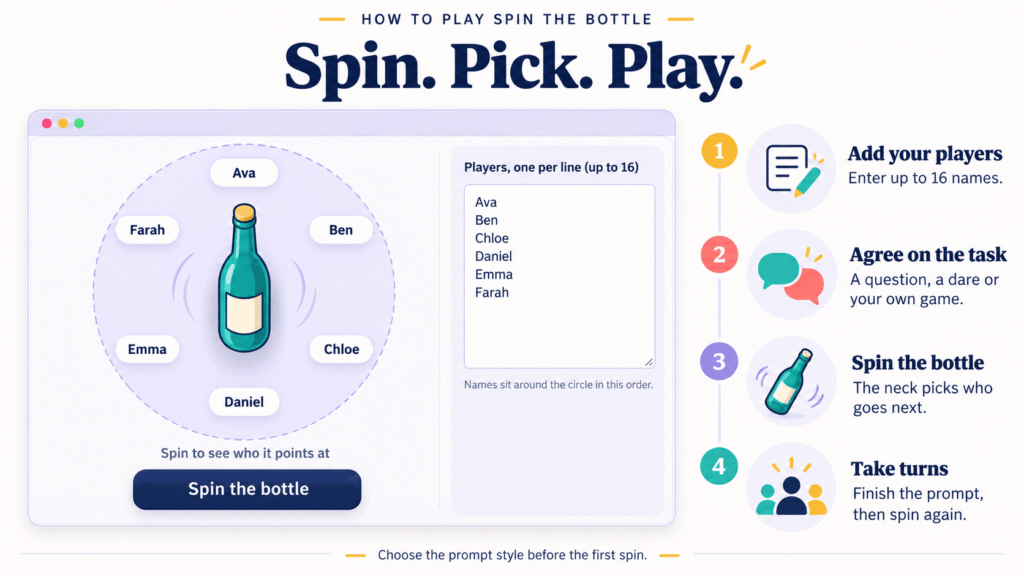
Playing spin the bottle online takes four moves: enter the names, choose a style of prompts, hit spin, and let the on-screen bottle pick whoever goes next.
Most browser-based versions open on an empty ring of seats. This is the order I follow when friends arrive:
- Add players by name, or use quick-start to drop in four players and rename them later. Keep the list between two to twenty names, since that is the range the roomier tools support.
- Pick a mode. Classic Spin the Bottle gives you a random player with nothing attached, while prompt modes pull from banks of questions and dares; one long-running app advertises 1,000+ on its page and 900+ in its own title.
- Press the spin button. The bottle lands on someone and their name flashes on screen.
- That person answers a truth or completes a dare, depending on the mode.
Before step one, I load custom prompts if the group has in-jokes and agree on a few common ground rules out loud. When the night ends, I clear all players so the next crowd doesn’t inherit stale names.
Some general spin wheels offer a stripped-down cousin: two slices, each marked with a pointing emoji. It works as a random player picker for a pair of people, but it loses the circle feel that makes the bottle version social.
Are There Official Rules for Spin the Bottle?
Spin the bottle has no governing body or standard rulebook, so the rules are whatever each group agrees on before the first spin, usually covering the task, re-spins and when to stop.
The closest thing to authority is a thin paper trail. Researchers who trace the game lean on a handful of printed sources, and none of them reads like a rulebook:
| Year | Source | What it is cited for |
|---|---|---|
| 1922 | The Playground, Vol. 16, p. 231, from the Executive Committee of the Playground Association of America | A related bottle game in early recreation writing |
| 1925 | Clara B. Stoddard, “A Program of Speech Education for the Elementary Grades,” The Quarterly Journal of Speech Education 11.2, pp. 164–169 | One of the earliest printed mentions of the spinning game |
| June 1999 | Maria Demopolous, SPIN magazine, p. 61 | The game’s place in late-century teen party culture |
| 2007 | Lynne Stanton, Spin the Bottle: Kissing Games from Romantic to Risque, ISBN 9780762425112 | A full book of party kissing games built around the original |
None of these sources settles the arguments I hear at real parties. Most groups still need to set ground rules on three points: whether the spinner gets to spin again when the bottle faces them, what an empty space between two people means, and whether to assign a self-task instead.
My default is simple to explain in ten seconds. A gap counts as a re-spin, and landing on yourself means you pick a prompt for yourself while the group watches.
What Are the Different Ways to Play Spin the Bottle?
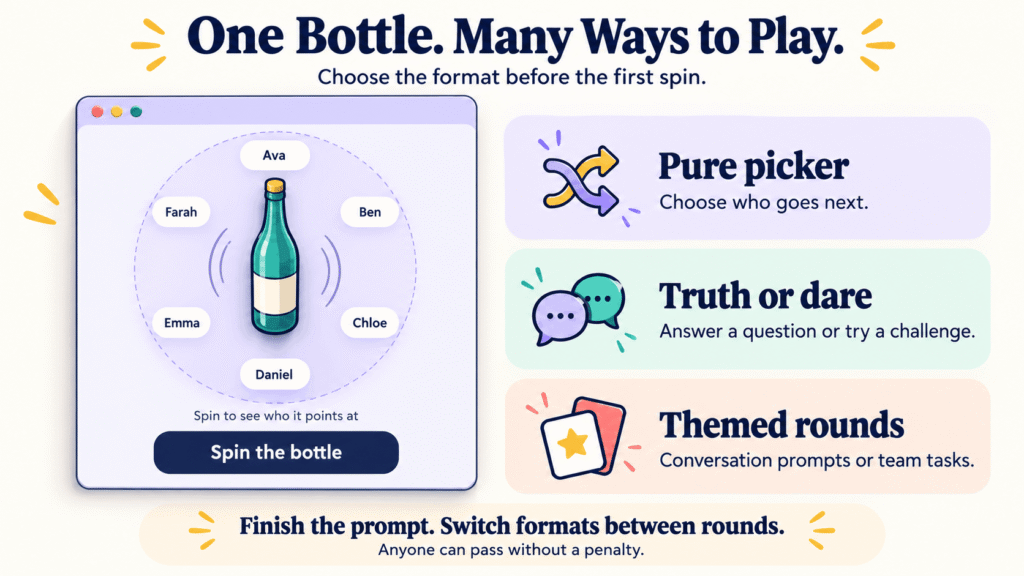
Spin the bottle can be played as a pure picker, as truth or dare, or as a themed game mode built for a specific crowd, and the right choice depends mostly on who is sitting in the circle.
I now set mode expectations up front. A selector that only names a person turns the bottle into a full party game engine for whatever you attach to it. In a dare-led format, the chosen person answers or performs; in a team format, they complete tasks for their side. The random prompt layer is entirely up to you.
With mixed ages in the room, I agree on a mode before the first spin and only switch modes between full rounds. Most online versions let you change instantly, which is tempting, but swapping halfway confuses whoever is up. The same logic applies to content: finish a prompt before anyone spins again.
Family gatherings and office socials need a different comfort level than a late-night crowd. For those rooms I keep conversation prompts ready and let anyone skip prompts without a penalty, which keeps quieter guests in the circle.
Why Play Spin the Bottle Online Instead of With a Real Bottle?
Playing spin the bottle online swaps a glass object and disputed spins for a coded selector that treats every seat the same and cannot shatter.
A virtual bottle clears the play area of breakables, which matters more than people expect once snacks and cups pile up on the carpet. You tap or click, the result is decided before the bottle moves, and the screen displays a player’s name so nobody argues about which of two neighbors the neck was facing.
The same tool doubles as a turn-picker outside party night. I’ve used one for card games, small office giveaways and quick choices like who orders lunch, the moment someone says they can’t decide. Random player selection with no prompts attached lets you run house rules of your own, so it is really a random picker wearing a bottle skin.
Practical details seal it. A web app that is mobile-friendly sets up in seconds, tapping the screen starts the spin, a prompt appears automatically once a choice is made, and the board rearranges when people are added or removed halfway through the night.
How Do You Keep Spin the Bottle Fun and Respectful?
Spin the bottle stays fun and respectful when the group agrees on limits before the first spin and picks a prompt style that suits the most reserved person present.
My routine starts with a two-minute chat to discuss boundaries: what is off-limits, what is acceptable, and how someone bows out. That small step heads off most awkward moments. I also veto anything harsh or cruel, because a prompt that earns shared laughter beats one that earns a gasp.
Mode choice does the rest of the work. The common browser modes line up like this:
- Friends mode: clean, funny questions and quick dares for people who already know each other.
- Couples mode: playful, relationship-friendly prompts with no explicit content.
- Party mode: energetic group challenges designed to work with non-alcoholic drinks.
- Kids and Family: age-appropriate, non-romantic activities for rooms with younger guests.
- Custom mode: your own lines, stored in your browser.
Setup matters as much as content. Sit on the floor or around a large table so everyone can reach the bottle, and lay the device flat in the middle of the circle. A phone propped on a cup risks losing or breaking it when someone lunges for a better view. Keep it fun by remembering that fun comes first; there is no score to protect.
What Does the Spin the Bottle App on the Play Store Offer?
The spin the bottle app on the Play Store works as a general-purpose picker that spins to choose one person from a group, with party prompts secondary to that core job.
The listing pitches it as a way to randomly choose someone in group games and party activities, and it stretches into practical group activities like splitting team members or settling who goes first. It claims to handle any number of players with no complicated setup, in groups, pairs, or even solo. For more games to play with a group, browse all our party games.
I treat the Android app as a convenience rather than an upgrade. Google Play and the App Store both carry spin the bottle apps for iPhone and Android, but store versions can put an upgrade offer in front of the first spin, as reviewers of this listing point out.
The browser version I use needs no sign-up, keeps names in local storage and never sends them off the device. Where an installed app earns its place is quick challenges away from a laptop: open it, spin, done.
How Do You Play Spin the Bottle, Step by Step?
You play spin the bottle by sitting in a circle, choosing who spins first, carrying out whatever task the bottle hands out, and passing control to whoever it stopped on.
- Gather in a circle and sit close together so the bottle or screen is visible to all.
- Choose the first spinner: the host, the youngest or oldest guest, or anyone the group nominates.
- Spin the bottle, or tap the circle on screen, and wait for a complete stop.
- Call out “choose your fate,” and the person pointed at picks a question or a dare.
- The selected player must perform the task the group agreed on.
- Pass the turn: that person becomes the next spinner, so you pass the bottle to them and the next person gets picked.
Players take turns for as long as players want, and there are no winners or losers. I end the game either once everyone has had a turn or when a preset time limit runs out; twenty minutes suits most of my groups. To decide who spins first, flip a coin online or play a quick round of rock paper scissors.
Is Spin the Bottle Really Random?
A digital spin the bottle is random in the way that matters, because well-built versions give every name equal odds and decide the pick in code rather than by how hard someone flicks the bottle.
The animation is theatre. The bottle slows to a stop for drama, but the pick was settled when you pressed spin, and the screen announces results plainly so there is no debate.
A real bottle is less fair than it looks. Tilted floors, thick carpet and a practiced wrist all nudge it, and I once watched the same friend get picked four times on a sloped patio.
One tool’s instructions sum up the digital approach in a line: press spin, and the bottle lands on the next player. The software handles the choosing, not the slope of the room.
How Many People Can Play Spin the Bottle?
Spin the bottle works for any group of people from two upward, though a physical circle feels best at about 5 to 10 players.
Online tools set their own ceilings. One lets you enter up to 16 names, one per line, while another supports 2 to 20 players and lets you add or remove players mid-game without restarting the session.
Past a dozen people, I split the room. Waiting fifteen turns for a spin drains the energy, so I gather participants into two smaller rings and rotate between them every few rounds.
With fewer than five people, the bottle comes round too fast for suspense, so I keep rounds short and lean on longer prompts.
Is Spin the Bottle Free to Play?
Spin the bottle is free in most browser versions, which need no account and no download, while store apps are usually free to install but funded by ads and upgrades.
Browser tools generally just need JavaScript switched on, and one version works offline once the page has loaded, which helps at a cabin with patchy signal. One prompt site is translated into 21 languages, so you can share a link with a mixed-language group.
Store apps are where costs creep in. One Play Store listing contains in-app purchases, and reviewers complain about a free trial offer showing before the app’s purpose is clear, plus excessive ads. I test any app alone before handing it to a party.
Can You Play Spin the Bottle Without Kissing?
Yes, spin the bottle works perfectly well without kissing, and many current versions treat kissing as entirely optional or leave it out altogether.
History backs this up, since the early accounts of bottle-spinning games don’t mention kissing at all. Swap the kiss for a Compliment circle, where the chosen person says something nice about whoever the bottle faces, or a Story chain, where they add the next sentence.
Question time turns each spin into an icebreaker, and you can mix truths and dares with light challenges for variety.
Whatever the format, consent comes from the whole circle. Allow passes by group agreement, respect decisions when someone feels uncomfortable, and never pressure anyone into a turn.
Do Spin the Bottle Apps Save or Share Your Data?
It depends on the version: the browser game I use keeps names on your device and sends nothing out, while one Play Store app says it may collect data and share it.
| Question | Browser version | Play Store app |
|---|---|---|
| Where data lives | Local browser storage, alongside your theme preference | Collects personal info and app activity, plus two other categories |
| Is it shared? | No data is sent anywhere | May go to third parties |
| Encryption and deletion | You can clear at any time; names can be deleted anytime | Not encrypted and can’t be deleted, per the developer’s data safety section |
| Listing stats | No store listing | 4.2 stars, 396 reviews in the header (390 in the ratings panel), 100K+ downloads |
| Rating and category | None | Content rating Everyone, Entertainment category, updated Oct 16, 2026 |
The listing also says practices vary by use, region, and age, and reviews mention phone issues answered with a support email.
Inside the game itself, the rule I repeat is keep it private: personal information revealed in a round stays in the round, and player information on screen never needs to be more than a first name.