What Is a Charades Generator and How Does It Pick Words for You?
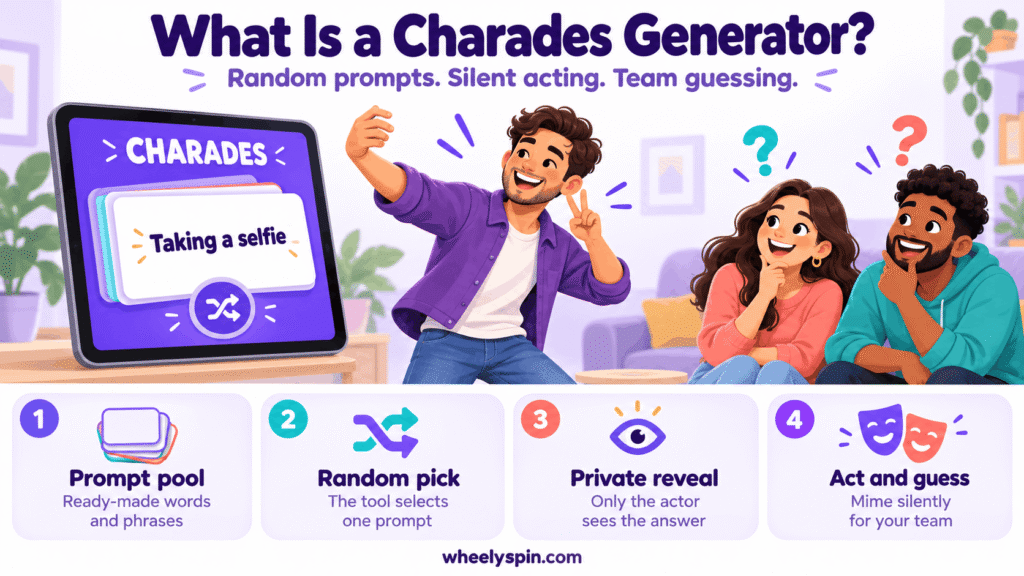
A charades generator is an online tool that deals one random prompt at a time for a player to act out silently, usually alongside a round timer, a hidden-word screen and team scoring, so nobody has to invent prompts in the middle of a game.
I have hosted charades both ways, and the difference shows up in the first ten minutes. Without a generator, the actor stands there whispering “give me a good one” while someone scribbles Folding laundry on a napkin that three people have already read. With one, the actor doesn’t have to think one up, and the room never sees the answer before the miming starts.
Charades itself is a gesture and acting game wrapped around a word-guessing game. Families play it as teams competing against each other, offices play it around a meeting table, and remote friends play it over Zoom, Teams or Google Meet with one person squeezed into the frame. The tool leaves those rules alone; it only changes who carries the burden of choosing the prompt.
What surprised me most is how much a neutral picker improves the mood. When the host chooses, people suspect favoritism. When the screen hands Taking a selfie to one side and a tricky film title to the other, everyone shrugs and blames the draw instead of the host.
What Does a Charades Generator Actually Do During a Game?
A charades generator replaces the host’s notebook: it draws a prompt from a stored word bank, shows that prompt only to the current actor, and often times the round and tracks points as well.
Think of it as a random word generator for charades with game logic bolted on. Some versions are bare lists you refresh; better ones store hand-picked prompts, sort them by difficulty and remember which ones already came up. One tool’s own comparison puts typical charades sites at 50–200 words, a bank that runs dry quickly at a big party.
The format question matters too. A host can treat each person is their own team, where whoever guesses first scores, or split the room into teams of two or more racing a clock. The two approaches can be combined: I often run solo rounds while late guests trickle in, then switch to teams once the doorbell stops.
In practice, the generator deals the word, the actor glances at it, and the miming begins. A prompt like Opening a stuck jar or Losing your keys lands instantly because nobody had to argue over it first. Most browser versions need no signup, and dumb charades, another name for charades, runs the same way on these tools.
How Do You Play a Round of Charades Step by Step?
A round of charades with a generator follows six moves: agree on clue rules, hand the device over privately, act, run the clock, skip if needed, and score before the other side takes over.
- Set clue rules first: decide whether sounds, pointing or props count before anyone stands up, because arguing mid-round wastes the clock.
- Private handoff: divide the group into two sides, then pass the device face-down so only the actor sees the word or phrase.
- One player acts a word silently: the actor has to act it out without speaking, and teammates call out guesses as fast as they like.
- 60 s standard: start the countdown; one minute suits most adult groups, while kids usually need longer.
- Pass option: if the prompt means nothing to the actor, skipping beats a dead minute of confused waving.
- Score per correct guess: tally the point, then switch teams so the other side gets the device.
Some tools wrap these steps into Single-Word Rounds, where each turn carries exactly one prompt. That keeps scoring clean for younger players, who tend to lose track when a turn stacks several prompts.
My one house rule is that the actor must act silently even when frustrated. Groans count as sound in my living room, and enforcing that during the first round saves arguments for the rest of the evening.
Which Hand Signals Do Charades Players Need to Know?
Charades players need a small set of shared hand signals: category shapes, counts for words and syllables, a sound-alike cue, size cues for tiny or long words, and a “getting warmer” wave.
Start with categories. Most groups use specific shapes for movies, books and TV before anything else, because knowing the category halves the guessing. Next come counts: fingers for word count, then a word number to show which slot is being acted, then forearm taps for syllables.
The cupped ear flags a rhyme clue, and pinched or stretched hands tell guessers the target is a tiny word like “a” or a very long one. The waving motion toward yourself says the team is close and should push on with that line of guessing.
The rule underneath all of it is no speaking, mouthing or spelling. That means no words or sounds at all, including noises like animal calls. An actor doing a penguin has to waddle and flap their arms rather than squawk.
On video calls, ask the actor to step back so their upper body fits the frame; gestures made at chest height vanish otherwise. I also print a quick rules and gesture sheet for first-timers, because the signals are exactly where new guests get lost.
Which Word Categories Make the Best Charades Decks?
The best charades decks mix concrete categories, such as actions, animals, objects and film titles, with a difficulty level matched to the people in the room.
Category design is where generators differ most. A basic site offers one list or a few themes; a stronger one draws from several categories and lets you set filters before dealing. One tool’s English classic deck packs 180 words into six groups, while another treats Movies and TV as a single pick. Either way, the word source shapes the night more than the timer does.
Parties gravitate to the most requested decks, usually movies, animals and actions, each sitting behind a one-tap button. The trick is pairing them with the crowd, and this is the setup I borrow from one generator’s own recommendations:
| Group | Categories | Difficulty | Timer | Medium-level test prompt |
|---|---|---|---|---|
| Kids’ party | Kids & Family, Animals | Easy | 90–120 s, or off | — |
| Family game night | Animals, Actions, Objects | Easy to Medium | 60–90 s | Washing machine |
| Adult party | Movies, Idioms & Phrases, TV & Books | Medium to Hard | 60 s | The Wizard of Oz |
| Classroom | Actions, Animals, People & Jobs | Easy | 60–90 s | Woodpecker |
| Office or team building | People & Jobs, Sports & Games, Actions | Medium | 60 s | Waking up late for work |
| Christmas or holidays | A dedicated list | Mixed | 60–90 s | — |
For little ones, stick to kid-friendly categories and actable words rather than abstract nouns. A prompt you cannot picture is a prompt nobody can mime.
How Should You Choose Between Easy, Medium and Hard Charades Words?
Charades difficulty should be picked for the least confident actor in the group, not the sharpest guesser, because a prompt nobody can mime stalls the whole round.
Most decks ship tagged easy, medium or hard, while cheaper lists are often untagged, which means you discover a word is brutal only when someone freezes. One generator even adds a fourth tier, Really Hard, on top of the usual three, and a few let you set difficulty choices when adding words.
Easy prompts are physical and singular: an animal, an object, a chore. Medium prompts add a scenario. Hard decks bring harder concepts and multi-step actions, like A magician losing the rabbit or Meeting your future self, where the actor has to stage a tiny story with a beginning and an end.
Here is the contrarian part: hard words are not always the fun ones. Charades is already surprisingly hard with simple nouns, and I have watched beginners lose interest after three dead rounds in a row. Start low, then save a Hard quick deck for the last harder round of the night, once everyone is loose.
How Long Should Players Get to Guess Each Charades Word?
Players should usually get about one minute per charades word, with extra time for kids and online games and less time when an experienced group wants pressure.
Across generators, 60 seconds is standard, but several tools let you choose 30, 60, 90 or 120 seconds or turn it off entirely. A shared time limit makes the game faster and fairer, because nobody can accuse the host of letting a favorite side run long.
The countdown usually begins when the actor taps Start round, which also hides the prompt. Some tools add an option to Start the 60-second timer with each card, and better ones let you pause and resume without losing time when a toddler wanders into the acting space.
Mode choice changes the feel more than the number does. One generator offers a relaxed mode with no timer, labelled Simple Generator, a Single Word mode with one prompt per turn, and Speed Charades, a fast-paced timed mode where prompts change automatically every few seconds.
Online, video lag eats into every round, so I add half a minute on calls and use shorter timers only when everyone shares the same room.
How Many People Can Play Charades and How Do You Keep Score?
Charades has no upper player limit, and a generator with built-in scoring can track two to four sides so nobody keeps a tally on the back of a receipt.
Old-school groups kept team scores with pen and paper; generators now do it in the corner of the screen. One tool supports 2, 3 or 4 teams, though everyone playing against everyone else works fine for small groups where whoever shouts first takes the point.
Each turn, a player from each team acts in rotation, and the screen shows whose turn it is. The scoring buttons are blunt: Got it adds a point, Missed passes the turn. You either race to an agreed score or play a set number of rounds, and the side with the most points wins. On video calls, a first correct message wins rule settles near-ties in chat.
When play stops, one tool ends the game and shows results on a Game Complete! screen with a Total Score. To size the deck in advance, plan roughly 3 words per player for a 20–30 minute game:
| Players | Teams | Turns per player | Words to deal |
|---|---|---|---|
| 4 | 2 | 3 | About 12 |
| 8 | 2 | 3 | About 24 |
| 12 | 3 | 3 | About 36 |
| 20 | 4 | 2 | About 40 |
Which Game Modes and Controls Change How Charades Feels?
Charades generators change the feel of a game mainly through their controls: how the prompt is hidden, whether the clock restarts on its own, and how turns and points move between sides.
The core loop lives in two buttons. Next word draws the prompt, and Hide word covers it before the device travels to the next actor. A dedicated button to hide the answer sounds trivial until a guesser glimpses the screen and the round is spoiled.
Team-based layouts add a turn bar. One tool shows Team 1 Start Turn, then Correct Guess and Forfeit Turn buttons, and closes with a Game Summary. Another lets the actor reveal the word mid-round, and its next-word control resets the timer without starting it, which gives the incoming actor a breath before the clock runs.
Display options matter for groups bigger than a sofa. The scoreboard can be enlarged for casting or projecting, and Esc exits that view. Reset scores clears the board between games, and Off disables scoring when the group just wants casual play. On video calls, I remind actors to turn the camera back on only after the prompt is covered.
Can You Load Your Own Charades Words or AI Themes?
Yes, many charades generators accept your own words or build themed prompts with AI, which is the quickest way to fit a game to inside jokes, a class topic or a holiday.
In one tool, a custom word list takes 2 to 300 entries, separated by commas or line breaks. There, these own word lists are not saved anywhere beyond the open tab, which is a privacy plus for office games full of colleague names.
AI ideas go the other direction: you type a theme, and the tool returns AI-created ideas on that subject. Those requests draw on a daily allowance, but any generated batch stays playable without a new request, so I generate once before guests arrive and leave it at that.
Built-in instant word sources still beat both for speed, since you can generate words instantly with one tap. For a hybrid, copy the full word bank from a deck, paste it into a document, delete the duds, and paste the trimmed list back in.
Custom lists shine at reunions, in my experience. A teacher’s catchphrase or a family road-trip disaster gets a louder reaction than any stock film title.
How Do You Turn a Charades Generator Into Printable Cards?
To turn a charades generator into printable cards, filter the deck, use the tool’s print or copy option, and cut the output into slips so the group can play screen-free.
Printing suits prepared rounds: classroom sessions, camp nights or a party where phones stay in a basket. Pick a classic category, generate a batch, then use the list controls to copy it or send it to the printer. One tool trims batches so they come out shorter at the end of a deck, guaranteeing no word is printed twice.
Custom lists need a little care. Typed words often clear when you reload, so print before refreshing. Tools with Hide Word List and Edit Word List toggles, plus an Add Word button, let you polish entries on screen first.
Paper also changes scoring. I draw a quick Round table on the back of a sheet, and at the end I compare it with the tool’s Word Summary if we switched between paper and screen. The biggest benefit is that kids can play without a phone, so nobody fights over who holds the device.
How Many Charades Words Should You Deal for Your Group?
The number of charades words you need depends on players and turns, but a generator that never recycles prompts makes exact counting mostly unnecessary.
Charades has no maximum number of players. Two people can play, yet the game gets lively with 3+ players, and 6+ players should split into two sides. Once you pass groups over eight, each person acts less often, so the deck lasts longer than you expect.
Deck memory is the feature that matters here. Some generators promise no repeats until the deck is used up, and the deck reshuffles only after every prompt is dealt. In another tool, the next-word control marks the current one as used, and the end screen lists Words Used. Note that changing theme or difficulty starts a new deck, so mid-game switches can bring old prompts back.
Basic word lists behave differently. Refresh-style pages pick at random each time, so words repeat within a single evening, which I find kills momentum. If you prefer to preset volume, one tool asks for the Number of Charade Words before dealing a batch.
What Charades Settings Work for Kids, Families, Classrooms and Offices?
Charades settings should follow the audience: easy words and long timers for kids, medium words and one-minute rounds for families and offices, and tougher prompts for adults who already know the signals.
Group size decides structure first. You need at least three people for a truly competitive game, and once sides form, teams alternate every turn. Whatever timer you choose, every side must play the same time period, or the final tally means little.
For young children, keep prompts physical and the timer generous. Classrooms work well with object decks covering tools, foods and classroom items. One printable 15-minute classroom plan I came across offers seated and partner options, though its maker notes it has not been classroom-tested, so treat it as a draft.
Seasonal play needs its own lists. One generator sorts decks into Category Groupings called Family, Classic, Holiday, Custom, with a Select Categories menu, and seasonal prompts elsewhere cover Halloween, birthdays, vacations and family traditions.
Mixed groups of kids and grandparents are my favorite crowd: let small circles shout guesses, and give the youngest actors the easiest card.
How Do You Play Charades Over a Video Call?
Charades works over video when the actor receives the prompt privately on a separate device and acts inside the camera frame while everyone else guesses.
Remote play flips the usual setup. The video call carries the acting, while the generator works on any phone, so the actor reads the prompt on a handset where only the actor sees it. A hide screen covers the word before the actor looks back at the laptop.
Gestures must be bigger than in-person play. The old-fashioned camera crank for films, open your palms for books and draw a rectangle for TV all read well on a small tile, while subtle finger counts blur. Prompts with easy visual clues survive compression: A cat stuck in a box, A dog chasing bubbles or A flamingo losing balance look funny even at low resolution.
Longer titles are the opposite, since a five-word film eats the clock before anyone sees the second word. Small calls can guess aloud; bigger ones get messy fast.
For hybrid nights, offline players in the room can follow on a TV using large type, while remote guests watch the actor’s tile.
What Separates a Good Charades Generator From a Basic Word List?
A good charades generator is separated from a basic word list by deck size, difficulty labels, repeat control and built-in timing and scoring, not by flashy design.
Size claims vary widely. One idea site advertises 1,500+ charades ideas in its headline while its page description says 1,000+, with a database updated regularly. Bigger is not automatically better; I would take a few hundred prompts labeled Easy, Medium or Hard over thousands of unlabeled ones.
Repeat handling is the hidden test. A tool that avoids repeats keeps a two-hour party fresh, while a plain list starts recycling. Export matters too: a copyable word list lets you print, edit or share prompts, and some sites even point families toward physical charades games for cards on the table.
Pricing models differ. Several generators need no account, but one tool reserves paid categories and extra AI generation for Premium users.
Finally, check who maintains the tool. One developer says it reviews game flows and generated prompts and uses player feedback to improve them, which is more transparency than most word pages offer.
What Do Experienced Charades Hosts Do Differently?
Experienced charades hosts settle the rules, the prompt list and the device handoff before the first actor stands up, then keep the pace high by dropping dead prompts quickly.
Charades runs on simple rules, but groups disagree about edge cases like pointing at real objects or acting words that sound alike. I hand out the signals early and ask players to learn them beforehand, often from a printed host kit.
The handoff is where games leak answers. With one shared phone, the actor hides the screen before they pass the phone along. Generators that keep each prompt hidden until the actor is ready save you from that nervous fumble. On video, pin or spotlight the actor so guessers are not staring at the host.
Pace is everything. A pass button that skips the current word lets actors skip unfamiliar references without penalty, and with paper I write a few spares for passes on slips and put them in a bowl.
Animals and actions make good warmups. For mixed crowds, let each confident adult swap one hard word per game into the deck so the sharpest guessers stay challenged.
How do you play charades with a generator?
To play charades with a generator, divide the group, let the actor draw a prompt privately, and have that actor mime it while teammates guess against a timer.
Players split into two teams, and the actor draws a prompt on the device. Teammates shout answers and earn one point for a correct guess made before time runs out.
Signals help narrow down the answer: show the word count, then which word you’re acting first, then the number of syllables. A beckoning wave tells the team to keep guessing.
Example Round: the draw is Penguin. The actor tucks both elbows in, shuffles stiffly and belly-flops onto the rug, and someone usually yells the answer within a few seconds. I open most nights with an animal prompt like that, because the first round always runs slower than the rest.
Is a charades generator free to use?
Most charades generators cost nothing to use in a browser, though some cap AI-generated prompts while keeping their classic decks unlimited.
In one tool, classic decks carry no daily play limit, and another needs no app and sits behind no paywall. Where limits exist, they apply to AI themes, which draw on a generation allowance that is capped each day.
Privacy is better than many hosts assume. In one tool, typed lists stay in the current tab and are never sent to the AI generator.
Printables tend to be free as well: one printable kit is offered for game nights, classes or community groups at no charge. I have run an entire school fundraiser game off a browser tab and a projector without paying for anything.
Is a charades generator good for kids?
A charades generator is good for kids when it offers a kids deck or an easy filter, since simple physical prompts keep young actors confident and moving.
Set difficulty to Easy, or pick a dedicated 60-card kids deck if your tool has one. Prompts like Flying a kite, Riding a bike, Jumping rope and Robot dance work because children already do these things daily. An animal prompt where the actor has to slide on ice gets giggles every time.
Timers should stretch to 90 or 120 seconds for little ones. Some generators cover kids to adults in one place, so check the labels rather than trusting a deck name.
One developer says it screens prompts for fit, readability and obvious safety problems, but I still skim a deck first. For a printed game, write the cards, fold them and let kids draw from a hat.
How does the charades timer work, and can it start on its own?
A charades timer counts down each turn once the actor is ready, and many tools can start that countdown automatically with every new card.
Usually the actor taps Start timer after reading the prompt. With auto-start switched on, each new card triggers a fresh countdown, which keeps quick prompts like Untangling headphones, Chasing a rolling suitcase or Folding a giant map flowing without pauses.
Lengths vary by tool. One offers a Timer Duration menu of 30 seconds, 1 minute, 2 minutes, 3 minutes, while basic word sites have no clock at all or push it to a separate page.
I prefer automatic starts for adults and manual starts for kids, who need a moment to plan their moves. A visible countdown also settles disputes, since the buzzer, not the host, ends the turn.
How long should each charades turn last?
Each charades turn should last about one minute for most groups, longer for kids or online play and shorter when experienced players want a sprint.
Most tools agree that 60 s is classic: one has a built-in 60-second timer, and another sets a default 1:00. A single minute usually covers 1–3 words in turn-based play.
Not every source agrees. One word site says the default time is 3 minutes, adjusted up or down for the group and difficulty. Online, allow 60–90 seconds per word to absorb lag.
I time-test prompts like An alarm clock refusing to stop, A vacuum cleaner eating a sock or A kite caught in a tree on myself. If I cannot land one in a minute, the deck is too hard for my crowd.
Can a charades generator show who acts next?
Yes, some charades generators show who acts next once you enter player names, and team modes rotate turns without manual tracking.
In one tool, you Add players in settings and each card names the next actor in order. Team modes offer automatic turns: turns rotate to the next team automatically, and the actor rotates within each team.
If your tool lacks this, rotate actors and teams by hand after each round. The incoming actor taps Show word before drawing the next card from a fresh screen.
For classrooms, I build sides first with a random team generator, then type the names in so nobody argues about order. It saves a lot of “it’s my go” debates during a game.
Can a charades generator keep score for teams?
Yes, many charades generators keep score for teams, adding a point per correct guess and showing the tally on screen.
Open the scoring controls (one tool calls them Teams & scoring) to add sides and optionally name them. When time expires, no point is awarded, and a running score stays visible.
One tool’s suggested target score is 10; alternatively, play a fixed number of rounds. Simpler tools just show Team 1 and Team 2 with a Final Score at the end.
For long games or paper play, a ten-round score sheet for four teams helps. Online, have guessers type guesses in chat so the scorekeeper can see who answered first without refereeing a shouting match.
What gestures are allowed in charades?
Charades allows any silent body movement, and most groups add a shared set of signals for categories, counts and word size.
The actor must act without making sounds: no talking, mouthing, or spelling in the air. These are the common signals:
- Crank an old film camera beside your head for a movie.
- Hold up that many fingers for the word count.
- Syllable count: place fingers against your forearm.
- Sounds like: cup a hand behind your ear.
- Short word: bring finger and thumb close together; for a long word, spread thumb and index finger far apart.
- Plural words: hook your little fingers together.
- Wave both hands toward yourself when guessers are getting close.
New groups rarely remember all of these, so I demonstrate them once before the first card.
Can you create custom charades prompts?
Yes, you can create custom charades prompts in most generators by pasting a list or entering a theme.
Choose Use my own words (or an Add Custom Words form) and paste your own list. Tools ask you to Separate words with commas or put each word on a new line.
A Custom Theme box can produce a travel set in the style of Missing an airport gate, Getting lost in a museum or Camping in heavy rain, which suits a holiday reunion.
Offline, twelve blank prompt cards from a printable kit do the same job. I keep a stack of those for family in-jokes, because those prompts get the biggest laughs and never appear in a stock deck.
Can you print charades words to play offline?
Yes, you can print charades words to play offline by using a generator’s print button or a downloadable card kit.
Choose your filters, press Print this deck, and the tool opens a print-ready sheet; then cut the sheet into cards. Some tools print any filtered deck, and others copy or print a batch of prompts.
One host kit runs four printable pages in US Letter and A4, so it works on either side of the Atlantic.
I print seasonal sets in advance: Santa Claus, Snowman and Birthday cake cover December and birthday parties. Paper cards also survive spilled drinks better than a phone does, which matters at a crowded party.
Is there a fullscreen charades mode for TVs and classrooms?
Yes, some charades generators include a fullscreen mode built for TVs, projectors and classroom screens.
One tool’s Fullscreen big text view enlarges the word, timer and points for TVs and projectors, and it even supports forehead play, where the guesser holds the device up without looking.
Desktop versions add Keyboard Shortcuts: Space or Enter for the next word, P to pass, and F to finish.
Be careful with a shared screen, because the whole room can see the prompt. In classrooms, I show only the timer and points, then hand actors cards like Winning a mystery prize, Forgetting an important name or Hearing a noise downstairs privately, which keeps the answer hidden from the class.
Can you get a random charades word with one tap?
Yes, charades generators deliver a random prompt with one tap, usually behind a covered screen so guessers cannot peek.
Each tap or click generate returns a random charades word: the tool picks a random word from its bank and shows a hide-the-word screen first.
A Random Mix blends categories, so you might get Vacuum cleaner, Remote control and Toaster in a row.
Online, send the actor a word privately by message. If a prompt flops, skip fast rather than letting the actor struggle. For planned games, generate five or ten prompts at once and keep them ready on a second tab, so the next actor never waits.
How many words does a charades generator have?
Charades generator word banks vary widely, from compact classic decks to idea sites claiming thousands of prompts.
One tool lists 621 charades words across 13 categories: Actions (75), Movies (70), Objects (63), Animals (60), People & Jobs (60), Kids & Family (60), Sports & Games (50), TV & Books (45), Idioms & Phrases (45), Emotions (26), Nature & Weather (25), Songs (21) and Food (21).
By level, that bank splits into Easy (292 words), Medium (244) and Hard (85). Its page description says 528 words, a figure that does not match the category totals.
With no-repeat dealing, counting isn’t needed: most groups run out of energy long before the prompts run out.
What are easy charades words for first-time players?
Easy charades words are concrete, physical prompts such as daily actions, animals and household objects that anyone can mime in seconds.
Everyday motions and simple verbs suit new players: Reading a book, Eating pizza, Playing guitar and Washing dishes. A cartoon like Tom and Jerry adds a fun character round.
One generator shows one word per category at each level as a sample, which is handy for calibrating a group.
I always start easy with visual words, then raise the difficulty after everyone has acted once. Nervous guests relax once they land a first prompt, and the whole room gets louder after that.
What are hard charades words for adults?
Hard charades words for adults are abstract or multi-part prompts, such as idioms, situations and well-known names, that force the actor to build a scene instead of miming an object.
Good examples include Parallel parking, Forgetting a password, Avoiding spoilers, Winning an argument, Trying to look busy, Explaining Wi-Fi and Teaching a grandparent to video call. Single words can be hard too: Chameleon, Avatar and Snow globe.
Hard decks lean on famous people, abstract ideas and multi-word phrases, or an idiom or custom theme. Horror titles like The Exorcist, Scream and Psycho appear in one movie list, so check before a family night.
These prompts are harder on a webcam. Use a hard sudden-death word to break ties, play all three mixed for balance, and generate another if a prompt feels unfair.
What are the best charades categories for a party?
The best charades categories for a party are movies, animals, actions and kid-friendly decks, because they are visual and familiar to most guests.
Party-tested quick decks cover these in one tap. Pop-culture fans can pick favorite categories like Actors, Athletes, Bands, Singers, Places, Plays, TV Shows and Video Games on one idea site.
For laughs, funny decks deal awkward actions, small disasters and dramatic everyday moments, and AI themes cover movies, books, songs, funny prompts. Stick to big, visual categories for a fast party round.
One tool claims all its prompts are family-safe, and filters narrow the choice further. Movies give the classic film version of the game, and for workplace crowds I pair charades with an icebreaker generator.
What is dumb charades?
Dumb charades is simply charades under a different name, where the actor mimes a title without speaking, most often a movie.
The “dumb” refers to silence: the actor cannot say words aloud. The target is usually a film or a novel, and movie decks draw on film titles, famous scenes and characters such as Jaws, The Matrix, Jurassic Park, Home Alone and Finding Nemo.
To act the whole idea at once, sweep your arms in a big circle, then mime the entire concept instead of each word.
I use that move for Home Alone: one big circle, then a horrified face with both hands on the cheeks, and the room usually gets it before the first word.
What are good words for charades?
Good charades words are prompts the whole group recognizes and an actor can show with the body alone, such as actions, animals, objects, jobs and well-known titles.
The best prompts are concrete, familiar and quick to picture, and movie titles work when everyone in the room has seen them. Here is a bank built from two generators’ sample cards:
| Category | Prompts |
|---|---|
| Actions | Brushing your teeth, Brushing teeth, Swimming, Sleeping, Driving a car, Eating spaghetti, Walking through mud, Blowing up balloons, Building a tent, Eating soup |
| Animals | Elephant, Monkey, Kangaroo, Snake, Octopus, Giraffe, Turtle, Chicken, Sloth |
| Movies and shows | Titanic, Spider-Man, Frozen, The Lion King, Friends, The Office, Stranger Things, Game of Thrones, Breaking Bad |
| Objects | Umbrella, Toothbrush, Guitar, Piano, Drums, Backpack, Sunglasses, Water bottle, Building blocks |
| People and jobs | Firefighter, Police officer, Doctor, Dentist, Chef, A nervous news anchor, A sleepy train conductor, A chef tasting soup |
| Sports | Basketball, Soccer, Baseball, Tennis, Golf, Jumping jacks |
| Idioms | Break a leg, Piece of cake, Raining cats and dogs, Spill the beans, Couch potato |
| Songs | Happy Birthday; Row, Row, Row Your Boat; Itsy Bitsy Spider; Old MacDonald Had a Farm; Baby Shark |
| Food | Peeling a banana, Licking an ice cream cone, Biting a lemon, Blowing on hot soup, Eating corn on the cob |
| Nature and weather | Rainbow, Thunderstorm, Volcano, Waterfall, Snowflake |
| Emotions | Happy, Sad, Angry, Scared, Sleepy |
| Funny and family | Tooth fairy, Stepping on a toy, Sneezing during a speech, Carrying too many groceries, Pretending to be a statue, Dancing in an elevator, Chasing a rolling lemon |