Gift Ideas Generator: How Do You Find the Right Gift Without Hours of Searching?
A gift idea generator is a tool that turns a few facts about the person you are buying for, such as their age, their hobbies, the occasion and how much you plan to spend, into a shortlist of gift suggestions you can open and buy straight away.
I came to these tools the hard way, after a December evening lost to shop pages while hunting something for an uncle whose only known passions were Whiskey and Golf. A generator does not know my uncle, but it knows how to shrink a catalogue. You describe the recipient, tick an interest or two, and the tool does the filtering a tired brain refuses to do at 11 p.m.
The suggestions inside these tools come from two very different places. Some finders and list tools link straight to retailers like Amazon, Etsy and Sephora, while others sell nothing and mix small favours with big experiences. The second type earns its place because it suggests things no checkout page would, like a Thoughtful handwritten promise or a donation made in someone’s name.
Hobby beats demographics in my experience. A search for teenagers on its own returns the same hoodies every site sells, yet Video Games plus Sci-Fi & Fantasy plus a modest cap returns something a 15-year-old might keep. Treat any result as a starting set of kinds of gifts, then apply what you know about the person.
How Do You Use a Gift Ideas Generator Step by Step?
You use a gift idea generator by telling it who the present is for, roughly how old they are, what they enjoy and what you can afford, then running the search and scanning the matches.
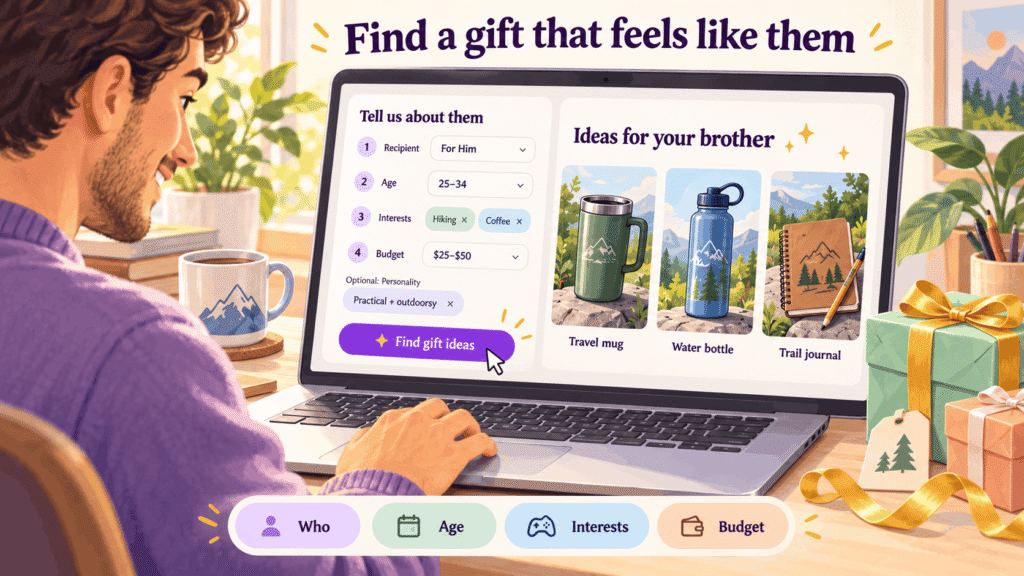
The form-based tools I have used follow nearly the same order, and filling it in that order saves backtracking:
- For Him, For Her, Either Gender or For Couples comes first, because every later filter hangs off that choice.
- Age range comes next; a toy that suits a five-year-old makes no sense for a pensioner, even with identical hobbies.
- Coffee, Hiking or Photography style interest tags come third, and they do most of the narrowing.
- Budget band comes last, followed by an occasion such as a Housewarming if the tool asks for one.
Some finders also let you describe the person’s character, and that box helped more than I expected. Typing “practical, outdoorsy, quiet” once moved a search away from novelty mugs toward Hunting and Woodworking kit that my brother-in-law still uses.
The chat-style AI gift finder works differently. You write a sentence about who you are shopping for, answer a couple of extra prompts, and the tool returns personalized gift ideas and AI-generated ideas in a list. While it thinks, one tool cycles through jokes about Santa’s elves, searching the galaxy, a gift search mission to Mars, studying gift trends from the future and unwrapping the mystery, which at least makes the wait feel shorter.
Who Are You Buying For, and Does Age Change the Ideas?
The person you are buying for is the first filter in any gift idea generator, and age changes the results because the same hobby leads to very different presents at 8, 18 and 80.
I have stopped treating that first choice as the whole story. Two people of the same age can share nothing, so I pair the person with one or two interest tags and a product type. The table below shows the profiles I fill in most often and the combinations that have worked for me.
| Profile I shop for | Interest tags to tick | Gift type to filter |
|---|---|---|
| The new parent | Parenting, House & Home | Baby, Homeware |
| The weekend griller | Barbeque, Carnivore, Beer | Cookware, Garden & Outdoor |
| The plant-based cook | Vegan, Vegetarian, Baking | Book, Handmade |
| The bedroom band | Guitar, Drums, Music Making | Musical, Tech |
| The armchair historian | History, Current Affairs, Reading | Educational, Collectibles |
| The endurance athlete | Trail Running, Triathlon, Cycling | Sports & Outdoors, Health |
| The animal-filled household | Cats, Dogs, Other Pets | Pets, Personalised |
| The home tinkerer | Smart Home, Computers & Software | Gadgets, Appliances |
Age bands in the better tools are surprisingly fine-grained. One UK finder splits each gender into eight stages, from newborn to elderly, and adds four stages for pairs, so a retired neighbour who loves Bird Watching and Conservation gets different ideas from a student who likes Nature and Animals.
When I am struggling to find a gift for someone at any age, I start with the four selections of person, age, hobby and price, then loosen one at a time until the list opens up. Calendar dates such as Father’s Day and Mother’s Day then decide the rest.
Which Hobbies and Interests Can You Pick From?
Most gift idea generators let you pick from a long menu of hobby tags, and one tool I tested lists more than 80 of them across entertainment, food and drink, home life, music, the outdoors, making things, sport and getaways.
That menu is what separates a useful finder from a generic one. Demographic filters alone give you thousands of ideas with no shape; a hobby tag cuts them down to a page you can actually read. Some tools also accept an optional character description of up to three traits, which adds personality on top of the hobby.
The same hobby still shifts with life stage and the event, and this is the pattern I fall back on when pairing them:
| Life stage | Occasions where hobby gifts land well | Spend band I usually pick |
|---|---|---|
| Baby boys and baby girls | Christening, Baby Shower | < 50 |
| Boy toddlers and girl toddlers | Easter | < 10 |
| Teenage boys and teenage girls | Back to School, Bar Mitzvah | < 100 |
| Young men and young women | Graduation, Congratulations | < 200 |
| Mature men and mature women | Retirement, Anniversary | < 500 |
| Old gentlemen and old ladies | Get Well Soon, Thank You | No Budget |
| Young couples | Wedding, Bridal Shower | < 1000 |
Older recipients are where hobby tags matter most to me. OAPs, OAP couples, mature couples and mature adults usually own the basics already, so a tag pulls the results away from slippers and toward something tied to what they still do every week. Shortcut pages such as Gifts for Golfers and Gifts for Cooks follow the same logic, starting from the hobby instead of the person.
Which Occasions Can a Gift Ideas Generator Plan For?
A gift ideas generator can plan for 26 occasion settings in the widest tool I tried, covering family milestones, seasonal holidays, work farewells, get-well and condolence moments, and presents given for no reason at all.
The occasion setting changes tone more than price. A condolence gift and a party gift can cost the same and still need opposite moods, which is why I set the occasion before I scroll. It also helps relieve the stress of mixed signals, because the tool stops offering novelty items when the moment is a sad one.
Seasonal events shift interests in a predictable way. Spring searches lean toward Gardening, summer toward Beach, Camping, Glamping, Road Trips and Overseas Travel, and winter toward Snowsports or a Luxury treat. Presents for babies and toddlers barely move with the season, which is one reason those age groups are the quickest to shop for. In December, the Christmas wheel adds a list of gifts under $25 next to festive activities and party games.
Group events change the rules again, and these are the three I plan around:
- Secret Santa: the price is fixed and the person is half-known, so I tick Snacks & Treats or Card Games and stop there.
- Group gifts: pooled money opens the higher price caps, so a team can afford a proper experience day.
- Wishlist events: when the person keeps a list, I skip the generator and buy from the list.
How Much Should You Spend, and Can You Filter by Budget?
You can filter most gift idea generators by price, with caps that run from under 10 to under 1,000 in your local currency, plus a setting that removes the limit entirely.
Most forms ask you to choose one price cap, and the cap matters less than people think, because the cheapest ideas are often the most remembered. One finder that has no products of its own ranges from a Mow their lawn voucher to a trip on the Orient Express, and it includes an ethical option to sponsor a goat for a family abroad. That spread taught me to look at the low end first. When a matching idea also turns up on price comparison sites or in high street shops, I check both before buying.
Low caps work well when the interest is narrow. These are low-cost pairings that have come back from my own searches:
| Interest tag | Low-cost idea | Gift type |
|---|---|---|
| Motor Sports | A car detailing kit | Automotive |
| Natural History & Geology | A rock and fossil starter set | Scientific |
| Board Games & Puzzles | A two-player strategy game | Toys & Games |
| Cocktails | A shaker printed with a pun | Joke |
| Graphic Design | A desk organiser and good pens | Office |
| Gym | A sweat-wicking training top | Clothing |
| Languages | A phrasebook with packing cubes | Travel |
| Movie Geek | A cinema membership | Experience |
| Superhero | An enamel pin set | Jewelry |
| Water Sports | Reef-safe sunscreen | Beauty |
Hobbies with expensive gear, such as Science, Space, Aviation or Farming, are where a low cap backfires. For a Birthday in one of those worlds, I either raise the cap or switch to a book, a museum ticket or a model kit. Price filters also help teens buying for parents, since pocket money sets a hard ceiling.
What Types of Gifts Does a Generator Suggest?
A gift idea generator usually sorts its suggestions into about 28 product types, from kitchen kit and wearable items to keepsakes, learning toys, outings and gag presents.
The type filter sits in a dropdown in the corner of the results page on most tools I have used, and I leave it on the broad mix setting until the list grows too long. Switching to one type early gives specific gift ideas but hides the surprises, and the surprises are usually why I opened the generator in the first place. Setting the overall budget first and the type second keeps the list manageable. For an office gift swap, the white elephant game generator sets the budget and the turn order.
Creative hobbies show the value of the type filter best. Someone into Painting & Drawing, Sculpture or Writing can receive a tool, a course or a framed print, and only the type filter separates those. The same goes for the Interior Design fan, the general Hobbyist, the DIY Enthusiast and the Retro / Old School collector, whose interests span several product types at once.
I use these tools to brainstorm present ideas rather than to order directly. Shortcut pages for women, men, boys and girls often sit beside the type list, and searches for kids and adults return different mixes even within one type. On a Valentine’s Day or Romantic search, I keep the type broad, since a Date night outing can beat any object. One UK site also keeps a gift ideas directory that steps through its lists one page at a time. Clicking an idea there opens a recommended website, and you can hover over the shop columns to see other places that sell it.
What Happens After You Click Find Gifts?
After you press Find Gifts, a gift idea generator shows a page of matching ideas, and clicking any idea sends you to a shop or website where you can buy it.
The number of results varies by tool. One random generator returns 1 to 12 gifts with each click, set through a Number of Gifts selector, and another offers a quantity setting that goes up to 99. In my experience, a dozen is the useful limit; past that I stop reading and start skimming.
The shops behind the ideas decide how fast you can act. AI finders claim to search 1,000s of brands, naming Target, Nike, Apple and lululemon among thousands more, so you can shop instantly from the result. Older list-style tools show a category drop-down and send you to a matching retailer for the item you pick.
Random results can be oddly specific, which is either useless or exactly right depending on the person. For Cooking fans, Restaurants lovers or Wine drinkers, I note the odd picks before searching for the perfect gift, because the odd one often wins. Searches for young adults throw up the most odd picks in my experience. Many tools also list a Christmas gift guide and return results in seconds.
How Do Wish Lists and Secret Santa Fit Into Gift Finding?
Wish lists and gift exchanges are the other half of gift finding: a generator suggests ideas when you know little about the person, while a shared list tells you exactly what they want.
I use the two together. A generator gives me a long shortlist, and I check it against whatever the person has saved before I commit. When the generator’s results are thin, I go back and refine the search with follow-up questions about how the person spends a typical weekend, then compare again.
Shared lists also change the etiquette of buying. The best lists I have used let people follow friends, see what others plan to give, and avoid duplicates for Christmas, Thanksgiving hosting or an Entertaining weekend. That matters most for couples who shop for the same relatives and end up buying the same item twice.
Music is the hobby where lists save me the most guessing. A Musician, a Music Lover or someone into Live Music & Festivals, Piano / Keyboard, Recording or Singing has gear opinions I cannot predict, so I check their list for the exact model. A finder points me to recommended retailers, but the list tells me which one to buy. A random finder once handed me a Filet Knife, a Lighted Vanity Mirror and a Cornhole Game in one click; a list would have told me which of those my cousin wanted.
Does It Cost Anything to Use a Gift Finder and Wish List?
A gift idea generator is usually free to use, and the wish-list and gift-exchange tools that sit beside it are free as well; you spend money only on the presents themselves.
One list service I tried charges nothing for creating lists, cash funds or a gift exchange where organisers draw names for up to 100 people, and it holds 4.8 out of 5 from more than 1,000 App Store ratings. Players can answer Mystery Q&A prompts so their giver gets hints, and a free account shows each person their Secret Santa match. For a No Occasion treat, I sometimes add a Running, Climbing or Cross-Fit item to my own list just to test how the reservation works.
Does the Person Buying the Gift Need an Account?
The person buying a gift usually does not need an account to view a shared list or claim an item on it.
On the list tools I have used, an item marked as reserved disappears for other givers, while the list owner chooses whether to reveal who claimed what. Reminders for birthdays and family groups need sign-up, but a friends and family visitor only needs basic details. Sending contributions through payment apps can carry the app’s own charges, even when the list itself would cost nothing. I tested this with a cousin’s list of American Football, Baseball and Football / Soccer kit, and the claim took less than a minute without signing up.
How Does Buying a Gift From a List Work?
Buying a gift from a list works by claiming the item on the list, then purchasing it on the store’s own website and marking it as bought.
The gift-giver enters a name and email, buys the item, and uses mark as purchased so nobody else buys it. The list service never touches the money, so you pay only for the gifts, and any fees come from the card or app you pay with. Some services also send thank-you cards and event invitations with RSVPs attached. I once bought a garden bench this way for a cousin’s Outdoor Living wish, and for a Religious milestone and a Sympathy gift the same steps applied, only the card changed.
Can You Add Gift Items From Any Website?
Yes, most wish-list tools let you add items from any website or any store, either by pasting a product link or by entering the details manually.
When you paste a link, the tool fills in product details such as the name and price if the shop provides them, and a browser extension gives one-tap saving while you browse. These universal lists work as a gift registry for big events, and you share one link instead of sending screenshots. Purchases still happen on the retailer’s site: the list service handles no payments, shipping or gift wrapping. A confirmation email follows each claim and includes an unreserve link in case plans change. As of 2026, that same link-based approach is what lets a generator’s suggestion end up on a real list.