What Is a Random Dinosaur Generator and How Does It Work?
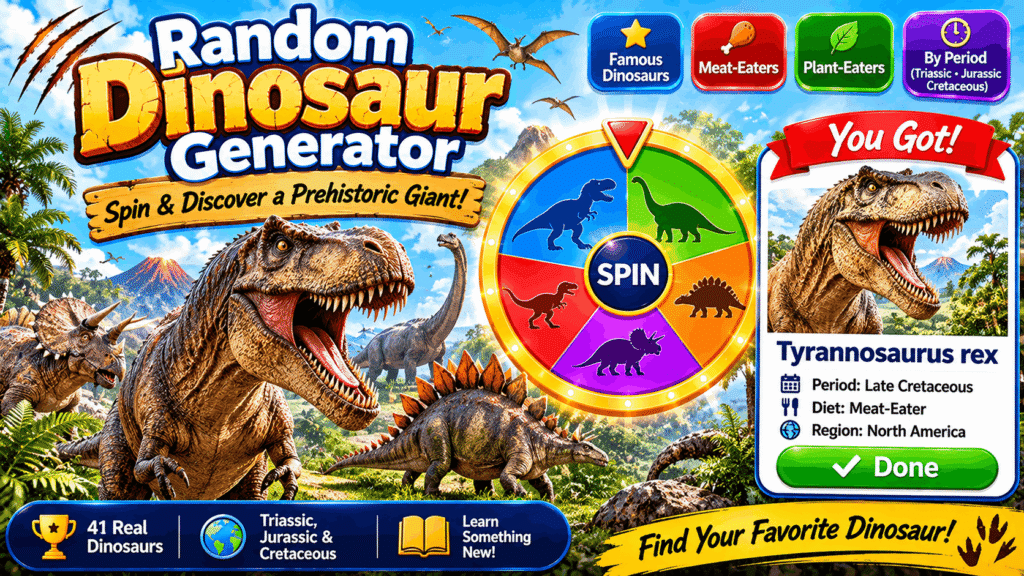
A random dinosaur generator picks a real dinosaur for you at random, along with its period, diet and the region where its fossils were found. Click Spin, and in seconds the pop-up shows a result such as Tyrannosaurus rex, Late Cretaceous, meat-eater, North America.
The wheel holds 41 real dinosaurs, from famous names like Triceratops and Stegosaurus to lesser-known ones like Therizinosaurus and Eoraptor. You can spin all of them or narrow the choice to famous dinosaurs, meat-eaters, plant-eaters, or one of the three periods of the Mesozoic: Triassic, Jurassic or Cretaceous.
It’s built for kids, teachers, artists, creative writers and gamers, and you might land on anything from Utahraptor to Giganotosaurus. Students use it to choose a dinosaur for class projects, artists use it for drawing prompts, and players use it to set a challenge in a park-building game. Every result is a prehistoric animal that really lived, so you learn something new with each spin.
The generator is free, needs no sign-up, and works on a phone or laptop. To spin your own list of anything else, start from the main spin the wheel page.
Why Use a Random Dinosaur Generator?
A random dinosaur generator is useful when you can’t decide which dinosaur to study, draw or write about. It also brings in surprise picks you’d never think of.
Most people know about ten dinosaurs. A spin pushes you past T. rex and Velociraptor toward animals like Kentrosaurus, Maiasaura or Suchomimus, which adds variety to a project and makes it stand out. It’s a simple way to learn something new each day: spin once in the morning and read about the result. Land on Carnotaurus or Dilophosaurus, an Early Jurassic hunter, and look up its claws, teeth and bite. With more than 750 species known, there’s always another to find.
It sparks discussion too. Families can spin at dinner and guess the dinosaur’s diet before reading the answer, and teachers can spin for a quick quiz question. Creative writers use it to pick a creature for a story, and gamers use it to decide what to build next.
Because every slice has an equal chance, your favorite doesn’t always win. That fairness makes it a good tiebreaker for kids arguing over which dinosaur is best. For a wheel that covers living animals instead, try the free random animal generator.
How Do You Spin for a Random Dinosaur?
You spin for a random dinosaur by choosing a list, pressing Spin or tapping the wheel, and reading the result in the pop-up.
- Tap a list button, such as All dinosaurs, Famous dinosaurs or Cretaceous.
- Click Spin, or tap the wheel on a phone.
- Read the pop-up, headed Your dinosaur. It shows the name, period, diet and fossil region.
- Spin again for the next player, the next drawing, or the next question.
- To add or remove dinosaurs, type in the entries box, one per line. The wheel redraws as you type.
The result appears in seconds, so it works well for fast games. If you’re spinning for a group, take turns and write each result down, or tick Remove winner so the same dinosaur can’t come up twice.
You can also add creatures that aren’t on the list, such as Pteranodon or Quetzalcoatlus for a flying round, or Mosasaurus and other marine reptiles for a sea round. Use Add entries, then Shuffle the slices. Just remember those aren’t dinosaurs, which makes a good quiz question of its own.
Which Dinosaurs Are on the Wheel?
The full list has 41 dinosaurs, grouped here by period.
| Period | Dinosaurs |
|---|---|
| Late Triassic | Coelophysis, Plateosaurus, Herrerasaurus, Eoraptor |
| Early and Middle Jurassic | Dilophosaurus, Megalosaurus |
| Late Jurassic | Stegosaurus, Brachiosaurus, Diplodocus, Apatosaurus, Brontosaurus, Allosaurus, Compsognathus, Archaeopteryx, Mamenchisaurus, Kentrosaurus |
| Early Cretaceous | Iguanodon, Deinonychus, Utahraptor, Baryonyx, Suchomimus, Microraptor |
| Cretaceous | Spinosaurus |
| Late Cretaceous | Tyrannosaurus rex, Triceratops, Velociraptor, Ankylosaurus, Parasaurolophus, Pachycephalosaurus, Giganotosaurus, Carnotaurus, Gallimimus, Oviraptor, Therizinosaurus, Argentinosaurus, Protoceratops, Styracosaurus, Edmontosaurus, Maiasaura, Corythosaurus, Albertosaurus |
The Late Cretaceous has the most names, 18 of the 41, because it’s the period with the richest fossil record of famous species. The Triassic list is small but important, since Eoraptor and Herrerasaurus are among the earliest dinosaurs known.
Brontosaurus and Apatosaurus both appear because many scientists now treat them as separate animals. Each result in the pop-up also shows the diet and region. Spinosaurus was the largest carnivore, Argentinosaurus reached 39.7 m, Megalosaurus was described by William Buckland in 1824, and Archaeopteryx shows that birds are theropods with feathers. Herrerasaurus and Eoraptor come from the Ischigualasto Formation in Argentina.
Which Lists Can You Spin?
The wheel has seven lists, so you can spin the whole set or focus on one group.
| List | Dinosaurs | Best for |
|---|---|---|
| All dinosaurs | 41 | Any game or project |
| Famous dinosaurs | 12 | Young kids and quick quizzes |
| Meat-eaters | 18 | Predator drawings and stories |
| Plant-eaters | 20 | Herbivore studies |
| Triassic | 4 | The earliest dinosaurs |
| Jurassic | 12 | Long necks, plates and early birds |
| Cretaceous | 25 | The last and most varied dinosaurs |
The Famous list holds Tyrannosaurus rex, Triceratops, Velociraptor, Stegosaurus, Brachiosaurus, Diplodocus, Spinosaurus, Ankylosaurus, Parasaurolophus, Pachycephalosaurus, Iguanodon and Allosaurus, the dinosaurs most children already know.
The Meat-eaters list includes fish-eaters like Baryonyx, so it counts 18 rather than 15. Work through the period lists in order to match your lessons.
The Triassic list covers 251.902 to 201.4 million years ago, the Jurassic 201.4 to 143.1, and the Cretaceous 143.1 to 66, the three parts of the Mesozoic, or middle life, which began about 252 million years ago. The Cretaceous list ends with the K-Pg extinction, when an asteroid struck. In class, use Full screen, and use Slice sizes as weights to favor famous names. For a Jurassic World Evolution park, spin the Jurassic list for each enclosure.
When Did Dinosaurs Live?
Dinosaurs lived during the Mesozoic, the “middle life” era, which ran from about 252 million to 66 million years ago. It splits into three periods.
| Period | Started | Ended |
|---|---|---|
| Triassic | 251.902 million years ago | 201.4 million years ago |
| Jurassic | 201.4 million years ago | 143.1 million years ago |
| Cretaceous | 143.1 million years ago | 66 million years ago |
The first dinosaurs appeared in the Late Triassic, about 20 million years after the Permian-Triassic extinction. The oldest solid fossils come from the Santa Maria Formation in Brazil, dated to 233.23 million years ago, and the Ischigualasto Formation in Argentina, home of Herrerasaurus. Nyasasaurus, from about 243 million years ago, may be older, but its bones are too few to be sure.
During the Mesozoic, the supercontinent Pangaea split into Laurasia in the north and Gondwana in the south. That’s why the wheel shows such a wide variety of regions. Dinosaurs became dominant after the Triassic–Jurassic extinction, about 201.3 million years ago, through the Early Jurassic, Middle Jurassic and Late Jurassic, and ruled until the end of the Early Cretaceous and Late Cretaceous.
What Did Dinosaurs Eat?
Dinosaurs ate plants, meat, fish or a mix, and the wheel shows each one’s diet in the pop-up. On the full list there are 20 plant-eaters, 15 meat-eaters, 3 fish and meat-eaters and 3 omnivores.
A herbivore like Triceratops used a sharp beak to snip tough plants, and long-necked sauropods like Brachiosaurus stripped leaves from tall trees. A carnivore like Tyrannosaurus rex had huge teeth and one of the strongest bites of any land animal. Duck-billed Edmontosaurus and Corythosaurus, hunted by Albertosaurus, chewed with hundreds of teeth.
Fish-eaters such as Spinosaurus, which grew 12.6–18 m long, Baryonyx and Suchomimus had narrow snouts like a crocodile’s. Omnivores like Gallimimus and Oviraptor ate plants, insects and small animals. Saurischia, the lizard-hipped group, held meat-eating theropods and plant-eating sauropods, while Ornithischia ate plants, often with horns or armor.
Size shaped diet. Most dinosaurs weighed 1–10 metric tons, and Shantungosaurus, a 16.6 m plant-eater, needed huge meals, while Microceratus and Wannanosaurus were only about 60 cm long. Therizinosaurus had enormous claws, yet it used them to pull down branches.
Where Have Dinosaur Fossils Been Found?
Dinosaur fossils have been found on every continent, including Antarctica. On the wheel, most results come from North America, but you’ll also land on Mongolia, Europe, South America, China, Africa and more.
| Region | Dinosaurs on the wheel |
|---|---|
| North America | 20 |
| Mongolia | 5 |
| Europe | 5 |
| South America | 5 |
| China | 2 |
| Africa, North Africa and Tanzania | 3 |
| England | 1 |
North America leads because of rich fossil beds in places like Montana, Alberta and Utah. Mongolia’s Gobi Desert gave us Velociraptor, Protoceratops and Oviraptor. Kentrosaurus comes from Tanzania, Spinosaurus from North Africa, and Megalosaurus from England. Mamenchisaurus comes from China, while Coelophysis and Plateosaurus are Triassic finds from North America and Europe. Because Pangaea split into Laurasia and Gondwana, related dinosaurs turn up on distant continents.
The earliest dinosaurs come from Argentina, Brazil and Zimbabwe. In the United States, the first dinosaur found was Hadrosaurus, discovered in 1858 by William Parker Foulke in New Jersey. To explore a country next, the random country generator picks one at random.
Which Was the Biggest Dinosaur?
The biggest dinosaurs were sauropods, the long necks, and Argentinosaurus, on the wheel, is one of the largest, at about 39.7 m long.
| Dinosaur | Size |
|---|---|
| Argentinosaurus | About 39.7 m long |
| Patagotitan | Mounted skeleton 37 m long |
| Diplodocus | About 27 m long |
| Sauroposeidon | Up to 18 m tall |
| Spinosaurus | 12.6–18 m long, the largest carnivore |
| Shantungosaurus | 16.6 m, the largest bird-hipped dinosaur |
Other giants include Giraffatitan, about 12 m tall, Maraapunisaurus, which may have reached 40 m, and Bruhathkayosaurus, with recent estimates up to 44 m. These figures are rough, because many giants are known only from a few bones.
Most dinosaurs were much smaller. The most common body mass was 1–10 metric tons, about the size of a large car to an elephant. Spin the Plant-eaters list to find the giants, since nearly all the biggest dinosaurs ate plants. Giants make great trivia, and they’re a favorite subject for paleoart, 3D models and pixel art concept pieces.
Which Was the Smallest Dinosaur?
The smallest dinosaur alive today is the bee hummingbird, about 5 cm long and 1.8 g, because birds are dinosaurs. Among non-bird dinosaurs, one of the smallest was Anchiornis huxleyi, about 34 cm long and 110 g.
The smallest plant-eaters, Microceratus and Wannanosaurus, were only about 60 cm long. On the wheel, small results include Compsognathus, about the size of a chicken, and Microraptor, a four-winged hunter from China.
Small dinosaurs make a fun contrast with giants. Spin twice, compare the results and start a discussion: a Compsognathus next to an Argentinosaurus shows how varied dinosaurs were. In the Mesozoic, most mammals were no bigger than a domestic cat, so even small dinosaurs ruled their world.
For a quick size game, spin, then ask players to guess whether the result was smaller than a person, the size of a car, or bigger than a bus. The answers are often surprising, and the game suits any reading level. Small dinosaurs also make cute cartoon or sticker characters.
Who Named the First Dinosaurs?
Richard Owen coined the word dinosaur in 1842, from the Greek deinos, meaning terrible, and sauros, meaning lizard, so the name means terrible lizard. He based it on three animals: Megalosaurus, Iguanodon and Hylaeosaurus.
Megalosaurus was the first non-bird dinosaur described in a scientific journal, by William Buckland in 1824. Iguanodon followed, published by Gideon Mantell in 1825, though the first teeth may have been found by Mary Ann Mantell in 1822. Both Megalosaurus and Iguanodon are on the wheel. The first American dinosaur, Hadrosaurus, was found in 1858 by William Parker Foulke in New Jersey.
In America, the Bone Wars between Edward Drinker Cope and Othniel Marsh lasted more than 30 years and ended in 1897. Marsh named 86 species and Cope named 56, a total of 142. Many famous names, such as Stegosaurus and Triceratops, came from that rivalry.
In 1969 John Ostrom described Deinonychus, a fast, bird-like hunter that changed how scientists saw dinosaurs. It started the dinosaur renaissance, when dinosaurs went from slow, cold-blooded lizards to active animals.
Are Birds Really Dinosaurs?
Yes, birds are dinosaurs. They are the only surviving dinosaur lineage, and they evolved from small theropods in the Late Jurassic.
Dinosaurs split into two main groups. Saurischia, the lizard-hipped dinosaurs, includes theropods like Tyrannosaurus rex and sauropods like Diplodocus. Ornithischia, the bird-hipped dinosaurs, includes Triceratops and Stegosaurus. Oddly, birds come from the lizard-hipped branch, through the theropod groups Coelurosauria and Maniraptora.
Archaeopteryx, on the wheel, is the famous early bird, with feathers, teeth and a long bony tail. Microraptor had feathered wings on its arms and legs. Many theropods, including Velociraptor, had feathers too, which is why modern drawings look so different from older ones.
Today there are more than 11,000 species of birds. The bee hummingbird, at 5 cm and 1.8 g, is the smallest living dinosaur, and the feathered Anchiornis huxleyi was just 34 cm and 110 g. Only birds survived the Cretaceous–Paleogene extinction that ended the non-avian dinosaurs. John Ostrom’s 1969 study of Deinonychus sparked the dinosaur renaissance, and family-tree games like DinoTree show how birds connect to them. Like birds, some dinosaurs had a sharp beak, and omnivores ate almost anything, even fish.
Is a Pterodactyl a Dinosaur?
No. A pterodactyl, or pterosaur, lived in the same era as dinosaurs, but it wasn’t a dinosaur. Pteranodon and Quetzalcoatlus were flying reptiles, and plesiosaurs and Mosasaurus were marine reptiles.
That’s why this wheel leaves them out. Some other wheels mix in animals that aren’t dinosaurs at all, such as Megalodon, a shark, Dimetrodon, which lived before dinosaurs, and Smilodon, a saber-toothed cat that lived long after them. Some also include fictional creatures like Indominus rex from the movies.
Every slice here is a real, named dinosaur. If you want a mixed prehistoric round, add pterosaurs or sea reptiles in the entries box, then ask players which ones are true dinosaurs.
It’s one of the most common mix-ups, so it’s a good quiz question, and the movies in the Jurassic Park franchise blurred the line further. Pterosaurs and many marine reptiles died out with the dinosaurs after the asteroid strike. Dinosaurs walked on land with their legs held straight under their bodies, while pterosaurs flew and marine reptiles swam.
What Wiped Out the Dinosaurs?
An asteroid wiped out the non-avian dinosaurs about 66 million years ago, in the K-Pg extinction, also called the Cretaceous–Paleogene extinction. Birds survived, which is why dinosaurs still live today.
The asteroid hit near the Yucatán Peninsula in Mexico, leaving the Chicxulub crater. The impact threw dust and gas into the sky, blocked sunlight and collapsed food chains. At the same time, volcanism in the Deccan Traps in India released gases that poisoned the atmosphere and added to the damage.
It wasn’t the first mass extinction in dinosaur history. The Triassic–Jurassic extinction, about 201.3 million years ago, cleared away many rivals and let dinosaurs take over. The earlier Permian-Triassic extinction set the stage for them to appear at all.
Every Late Cretaceous result on the wheel, from Tyrannosaurus rex to Triceratops, lived close to the end. Spin the Cretaceous list and you’re spinning the last 25 dinosaurs before the asteroid. The avian survivors, birds, are the only surviving dinosaurs, now more than 11,000 species, and mammals no bigger than a domestic cat grew into the giants that came next.
How Many Dinosaurs Have Been Discovered?
Scientists have identified more than 900 genera of non-bird dinosaurs as of 2018, and 1,124 species were recorded by 2016. Some sites round this to more than 750 species, and new ones are named every year.
Estimates suggest about 1,850 dinosaur genera are preserved as fossils, with nearly 75% still undiscovered. The total that ever lived may be around 3,400 genera, and one 2016 estimate put Mesozoic species at 1,543–2,468.
The pace is fast. By 2008, up to 30 new species were being named each year, and sauropodomorphs alone averaged 9.3 new species a year from 2009 to 2020. A 41-dinosaur wheel only scratches the surface. The Bone Wars alone added 142 species by 1897, 86 named by Marsh and 56 by Cope. The oldest finds come from the Santa Maria Formation, 233.23 million years old, and Nyasasaurus, about 243 million years old, may be older still. New giants keep appearing, like Patagotitan, mounted at 37 m. For more inspiration, browse all our idea generators.
When you read about a new discovery, type its name into the entries box and spin it alongside the classics. For more surprising science, the random fact generator gives a new fact with every click.
How Can Teachers and Kids Use It?
Teachers and kids use the wheel to choose a dinosaur for class projects, reports, quizzes and lessons. Every student gets a different animal.
For research, give each student a spin and ask them to find the dinosaur’s period, diet, size and fossil region. The pop-up gives a head start, and a museum website or a library book fills in the rest. Younger readers can start with the Famous dinosaurs list, while older students can take the full list.
For trivia, spin and ask a question about the result, such as “Was it a plant-eater?” or “Which period did it live in?” The period lists match textbook chapters, so you can run a quiz at the end of each topic.
Have students mark each result on a world map: North America, Mongolia, Europe, South America, North Africa, Tanzania or England, and find the Chicxulub crater on the Yucatán Peninsula. A spin each day keeps the topic fresh, and Remove winner works as an elimination draw. In the classroom, project the wheel and let students take turns spinning. For an alphabet game, spin the random letter generator first and challenge students to name a dinosaur starting with that letter.
How Do Artists and Writers Use It?
Artists and writers use the wheel for drawing prompts, character ideas and story starters.
For drawing practice, spin and sketch the result in different styles: realistic paleoart, a cute cartoon, a 3D model, pixel art or a sticker design. Focus on one feature, such as the horns of Styracosaurus, the snout of Baryonyx, the wings of Microraptor or the head crest of Parasaurolophus.
Writers can spin a dinosaur as the creature in a story, then spin again for a rival. Fantasy worldbuilding works too: use a real dinosaur as the base for a new creature concept, then give it a name with the dragon name generator.
For a full writing session, pair the wheel with the random writing prompt generator. Spin a prompt, spin a dinosaur, and combine them into one scene.
With nearly 75% of an estimated 1,850 genera still undiscovered, out of perhaps 3,400 that ever lived, you can invent a believable new creature. Draw Coelurosauria and Maniraptora such as Velociraptor with feathers. Early art got things wrong: Gideon Mantell’s 1825 Iguanodon, from teeth Mary Ann Mantell may have found in 1822, looked like a giant iguana beside Hylaeosaurus.
How Do Gamers Use a Random Dinosaur Wheel?
Gamers use the wheel to set challenges in dinosaur games, especially park-building games like Jurassic World Evolution. Spin to decide which species to add next, and build your park around the result.
Popular sandbox challenges include only adding dinosaurs the wheel picks, building one enclosure per period, or running a park with only plant-eaters. Players of the latest entry in the series use the same idea for new species, and fans of the Jurassic Park franchise use it to plan movie-themed parks.
The wheel also works for other games. Spin a dinosaur to play as in a survival game, pick a team mascot, or set the theme for a board game night. Some fans pair it with dinosaur family-tree games like DinoTree to learn how species are related. Big sauropods like Diplodocus, at 27 m, need the largest enclosures, and Sauroposeidon, up to 18 m tall, would tower over the fences. Park games also feature pterosaurs, plesiosaurs and fictional hybrids like Indominus rex, which is fun for worldbuilding and drawing practice.
For creature-collecting fans, the random Pokémon generator works the same way. Streamers can show the wheel on screen with the OBS wheel, so viewers see each pick.
Which Wheel Settings Should You Use?
The settings that matter most are Add entries, Remove winner and Slice sizes, because they decide which dinosaurs can land and how often.
| Setting | What it does | When to use it |
|---|---|---|
| Add entries | Type your own dinosaurs | Adding new discoveries or favorites |
| Remove winner | Takes the result off the wheel | Class projects with no repeats |
| Shuffle | Mixes the order of the slices | After adding many names |
| Slice sizes | Makes one slice bigger than another | Giving weights to famous dinosaurs |
| Full screen | Fills the screen with the wheel | Classrooms and streams |
Remove winner works like an elimination mode, so every student gets a different dinosaur. Other tools let you generate 5, 10 or 15 at once, Show All, Download a list or keep a history. Here, you spin one at a time and note the results as you go.
For a sandbox park game, spin before each build and switch between the seven lists for a surprise. For a party with dinosaur games, see our party games list.
Are These Real Dinosaurs?
Yes. Every dinosaur on the wheel is a real, scientifically named animal known from fossils. None of them are invented, and the list leaves out flying reptiles, sea reptiles and movie monsters.
The period, diet and region in each pop-up are standard facts, but sizes and dates in books are rough estimates, because most dinosaurs are known from partial skeletons and sources vary. Names change too: Brontosaurus was once lumped in with Apatosaurus, and it’s now treated as its own animal again.
There’s no pterodactyl, Megalodon, Dimetrodon or Smilodon here, even though some lived in the same era or close to it. Sizes for giants like Maraapunisaurus, maybe 40 m, and Bruhathkayosaurus, up to 44 m, rest on very few bones, and Giraffatitan was once filed under Brachiosaurus. Scientists still debate how much volcanism in the Deccan Traps added to the extinction.
If you’re writing school reports and doing research, check a library book too, or verify the details in a museum guide or the dinosaur article on Wikipedia. Each spin is fair, and you can see how the spins are checked on the randomness audit page.
Is the Random Dinosaur Generator Free?
Yes, it’s completely free. There’s no sign-up, no account and no download, and it works in any browser on a phone, tablet or laptop. Pick a list, tap Spin, and read the pop-up headed Your dinosaur. Add names one per line, and the wheel redraws instantly.
Every name is scientifically named, but sizes are rough estimates from partial skeletons and sources vary, so verify details for school work. Over 900 genera were known by 2018 and 1,124 species by 2016, found on every continent, even Antarctica, with the oldest from Argentina, Brazil and Zimbabwe. Other tools list 5, 10 or 15 at once or Show All; here you spin one at a time, which helps when you can’t decide.
The word itself comes from Richard Owen, who in 1842 joined the Greek deinos and sauros into terrible lizard. The count keeps climbing: by 2008 up to 30 new species were named a year, sauropodomorphs averaged 9.3 a year, and one 2016 estimate puts Mesozoic species at 1,543–2,468.