What Does a Random Zodiac Sign Generator Do?
A random zodiac sign generator randomly picks one of the 12 zodiac signs, or one of 13 signs when Ophiuchus is switched on, and hands you that sign with its classic traits without ever looking at anyone’s birth date.
That last detail matters more than it looks. People spin, land on Scorpio, and announce it as if the tool had read their chart. It hadn’t. The result is a game piece and never your real sign, and treating it that way is exactly what makes the tool useful instead of confusing.
I first leaned on a zodiac wheel to settle who reads first in a writing circle, and it stayed in my kit because nobody can accuse a sign of playing favourites. The same pick seeds icebreakers, creative prompts, and story planning, since a group gets one neutral answer to react to rather than an argument about whose idea wins.
Behind the animation, the better tools draw numbers from the browser’s own randomness, so you get unpredictable results instead of a list that quietly loops. Most of them can also be fully customized, which starts to matter once you layer your own house rules on top of the twelve signs.
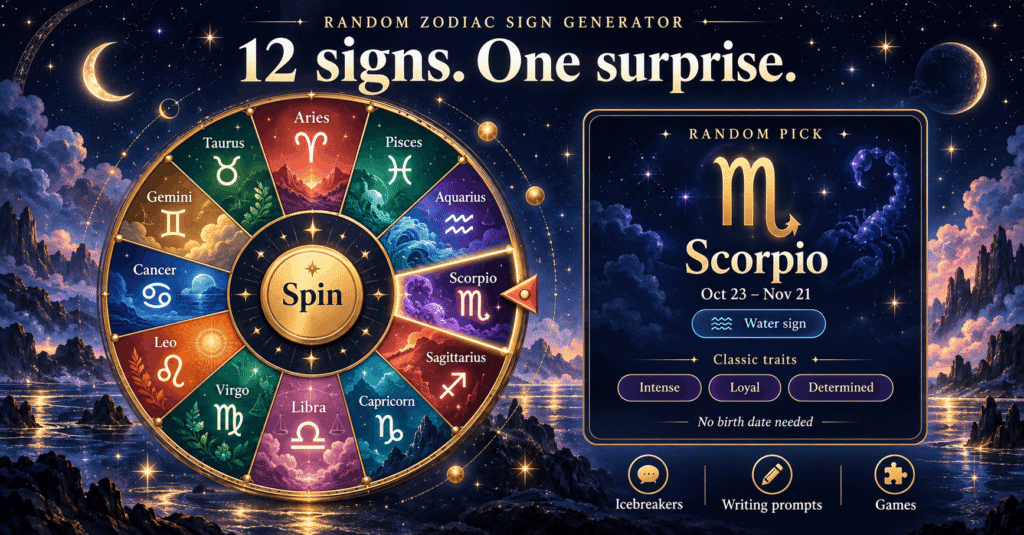
How Are the Zodiac Signs Laid Out on the Wheel?
A standard zodiac wheel is laid out as 12 slices in calendar order, opening with the spring sign of late March and closing with the late-winter sign of mid-March, and each slice carries one sign’s dates and element.
| Sign | Date range | Element |
|---|---|---|
| Aries | Mar 21 – Apr 19 | Fire |
| Taurus | Apr 20 – May 20 | Earth |
| Gemini | May 21 – Jun 20 | Air |
| Cancer | Jun 21 – Jul 22 | Water |
| Leo | Jul 23 – Aug 22 | Fire |
| Virgo | Aug 23 – Sep 22 | Earth |
| Libra | Sep 23 – Oct 22 | Air |
| Scorpio | Oct 23 – Nov 21 | Water |
| Sagittarius | Nov 22 – Dec 21 | Fire |
| Capricorn | Dec 22 – Jan 19 | Earth |
| Aquarius | Jan 20 – Feb 18 | Air |
| Pisces | Feb 19 – Mar 20 | Water |
Those ranges are the sun sign windows a newspaper horoscope works from, and a cusp birthday can slide a day either way depending on the year. The wheel itself ignores all of that. It only needs to know which twelve astrological star signs sit on the rim and in what sequence.
The sequence is not decoration. Elements cycle fire, earth, air, and water around the ring, so neighbouring slices never share one, which is how the traditional zodiac was built and why an accurate wheel keeps that rotation intact. When I want contrast between two spins, that alternation does the work for me.
How Do You Use a Random Zodiac Sign Generator?
Using a zodiac sign generator takes one spin: you start the wheel, wait a few seconds for it to slow down, and read the sign that stops under the pointer.
- Configuration first: check whether the rim holds twelve entries or thirteen, because that changes every sign’s odds.
- Winner next: start the spin and let it stop on its own; the highlighted slice is your result, usually shown with its slot in the year and its typical traits.
- Sun, Moon, and Rising for characters: spin twice more during character creation, so one figure ends up with a full three-sign profile.
- Proper formatting last: copy the sign into your notes or spreadsheet exactly as displayed, since data-style generators label each output cleanly.
The three-spin trick in step 3 is the one I reach for most. A single sign gives a stock personality, while a mismatched trio, say a fiery Sun under a watery Moon, produces dynamic characters who argue with themselves on the page.
Generators built for astrology applications and personality quizzes often hand back a batch in one go, which beats clicking twelve times. Some wheel tools also let you run 6 wheels at once, the quickest way I know to roll two signs for a pairing or an entire cast in a single pass.
What Can You Do With a Randomly Picked Zodiac Sign?
A randomly picked zodiac sign works best as a constraint, because it gives party games, writing prompts, and classroom activities one fixed starting point that everyone has to work with.
Classrooms get the most mileage from this in my experience. Hand each of your students a sign and ask for a paragraph written in that sign’s voice, and even reluctant writers have something to push against. The same move warms up teammates at a Monday stand-up, where a sign sets the tone of a two-minute opener.
Family threads and fan communities suit a softer version. A lucky sign of the week, or a sign crowned luckiest this month, gives zodiac fans an easy opener for astrology conversations that don’t require anyone to know their full chart or their rising sign.
Pairing is where it gets lively. Spin twice, then run quick compatibility tests on the result: does a Taurus and Aquarius couple hold up over a weekend trip? I prefer this to reading a static compatibility match chart, because a random pairing forces people to reason it out. Then apply the result to a scene, a costume, or the next round of the game.
How Can You Customize a Zodiac Sign Wheel?
A zodiac sign wheel is adjusted by editing its entry list, where you can remove signs, rename them, change their order, and set odds so certain signs land more often than others.
- Default signs first: load the stock list so you are trimming rather than typing thirteen names by hand.
- Wheel entries next: delete, relabel, or drag rows until the rim matches the game you are running.
- Weights after that: raise or lower the number beside an entry to change how wide its slice becomes.
- Custom spin wheels at the end: save the edited version as its own wheel so next week’s session starts ready.
I keep two saved versions. One holds all twelve signs for anything astrology-flavoured, and the other is stripped to four slices for quick decisions, like which element a craft table works with. When I truly can’t decide between story directions, I relabel slices with the options themselves and keep the zodiac colours.
Event hosts use the same editor for giveaways, swapping each sign label for a prize tier while keeping the starry look. Any decent free online wheel maker handles that in under a minute, though I’d always test the edited wheel on a phone before an event goes live.
Is a Zodiac Spin Wheel Actually Fair?
A zodiac spin wheel is fair when every sign gets an equal slice and the stopping point comes from a proper random source, which in modern tools means the browser’s cryptographic generator rather than a hidden list.
That generator only runs if JavaScript is enabled. With scripts blocked, you can press the Spin button all day and nothing moves, which is the first thing I check when someone tells me a wheel is “broken.” Because the number is drawn on your own device, there is no remote machine deciding outcomes.
Fairness has a second half that people forget: the wheel’s shape. A sign with a wider slice will show up more, so an edited sign can be likely to win without a single line of code being bent. Before I publish a shareable link for a prize draw, I count the slices and confirm they match.
For pure entertainment none of this matters much, and a slightly uneven wheel is fine. For anything with stakes, such as a raffle or the personality testing applications a developer might be seeding with sample data, an even, untouched wheel is the right tool for the job.
Does a Random Zodiac Sign Generator Tell You Your Real Sign?
No, a zodiac sign generator cannot tell you which sign you were born under, because it chooses from the wheel by chance and never asks when you were born.
Your own sign comes from the calendar, and the date table above gives the windows. A full chart would also need birth time and place, which no wheel collects or even asks about.
I mention this because the mystical styling some wheels wear, starry backgrounds and magical chimes, makes people half-believe the result. Spinning invites you to look to the stars for fun, not for a reading. Most astrology chats I’ve joined treat a spun sign as a role for the evening, kept apart from anyone’s actual chart.
At parties I assign each guest a spun sign and ask them to improvise as that sign for one round. Nobody takes it personally, precisely because everyone knows the wheel had no idea who they were.
Which Zodiac Signs Are Fire Signs?
Aries, Leo, and Sagittarius are the three signs of the fire element, spaced evenly around the zodiac wheel at four-slice intervals.
Astrologers describe that trio as energetic and direct. In practice, a fire result tends to hand a story a bold character vibe, or give a party round a loud fun trait to act out. I use fire spins to set the pace for team activities, since a Leo pick usually means someone has to perform.
Because the trio sits four slices apart, a zodiac-themed game can isolate it easily. Delete the other nine entries, keep those three, and you have a mini wheel for quick challenges like “talk like a Sagittarius for one minute” or “plan a party the way a Leo would.” The same filter works for earth, air, or water nights.
What Signs Are Included on a Zodiac Wheel?
A standard zodiac wheel includes the twelve tropical signs from the ram to the fish, and some versions add Ophiuchus, the serpent-bearer, as a thirteenth entry.
Twelve is the count newspaper columns use, so it is the safe default for most games. Thirteen only makes sense when the group already knows the serpent-bearer constellation, or when the whole point is a talking piece about astronomy versus astrology.
For a guessing game, the full set matters: one player reads out traits while describing traits without naming the sign, and the rest try to identify it. If entries are missing, players chase answers that can’t come up. The three fire signs, for example, are easy to confuse, which is half the fun. For another fun trait game, the Hogwarts house wheel sorts you into Gryffindor, Hufflepuff, Ravenclaw or Slytherin.
A trimmed set suits group choices, such as a sign of the day that decides the music for study-session playlists. Data-style generators with a Number of results field can even return all twelve in one shuffled batch, which I’ve used to seat dinner guests.
Can You Take Ophiuchus Off the Wheel or Change the Sign Order?
Yes, Ophiuchus can be deleted from a zodiac wheel, and the remaining signs can be dragged into any order you like.
Taking the thirteenth sign off is the first edit I make for most groups, since few people know where its dates fall (roughly late November to mid-December). Most editors let you reorder items by dragging, so signs can line up by element or by calendar.
That level of customization helps when a wheel is tailored to a lesson. A science class comparing constellations may want Ophiuchus kept, while a horoscope-themed party usually doesn’t. If the wheel is picking an outfit theme or a story twist, a thirteenth option simply adds variety, so I leave it in.
Whatever you change, save the edited version straight away. I’ve lost a carefully sorted wheel to a closed tab more than once, and rebuilding it during a live session is no fun.
Can You Make Some Zodiac Signs Come Up More Often?
Yes, a zodiac wheel can favour some signs by giving them a larger share of the rim, which raises their probability on every spin.
The draw itself stays honest. A wheel powered by the browser-native crypto.getRandomValues() function has no server-side rigging, so the only bias is the one you add on purpose. That is why a wheel can be 100% fair at the code level and still lopsided on screen.
Tilting the odds helps in a classroom when quieter signs keep getting skipped, or in a party round where one sign triggers a forfeit. Tell your friends before the first spin so everyone plays on the same setup. Nothing sours a game faster than discovering hidden odds halfway through.
How Do You Share a Custom Zodiac Wheel With Other People?
Sharing a custom zodiac wheel takes a single link, because the tool packs your edited list, odds, and settings into a web address that anyone can open.
I paste that address into a class page or an event invite, and everyone who opens it sees the exact slices I built, including removed signs or adjusted odds. Nothing needs rebuilding on their end, and they can spin again as often as they like without touching my original.
One caution from experience: on some tools, editing after sharing leaves older links showing the earlier version, so finish your edits first. For a stream or a group chat, one link keeps everyone on the identical wheel, which stops any debate over whether someone’s copy was different.
What Is Elimination Mode For on a Zodiac Wheel?
Elimination mode is for running through the zodiac without repeats, because each sign that gets picked is taken off the wheel automatically until every slice has had its turn.
The setting exists to prevent repeats, and the use is wider than it sounds. Pick signs at random for a class of twelve and normal spinning will hand out Gemini twice while Virgo never shows. With the winner removed after each spin, the wheel keeps going until all signs are used, then resets.
I rely on it to work out a full rotation, one sign per week across a season, and to reveal a cast one character at a time. Before a session I share the URL of the prepared wheel, since the setup travels with the link, and I send it early so nobody joins with the wrong version.