What to Eat Wheel: How Do You Let a Spin Decide What’s for Dinner?
A what to eat wheel is a spinning picker you fill with meals, cuisines, or restaurants you would genuinely accept; you spin once and eat whatever it lands on instead of arguing about it. That is the whole trick, and after years of using one for weeknight standoffs, I’d say the spin matters less than the promise everyone makes before it.
Food choices pile up faster than most people notice. One figure that gets quoted constantly, credited to studies on eating behavior, puts it at about 200 food decisions per day, and the evening meal is where that load tends to snap. A food wheel spinner doesn’t make anyone wiser about food; it simply takes the final vote off the table.
What follows is a working tour: the modes worth setting up, the ground rules that stop a group argument from restarting after the result, and the small settings that turn a novelty into a weekly habit. Whether the question is what to cook or where to eat, the logic holds: agree on the options first, then let chance pick.
How Do I Use a What to Eat Wheel?
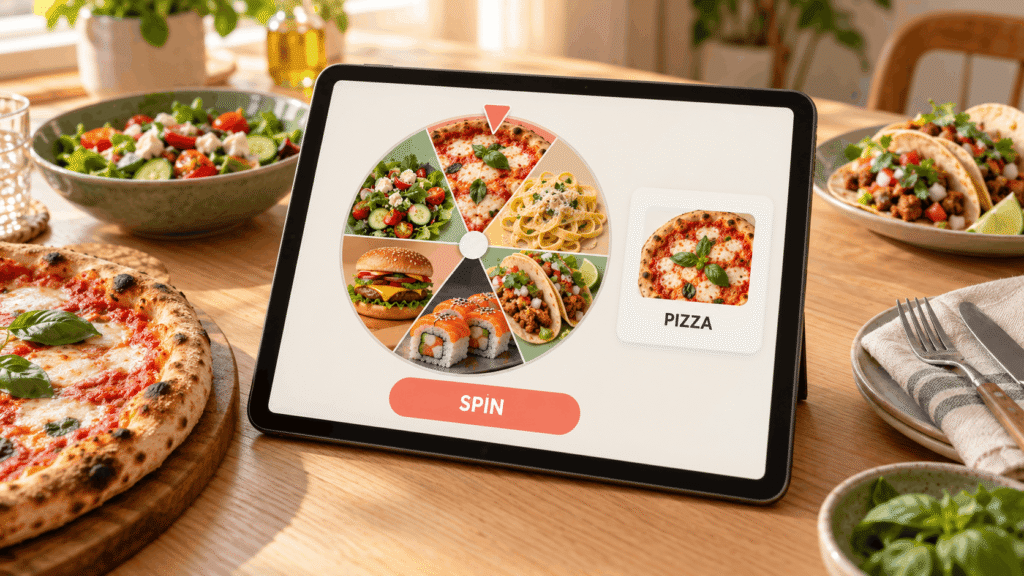
Using a what to eat wheel takes four moves: load a starting list, trim it, spin, and accept the winner. The decision wheel is only as good as what goes on it, so most of the real work happens before the first tap.
- Types of dinner options: start from a preloaded set; the larger collections hold around 40 popular meals, split into dinner ideas, lunch ideas, and breakfast ideas.
- One per slice: type each meal or place on its own slice and delete anything nobody wants tonight.
- Open, affordable options: cut the list down to places serving right now that fit the budget.
- Burden of choosing: tap spin, let the pointer settle, and accept the result; the wheel carries that weight now, not you.
A starter wheel with 12 slices is my sweet spot. It feels random enough to be fun, yet small enough that every slice is something I’d order. Before spinning, I run a ten-second check that everything left is all open and in budget, and that one habit removes most re-spins.
Plenty of people call this a what’s for dinner wheel, and the name fits. Still, the method works the same for lunch, late snacks, or a weekend brunch.
What Food Decision Wheel Modes Can I Try?
Four food wheel modes cover nearly every mealtime standoff: a cuisine-only spin, a takeout spin between named places, a healthy-versus-treat mix, and an everything-goes spin for nights with zero ideas. If you’d rather eat out, the restaurant picker wheel spins a type of restaurant or a chain.
Each mode answers a different question, and blending them is the most common mistake I see. A cuisine spin chooses between Sushi, Thai, or Indian; a takeout spin settles whose choice wins among specific places. Putting both kinds on one board creates slices that can’t be compared fairly.
Settings matter as much as slices. Weighted Choice lets one slice claim more of the circle, which has the same effect as adding an option twice by hand. Elimination Mode knocks out each winner so the next round works with what’s left, useful when a group wants to narrow things down rather than land on one answer immediately.
Share Links pass an exact setup along to housemates, and results come from the browser’s secure random generator, not anything a person could nudge. My own household leans on the everything-goes spin about once a week, and it keeps landing on dishes I was curious about but never ordered, like a Seafood night nobody would have suggested. That’s the cheapest way I know to get beyond your usual choices without a debate.
How Do I Go From a Cuisine to an Exact Restaurant in Two Spins?
Going from a cuisine to an exact restaurant works best as two separate spins: the first picks the style of food, and the second picks the place that serves it.
The reason is practical. A wheel that mixes pizza vs. sushi with named chains is asking it to compare categories with storefronts. Keeping each round at the same level means the first wheel only weighs styles like Italian vs. Mexican or Thai vs. Chinese, while the second only weighs places.
Once round one lands, I clear its slices and type in the nearby places for that style. This is the pairing I keep saved, built from entries that show up again and again on community-made wheels:
| First-spin result | Second-spin slices |
|---|---|
| Mexican | Chipotle, Taco Bell, La Tolteca |
| Pizza | Pizza Hut, Little Caesars, Any Pizza Place, Ponzetti’s, Bertucci’s |
| Burger | McDonald’s, Wendy’s, Burger King, In-N-Out |
| Subs | Subway, Jimmy John’s, Wawa Hoagies |
| Italian | Olive Garden |
| Chinese | Any Chinese Place, Panda Express |
| BBQ | Mission BBQ |
| Wings and chicken | Buffalo Wild Wings, Royal Farms Chicken, KFC, Chick-fil-A |
| Breakfast and coffee | Waffle House, Dunkin’ Donuts, Krispy Kreme, Starbucks, Donuts |
| Wildcards | LUCKY Anything, Costco, Grocery Store Food, Food From Your House, Gas Station Snacks |
Every row stays at one level on purpose: each slice is a place you could walk into tonight. The wildcard row is my favorite part, because a grocery run or a gas station stop is a legitimate dinner on a tired Tuesday, and putting it on the wheel makes it a fair outcome instead of a defeat.
What Can I Add to Customize My Food Wheel?
Anything you would honestly order or cook belongs on a food wheel, and customizing it mostly means trimming the list to what fits tonight rather than adding everything you can think of.
Since you control the entries, my first edit on any template is to replace the list with places and home meals we actually rotate through. A short wheel of real choices beats a big wheel of wishful ones every time; a slice for somewhere across town is just a future re-spin.
Themed wheels help. I keep one for fast food restaurants, one for restaurants or food types when friends visit, a healthy meals or snacks wheel for training weeks, and a silly one of pizza toppings for when the pie is already decided. Each holds only acceptable meals or restaurants, and closed places get deleted on sight.
Seasonal edits matter too. My weeknight-dinner recipes wheel drops soups in summer and gains grilled dishes, the Friday takeout wheel picks up a new Asian spot whenever one opens nearby, and I update options roughly once a month so the board never goes stale.
How Do I Keep the Food Wheel Realistic and Fair?
A food wheel stays realistic and fair when every slice is a place or meal the whole group can actually have tonight, at a price nobody resents.
Fairness starts with real options. I once watched a friend build a wheel with 32 slices, half of them an hour’s drive away; the first three spins got vetoed and the wheel lost all authority. Off-limits items for anyone at the table should never reach a slice.
Mixing levels is the second trap. A Steakhouse slice beside a specific restaurant beside Sandwiches forces the wheel to compare unlike things. I keep one category per board: either styles like Diner and American, or exact names, never both.
Money is the third. Splitting slices into price tiers keeps a Budget-Conscious group honest:
- Fast Food ($) for nights when everyone is tired and short on cash
- Casual Dining ($$) for a normal sit-down meal
- Nice Restaurant ($$$) for celebrations or payday
- Cook at Home (Free) as the zero-cost safety slice
Pulling the top tier during a tight week takes two seconds and avoids landing on a meal half the table can’t pay for.
How Can Groups, Couples, and Families Use a Food Wheel?
Groups, couples, and families use a food wheel the same way: each person contributes options, everyone agrees on the rules, and the spin replaces the vote.
The dinner debate in most homes isn’t really about food; it’s about nobody wanting the blame. The I don’t know, what do you want? loop ends fastest when everyone adds one option before the spin or, in a smaller group, each person adds three options. The wheel removes blame, because no single person made the call.
For friend groups, I set one house rule: No take-backs! Whatever wins is the right answer for tonight. Office teams do well with a quick round over chat: post the wheel, share the link, and spin while everyone watches.
Family wheels need more care. Kids will sneak options you dislike onto the board, so each person gets one veto before spinning, never after. A parent who wants a vegetable night can add a Salad slice, and a Home slice covers evenings nobody wants to go out. Over a month, a simple rotation of who edits the wheel keeps it from becoming one person’s menu.
Can a Food Wheel Plan a Whole Week of Dinners?
Yes, a food wheel can plan a whole week of dinners if winners are removed after each spin, so seven spins produce seven different meals.
I started doing this out of roommate meal planning fatigue: four people, one fridge, and nobody wanting to decide. Now we spin on the weekend before hunger sets in, which matters more than it sounds, since hungry people veto everything.
The trick is matching slices to the shape of each night. I tag slices by effort: Quick Meal for gym nights, Comfort Food for rainy ones, a Healthy Option midweek, a Fancy Dinner on Saturday, and a Snack Plate for the evening nobody can be bothered. If a winner clashes with the calendar, I spin again rather than force it.
Saved wheels do the rest. I bookmark three: Weeknight Dinners, Weekend Eats, and Healthy Options Only for the weeks after the holidays. The result is fewer repeated meals and far less weekly planning stress, and one saved wheel serves that purpose better than any meal calendar I’ve tried.
Can a Food Wheel Help Me Try New Restaurants and Cuisines?
A food wheel helps you try new restaurants and cuisines by putting unfamiliar places on equal footing with your regulars, so chance, not habit, makes the call.
The two-step food decision shines here. First spin the cuisine wheel with styles you rarely order, such as Japanese or Ethiopian, then swap in local restaurants that serve the winner. Solo diners get the most from this, since nobody is around to talk them back into the usual.
Phone apps push it further. One iPhone restaurant picker works as a meal decider for breakfast, lunch, dinner, or dessert: you set a travel distance or type a ZIP code or city, and it spins up a nearby restaurant. The app sits in the Food & Drink category with a 5.0 out of 5 score, though that rests on only 10 ratings, so read it as early feedback.
Recent updates improved its menu scanning, handy when the spin lands somewhere you’ve never seen a menu for. A search for places to eat near me hands you a list; a spin hands you a decision, and mixing in a few takeout spots you’ve never tried adds variety with very little risk.
What Ready-Made Food Wheel Lists Are There?
Ready-made food wheel lists come in four common modes (cuisine, takeout, healthy-versus-treat, and fully random) plus simple preset lists for dinner, lunch, Takeout cuisines, and dessert. For a healthy snack, the random fruit generator picks one of 30 fruits.
Templates save time, but I treat every one as a draft. Each preset is built for an imaginary household, so the first job is deleting anything that shouldn’t have been on the wheel for yours. What’s left should be acceptable options only.
| Mode | Slices to load | Ground rule |
|---|---|---|
| Cuisine clash | Mediterranean plus your usual styles, with Surprise Me among the wildcard options | One spin, no appeals |
| Takeout tie-breaker (Restaurant Roulette) | Domino’s and your other delivery regulars | The loser gets to pick dessert or tomorrow’s meal |
| Healthy compromise | Grilled Chicken & Veggies, Smoothie Bowl, Salmon & Rice, plus cheat meals such as Fried Chicken or Dessert Night | Healthy slices stay in the majority |
| Complete random | Tacos, Pasta, Soup, Stir Fry, Breakfast for Dinner, Leftovers, Skip Dinner (Snack Only) | Accept even the leftovers slice |
The random mode is the honest one. If anything food-related you’d eat is on the board, snack-only night included, every outcome counts as a win and the wheel stops feeling like a punishment.
How Do I Save and Share My Food Wheel?
You save a food wheel either in the page link itself or in your browser’s storage, and you share it by sending that link to whoever is eating with you.
On many web tools, your edits stay saved in your browser the moment you click “Edit” and close the panel, with no sign-up needed. Some tools write the whole setup into the address, which suits custom spin wheels you want on several devices. Either way, the habit worth building is to save and reuse a favorite wheel instead of rebuilding it each night.
Sharing is where the wheel earns its keep. For an office lunch, the trick is to share your screen on the morning call and spin there, which swaps 20-minute Slack debates for a ten-second result. At home, standing wheels pinned in a household group chat let families spin from any phone.
App versions handle data differently, so read the privacy label. One iPhone restaurant finder lists Location Services as optional, collects coarse location, and shares some data for third-party advertising and analytics, all developer-reported. A plain browser wheel avoids those questions.
How Do Weighted Choice, Elimination Mode, and Fairness Work on a Food Wheel?
Weighting makes one food more likely by giving it extra slices, elimination removes each winner from later spins, and fairness comes from the spin itself being random rather than steered.
The classic weighted hack is to list a favorite more than once. A wheel reading Pizza, Pizza, Sushi gives the first dish 2/3 odds; my house allows this only on birthdays or for whoever cooked last night. The same math serves health goals: loading 3 healthy options to 1 cheat option produces a 75% healthy bias over many spins.
Ticking Remove the winner turns a single spin into an elimination round. Spin a five-slice wheel until one slice is left and you get a full ranking in seconds, which is a surprisingly good way to plan a week or find the last restaurant standing.
The fairness part is less technical than people expect. A browser wheel decides neutrally because nobody at the table can influence where it stops. Weighting is fine as long as everyone sees it before the spin; secret duplicates are where trust breaks. Most dinner fights aren’t about bad food at all, just only indecision dressed up as preference.
Why Does Spinning Beat Overthinking Dinner?
Spinning beats overthinking dinner because it ends the choice in one move, while deliberating stacks yet another decision onto a day already full of small food choices.
Decision fatigue is the polite name for what happens at 7 p.m. when someone asks what to eat tonight and the room goes quiet. By evening, the energy for weighing meal or food ideas is gone, and the easiest reply becomes “whatever,” which nobody actually means.
Mealtime indecision carries a social cost too. When friends and family keep tossing Can’t decide? back and forth, the meal gets later and the mood gets worse.
The fix I’ve settled on is procedural, not psychological: we agree to accept the result before anyone touches the screen, and then the wheel chooses. One app sums up the attitude in its tagline, Stop debating. Start eating., and that line does more work than any meal-planning theory I’ve come across.
Can a Food Wheel Find Places to Eat Near Me?
Yes, a food wheel can find places to eat near you: location-aware apps spin only among restaurants that are open now within range, while a manual wheel works just as well if you load the nearby spots yourself.
Location-aware apps shine when you’re exploring a new city and have no local lineups in your head yet. One spin among places near you that are actually serving beats scrolling reviews for twenty minutes.
At home, I prefer a manual wheel. Nobody knows my nearby lunch spots better than I do, and a wheel I filled myself never suggests somewhere that shut last spring. Adding a Local Sushi Bar and a Thai Express next to the regulars is my small push toward trying new cuisines.
Whichever route you take, the manual version needs no download; it runs on a phone, tablet, or computer. Separate wheels for lunch, takeout, and dessert keep each spin focused, and the odd wildcard slice turns an ordinary Tuesday into a bit of culinary discovery. Treat the spin as a route to new experiences, not a test of taste.
How Do I Make a Wheel to Decide What to Eat?
To make a wheel that decides what to eat, list only meals or restaurants everyone would accept, keep them in one category, check that they’re open and affordable, and spin.
Start with in-budget choices you’d be happy with even on a bad day. Pick one level of choice: dishes, cuisines, or restaurants, never a mix. Decide early whether tonight is a cooking night or an order out night, since blending the two doubles the slices.
I keep a few quick choices at the top for nights when I need an answer in under a minute. Eight to twelve slices is plenty; past that, the spin starts to feel like a lottery rather than a decision.
Can I Add My Own Restaurants to the Food Wheel?
Yes, you can add your own restaurants to a food wheel by deleting the template slices and typing in restaurant names from your area.
A pizza wheel might hold Joe’s Pizzeria, Slice House, and Artisan Pizza Co., while a Mexican one lists a Local Taqueria next to Qdoba. Mixing local favorites with a couple of chains keeps the board grounded in places you’d actually go.
On tools where the setup saves automatically to the URL, a customized wheel follows you to any browser you open it in. I add favorite restaurants first, then one wildcard I’ve been meaning to try, so every spin has a small chance of surprising me.
How Does a Food Wheel Settle a Group Decision?
A food wheel settles a group decision by turning a vote nobody wants to cast into a random draw everyone agreed to in advance.
Food is a classic group deadlock, with each person waiting for someone else to choose. Picture the Family Dinner Dilemma: the kids want Mac & Cheese, one parent wants Steak, and the other wants anything green. Put all three on the wheel, spin, and nobody personally chose the winner, so there’s nothing to resent.
Indecisive groups do best when everyone promises to commit to the result before spinning. The same logic holds for two people: each partner gets equal slices, and the spin settles it in seconds.
Can Couples Use a What to Eat Wheel?
Yes, couples can use a what to eat wheel, and it works best when both people add the same number of picks so the spin stays even.
Each of you lists your top 3 choices, which gives equal representation and keeps one person’s cravings from filling the circle. For Date Night, I’d cap it at 5 restaurant options and save them as a Date Night Restaurants wheel.
Pre-built couple wheels run to about 24 entries of meal and date food ideas, a decent starting point to trim down. Rotate who spins each week, and the rule that everyone adds options stays fair even when friends tag along.
Is a What to Eat Wheel the Same as a What’s for Dinner Wheel?
Yes, a what to eat wheel is essentially the same tool as a dinner wheel; the dinner version is simply one preset among several.
Most tools include a Dinner list that settles dinner decisions, plus separate presets for other broad meal categories such as lunch or dessert. The difference lies only in the starting slices, not in how the spin works.
Some households spin weekly to set the whole plan, while others spin nightly. I keep the dinner preset as my default because that’s the meal where arguments actually happen; lunch at my desk rarely needs a referee. If you only want one wheel, start with dinner and branch out later.
What If the Wheel Lands on Something We Can’t Have?
If the wheel lands on something you can’t have, that slice was a setup mistake, so delete it and spin again.
A food wheel exists to choose among acceptable meals, not to test hard constraints. Before spinning, strip out allergies, hard nos, and closed, distant, or over-budget places. For mixed diets, keep only compliant foods for the strictest eater at the table.
Once that’s done, there are no bad meals left on the board, only different good ones. I treat the occasional bad landing as useful feedback: it means the list needs a quick cleanup before next time, and the next spin will be cleaner for it.
Can I Use a Food Wheel for Meal Planning?
Yes, a food wheel works well for meal planning: load your regular dinners, remove each winner as you go, and a week’s menu falls out in a few minutes.
- 15 to 20 recipes: build a pool big enough for variety; a smaller household can start with 10 dinners everyone likes.
- Remove the winner after each spin: switch this on so the plan has no repeats.
- Spin seven times: one result per night gives a no-repeat weekly meal plan.
- Shopping list: jot down ingredients as each winner lands, so the groceries are sorted when the spinning ends.
I spin each Sunday morning and let the wheel do the work, and mixing home recipes with one takeout night keeps the week realistic.
Can I Filter the Food Wheel by Dietary Restrictions?
Yes, you can filter a food wheel by dietary restrictions by adding only the meals that fit them, because the wheel never picks anything you didn’t put on it.
Build a separate wheel for each need: vegetarian, vegan, gluten-free, or keto-friendly. That way nobody has to scan each result for problems after the spin.
Some people remove constraints at the last second to widen the options; I’d suggest the opposite and tailor the list before anyone spins. In my experience, a dedicated diet wheel gets used far more often than a general one with warnings attached, since it never lands on something that needs a second spin.
Is a Food Wheel Free to Use?
Yes, most food wheels are free to use in a web browser, and app versions are usually free to install with optional paid extras.
A typical free online wheel maker handles food alongside giveaways and party games, and your wheel stays one click away each time you return. A few sites let you keep wheels after logging in, which costs nothing either.
App versions add fine print. One iOS restaurant wheel on the App Store is free with in-app purchases, weighs 15.5 MB, carries a 4+ age rating, and needs iOS 16.4 on iPhone, iPadOS 16.4 on iPad, macOS 13.3 on a Mac with an Apple M1 chip, or visionOS 1.0 on Apple Vision.
What Should I Add to a Food Wheel?
You should add anything you’d genuinely eat this week to a food wheel: restaurants, cuisines, home-cooked dishes, delivery from takeout apps, or a plain Cook at Home slice.
Shape the list around your location, diet, and budget. Households that eat halal or kosher do best with a wheel limited to places and dishes that fit, and the same goes for any strict diet.
Rotate through your full recipe collection over a month so old favorites resurface. Snack wheels deserve a mention as well: a movie-night list of sweet or savory snacks can run to 50 entries, while a shorter wheel of snack ideas handles the late-night “something small” question. My rule of thumb is simple: if you’d sigh when a slice wins, take it off.