How Do You Use a Minecraft Challenge Wheel to Pick Your Next Goal?
A Minecraft challenge wheel is a free spinner loaded with in-game tasks: you spin it before or during a session, it lands on one task such as a mob kill, a resource grab or a crafting job, and you keep playing until you finish it or lose.
I started using one when my long-running survival world went stale, around the point where every evening was the same strip mine and the same sorting chests. The wheel takes the decision away from you, so an hour of routine turns into Kill a polar bear or Get every leaf in the game, and both of those drag you into biomes you had stopped visiting.
The prebuilt lists I have used fall into five families, and the mix between them decides how chaotic a night gets:
| Family | Typical slices | What it really tests |
|---|---|---|
| Resource grabs | Get 100 wood, Get one coal, Get 100 quartz, Get a stack of sculk, Get one iron, Get one gold, Get stone, Get glass | Route planning and inventory space |
| Mob kills | Kill a zombie, Kill a skeleton, Kill a creeper, Kill a blaze, Kill a warden, Kill a wither, Kill the ender dragon | Gear and combat timing |
| Stunts and clutches | Make a boat clutch, Make a cobweb clutch, Water clutch from height limit to bedrock, Survive a 30 block jump, 50 block height 360 MLG | Movement and nerve |
| Crafting jobs | Craft a clock, Craft a redstone lamp, Craft a firework, Make a jukebox, Craft a hay bale | Recipe knowledge |
| Score and social slices | Tag any player, Tag every player, 250 points, 500 points, Spin again | Group play and scorekeeping |
The score slices need a word of warning. Values like 200 points and 400 points only mean something if the group agrees on a scoreboard before the first spin; when I play alone I treat them as a free pass and move on.
Some tools also let you narrow the pool, so you can spin All challenges at once or limit the draw to one type when you only want fights or only want builds.
What Kind of Tool Is a Minecraft Challenge Wheel?
A Minecraft challenge wheel is a random wheel spinner generator filled with game tasks instead of names or prizes, so every result is something you go and do inside your world.
Challenge runs existed long before anyone put them on a spinner. Creators on YouTube spent years inventing survival restrictions, speedrun tasks and biome rules by hand, and the wheel simply removes the five minutes of arguing about which rule comes next. The tool randomly selects, and the player obeys.
Today’s lists blend building challenges, mob challenges, late-game challenges and creative prompts, and what surprised me most is how small many of the slices are. Eat a berry, Get an apple, Eat bread and Eat 1 rotten flesh take seconds, while Fish 10 of every fish can swallow an entire evening. That spread looks deliberate: quick wins keep momentum going, and bigger goals give a session a backbone.
The randomness matters for fairness too. A trustworthy wheel draws its results from a secure random generator or other browser-based randomness, so nobody at the table can claim the host rigged Eat a raw beef onto a rival’s turn.
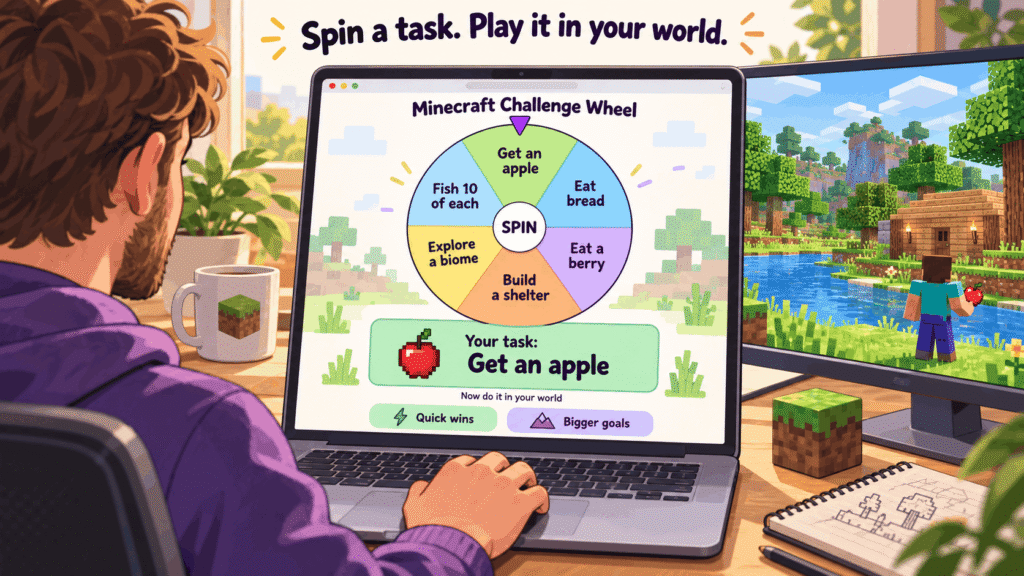
Which Challenges Come on a Prebuilt Minecraft Challenge Wheel?
Prebuilt Minecraft challenge wheels range from short eight-slot lists to rosters of 115 tasks, mixing resource grabs, mob kills, crafting jobs, stunts and score slices.
A tidy 30-slot list sits in the middle. It spreads 30 different Minecraft challenges across building, restrictions, exploration, farming and the Nether, so Build a House in 10 Minutes, Only Use Stone Tools, Find a Shipwreck, Tame a Wolf and Build a Nether Portal all share the same rim. Its building side alone runs from Build a Tower to the Sky, Build a Bridge and Build a Watch Tower to Build a Secret Base, Decorate Your Base and the open-ended Build Something Random.
The exploration side of that 30-slot list is just as broad. Find a Village, Find Diamonds, Explore a Cave and Swim Across a River are simple discovery goals, yet each carries a time element because nobody knows how far the nearest one sits. That balance makes it the easiest list to hand to a newer player.
The longest community lists are messier, and I mean that kindly. They read like a group chat brainstorm, with mining missions, crafting limits, survival goals and loose gameplay tasks thrown in side by side, plus a few spelling slips and near-duplicates nobody bothered to clean up.
Short lists flip the experience around. An eight-slot wheel built mostly around structures turns into a pure scouting session, which suits a fresh seed far better than a world you have already mapped.
What Building Challenges Can the Wheel Throw at You?
Building challenges on a Minecraft wheel range from quick shapes like Build your name to height tests like Build a tower 2×2 to height limit, and they judge speed and planning more than decoration.
The height slices come in pairs on some wheels. Build to Y level 200 sends you upward, while Reach Y level 5 sends you down into deepslate, and doing both in one night shows how much a vertical build idea depends on scaffolding and torches. Wall slices like Build a 4×4 concrete wall, Build a 4×4 mossy cobble wall and Build an M with soul sand look trivial until you remember that concrete needs gravel, sand and dye first.
Digging counts as building on most lists. Mine a hole 16×16, Mine to bedrock, Mine an entire obsidian pillar and Drain a river are all shape jobs in reverse, and Make a swimming pool is the same idea with a bucket. Restricting yourself to a single block type makes any of them slower in a way I find oddly satisfying.
Then there are the contraptions. Make a trap, Get any mob in a hole and Make a cobblestone generator reward players who know water and lava flow, which is why I treat a plain Build a house slice as the beginner version of the category.
What Are Survival and Restriction Challenges in Minecraft?
Survival and restriction challenges take something away from you, whether that is armor, jumping or a safe health bar, and make you play a normal session without it.
The classic restrictions are easy to explain and hard to live with. Surviving without armor, avoiding jumping and staying in one biome each turn a routine evening into a harder run, and stacking a second survival rule on top is where things usually fall apart for my group.
Health dares sit right next to those rules. Get to half a heart, Set yourself on fire but not die, Turn off fire with splash water and Take nausea effect all test how calmly you manage a bad situation, and Survive an apocalypse is the open-ended version that hosts interpret however they like.
The self-destruct slices are the part people misjudge. Blow yourself up, Die to lava, Kill yourself, Kill yourself by falling anvils, Kill yourself using arrows, Die and Get struck by lightning sound like punishments, and so does Build to height limit then jump without using water, but in my experience the real cost is the lost inventory, which is why Drop any item you have in lava often hurts more than the death itself. The same goes for dangerous structures, since a trapped room in Explore a Jungle Temple can take your gear without warning.
One joke slice deserves a mention: Burp usually means eating something and typing the word in chat. My group also likes to Stack it by spinning three survival rules at once, which turns a calm night into a proper test.
Which Exploration Challenges Send You Across the Map?
Exploration challenges send you looking for a structure or a distance marker, such as Find a stronghold, Find a mineshaft or Travel 10000 blocks without elytra, and the seed decides how hard each one turns out. A stronghold hunt quietly contains four smaller slices, because you need to Get blaze rod, Get ender pearl, Craft one eye of ender and then Get ender eye in your hand before you can track it.
Structure slices are where luck shows up most. Find a portal might mean a ruined portal two minutes from spawn, while Find a desert temple can be impossible in a cold, forested seed. Get 10 diamonds belongs here as well, because the challenge is mostly about knowing which depth and which cave system to go looking in.
Villages generate their own strange category. Trade With a Villager needs a settlement first, and once you find one, slices like Ring a bell and Open a book in a lectern take seconds. Start a raid needs a bad omen first, and the two kidnapping slices, Kidnap a villager in night time and leave him in the ocean and Kidnap an entire village and put them in the ocean, are really pathfinding puzzles with boats and leads.
I like ending an exploration night with a ranged task. Hit a target 50 blocks away sounds unrelated, yet it rewards anyone who crafted a bow on the way, and it turns a long exploration goal into one tidy final shot. Flying shortcuts usually wait until someone can Get an elytra.
Are There Calmer Farming, Trading and Animal Challenges?
Yes, a good share of Minecraft wheel slices are calm animal and food jobs, like Breed 2 chickens, Tame a horse or Grow one wheat seed, which suit younger players or a cool-down spin after a tough round.
Animal slices often hide a second step. Get an orange baby sheep means dyeing a sheep and then breeding it, Craft a piece of wool needs string or shears, and Get a rabbit’s foot depends on the biome you spawned in. Get a fish in a bucket, Obtain a honey bottle and Obtain either a red or brown mushroom are gentle, but each one asks you to remember an item you rarely use.
Food slices make up a surprising share of the bigger lists. Eat a cake, Make a cake and eat it, Eat 2 puffer fish, Eat a puffer fish, Eat a chorus fruit, Eat cooked salmon and Get a cooked salmon cover everything from a sugar run to an End trip, and the puffer fish slices are the only ones that poison you on purpose.
Villager work rounds the category out. Cure a zombie villager is the patient choice, Make an iron farm is the ambitious one, and Get a stack of seeds is the quiet slice I hope for when a session has already run long. Those slices also build reliable food sources that make every later task easier.
Which Nether and Late-Game Challenges Should You Save for Later?
Nether and late-game challenges are the slices that require advanced gear, blaze rods or netherite, so they fit a world that has already moved past its first few nights.
Gear slices climb in a clear order, from basic protection to endgame kit, and many wheels lock you into a single tool tier at a time, so seeing them side by side shows which ones to delay:
| Gear tier | Tool slices | Armour slices |
|---|---|---|
| Leather and wood | Get full wooden tools | Get full leather armour |
| Gold | Get full gold tools | Get full gold armour, Make gold helmet |
| Iron | Get full iron tools, Make a full set of iron tools | Get full iron armour, Craft a full set of iron armour |
| Diamond | Get full diamond tools, Get a diamond pickaxe, Get a diamond sword, Craft a diamond hoe | Get full diamond armour |
| Netherite | Get full netherite tools | Get full netherite armour |
The netherite path itself is a chain of separate slices. Get a debris, Get a stack of ancient debris, Get a netherite scrap, Get a netherite ingot and Make a netherite block escalate from one lucky find to dozens of trips, and I would not accept the last one before I could Get a beacon, let alone Make a full beacon or Make a diamond block for the pyramid.
Nether mobs and blocks fill the rest. Kill a brute, Kill a ghast and Deflect a ghast’s ball reward a steady shield hand, while Craft 8 nether bricks, Craft warped or crimson hyphae, Craft a nether wart block and Brew a fire res potion reward anyone who packed a pickaxe and an empty bottle, and Get a potion follows naturally once a brewing stand is running.
How Do You Spin and Play by the Challenge Rules?
Playing by the challenge rules means spinning once, accepting whatever lands, and agreeing on how a run counts as complete before anyone starts digging.
My group follows the same order every time, because skipping a step always causes an argument later:
- Custom rules: settle the house rules first, including whether a reroll is allowed and what happens when a slice like Explore a Desert Temple is impossible in your seed.
- Goal for the session: spin once and write the result in chat, so nobody “misremembers” an easier one an hour later.
- Spin individually or share: decide whether everyone shares one slice or each person gets a different task.
- Clear rules: name the finish line, for example a screenshot of the item or a witness at the kill.
A clock changes the feel of the night more than anything else. In a Build battle, everyone builds the same random idea in 30 minutes, and that one deadline is often the difference between a relaxed session and a race.
I also like an “after” step that most lists skip. Whoever completes a task first gets to spin the next one for the group, which keeps the turn order fair without needing a scoreboard.
What Are Fun Ways to Play With a Group or on Stream?
Group and stream play works best when the wheel decides something everyone can watch, such as who gets hunted, who hides, or which rule changes next. If your group plays Roblox too, the Dandy’s World toon wheel picks a toon for each round in the same way.
For multiplayer groups, the player-versus-player slices do the heavy lifting. Kill a player and Kill the other player set up a quick duel, Hide or seek turns a village into a playground, and Death Run gives a server its own obstacle course. Give any item you have to the player after you is my favorite chaos slice, because it ruins a carefully packed hotbar in one turn.
Inventory slices make great group races. Fill your inventory, Fill inventory, Fill your inventory with wood in stacks, Fill your inventory with cobblestone in stacks and Fill your inventory with netherrack in stacks sound boring, but on a shared world they become a frantic resource grab with no obvious winner. Wood slices work the same way: Collect 20 Wood Logs, Get a stack of wood, Get oak wood, Get birch wood, Get spruce wood, Get jungle wood and Get acacia wood turn into a resource sprint across five biomes.
For content creators, the wheel is a ready source of livestream content because the audience sees the result at the same moment the streamer does. The format also works for friendly competitions at game nights, where two teams take turns and the loser has to accept whatever the next slice says. Tools with an OBS streamer mode or the option to spin six wheels at once make the format easier to show on screen.
How Do You Make the Challenge Wheel Your Own?
Making a challenge wheel your own means copying a prebuilt list, then rewriting, weighting and sharing it so it fits your world and your group.
The editing flow on most wheel tools follows a predictable order:
- Duplicate option: copy the original list first, so the source stays intact if you want it back.
- Edit the slices: fix typos, cut slices your version of the game does not support, and add your own challenges, typing each one on a new line.
- Adjust slice weights: add weights so harder goals rarer and favorites more frequent become one setting.
- Save your customized wheel: store it, then share it with others before the session starts.
I rewrite the odd crafting slices more than anything else. Craft a fletching table, Craft a cartography table, Craft black stained glass, Craft a magma block and Obtain pink glazed terracotta are fine for adults but confusing for younger cousins, so I swap a few for simpler jobs like Make a bed, Make a purple bed, Get a music disc or Obtain a trident. I once reworded Find a Treasure Chest as well, because reading a map confused the youngest players at the table.
Visual tweaks matter more than they sound. Recoloring is quick: when you change colors so that combat slices are red and crafting slices are green, players can read the result from across the room, and when you add sounds, a stream gets a clear audio cue for every result.
What Features Make a Challenge Wheel Tool Worth Using?
A challenge wheel tool is worth using when it lets you edit quickly, control the odds, prevent repeats and share the exact same list with your group.
Size handling is the first test. Lists I have seen run to 115 slices, 66 slices and as few as 8 slices, and a tool that cannot render a crowded rim legibly makes the biggest lists almost unusable on a phone. A free online wheel maker should let you build custom spin wheels in seconds whether the list is long or short.
Control over results comes next. Elimination mode prevents repeats during a session, weighting handles balance, and the best tools I tried also handle giveaways and quick decisions with the same setup.
Stream features close the list for me. A dedicated overlay mode for streaming software, file import and export, and an option for offline use through a companion app all save time once a wheel becomes part of a weekly show. Being able to import a list for LAN sessions or a trip without internet access is a small feature I now check for first.
What Is a Minecraft Challenge Wheel Used For?
A Minecraft challenge wheel is used to pick a task for a Minecraft session, so you or your group always have a clear goal without arguing about it.
Most people use it to break out of routines and make an old world feel fresh again. It suits solo players chasing personal goals, groups on multiplayer servers, and anyone whose survival and creative worlds ran out of new things to do after hundreds of hours. A small push decided on the spot is usually enough, even when the result is as mild as Ride a Horse, which sends you hunting for specific animals on the plains. Weekly mini-challenge nights work the same way: spin, complete that challenge, and spin again next week.
How Does the Minecraft Challenge Wheel Work?
The Minecraft challenge wheel works by spinning once, stopping on one slice, and turning that slice into your task until it is done or failed.
You Press Spin, read the random result, and follow the selected challenge for the round, whether the list holds gameplay prompts or harder random challenges. Some groups add a time limit, others agree on a win condition, and either one turns a loose evening into a structured game. Rolling before a session gives you something specific to follow from minute one, and the spin adds a bit of excitement to a plain night. You can find wheels for more games on the game wheels page.
Restriction slices show the idea clearly. Mine Without a Pickaxe, Only Use Wooden Tools, Survive the Night Without Shelter, Only Eat What You Find and the No Crafting Challenge each remove a core mechanic, so the fun comes from the workarounds you invent on the fly.
What Should You Put on a Minecraft Challenge Wheel?
You should put a balanced mix of short and long tasks on a Minecraft challenge wheel, covering building, restrictions, exploration, mobs and a few creative jobs.
An online spinner works best with build tasks that reward building speed and creativity, plus a time-pressure test or two that forces fast choices about materials and layout. Add height slices that reach the maximum build height, decoration slices that move from function to appearance, and anything needing spatial planning. Mix in mining a rare ore, defeating a mob, crafting a specific item and one boss fight for the end of a long night.
Calmer slices keep younger players involved. Build a Farm and Collect 10 Different Foods lean on crops and other gentler mechanics, and a few challenge-run ideas in reserve help whenever Bored of the same Minecraft world? shows up in the group chat.
Is the Minecraft Challenge Wheel Free to Use?
Yes, a Minecraft challenge wheel is free to spin online on the usual wheel tools, with no payment needed.
A tool that randomly chooses a task this way is handy for Can’t decide? moments, and the same ready-made list opens on a laptop or a phone. It also does not matter whether you play Bedrock or Java, since the slices use features found in both editions. Even basic wheel spinners deliver fair results; paid extras are about convenience, not the spin itself.
Can You Use the Wheel for Multiplayer or Streaming?
Yes, a Minecraft challenge wheel works for multiplayer and streaming, because the whole group or chat sees the result at the same moment.
Group challenges have everyone chase the same result, while a Server event works better when each player spins for a personal task. Speedrun-style rounds use a time limit per pick, and stream chat games let viewers choose the next objective. A new rule every time you die keeps a long stream unpredictable. Sending a wheel link, or using a share a URL button, keeps everyone on the same setup. If you also play on mobile, the Clash Royale card wheel sets a random deck challenge.
Can You Use a Minecraft Challenge Wheel Offline?
Yes, some Minecraft challenge wheel tools can be used offline once the list is stored in an app on your device.
Browser tools with auto-save keep your list ready, and a list that saves in your browser often loads again without a fresh connection. Tools with JSON import/export let you keep a backup file, which I recommend before any trip. The browser route needs no downloads and nothing to install, while an app is the safer choice for a long journey.
Can You Add, Edit or Fix Challenges on the Wheel?
Yes, most Minecraft challenge wheels let you add, edit or remove slices, so the list matches your version of the game.
The usual route is to duplicate the wheel to your account, then add or remove challenges, change wording and remove items that do not fit your server rules. That fast editing lets you tailor a list to your playstyle in a few minutes, and many editors also let you add sound effects for each result. On simpler tools, you just type into the entries box and the wheel updates instantly.
How Do You Stop the Same Challenge From Repeating?
You stop the same Minecraft challenge from repeating by switching on a setting that removes each slice after it is picked, until the list resets.
On a 30-slot list, every spin then lands on one of 30 fresh tasks until the rim runs out. Big lists need extra care, because near-duplicates such as Kill 100 cows, Kill 100 pigs, Kill 100 sheep and Kill 100 chicken feel repetitive even when no slice actually repeats. The same applies to Kill an iron golem next to Kill 7 iron golems, or Kill a villager next to Kill every Overworld mob, so I trim those or use weighted choices instead.
Can You Make Some Challenges Rarer or More Common?
Yes, you can make some Minecraft challenges rarer or more common by giving each slice its own weight.
I give long-haul slices like Get 100 diamonds, Get 100 iron, Get 100 gold and Get 100 coal a low weight, while a single Get a diamond stays common. Survive in the Nether for 5 Minutes suits experienced players and veterans, and Craft Full Iron Armor is a milestone for a newcomer but a speedrun target for others, so it scales with skill at a normal weight. Joke slices such as Make a zombie wear a diamond helmet work best as rare surprises.
How Do You Share Your Challenge Wheel With Friends?
You share a Minecraft challenge wheel by sending its link, so every friend opens the exact same list and settings.
Tools with share links let a group spin together or share a challenge across a voice call, and streamers can spin live for everyone at once. Most of these tools are completely free and skip sign-ups for viewers, so friends only need to click. I post mine in our group chat before game night, which saves the first ten minutes of “which version are we using?”
Does the Challenge Wheel Work on Both Minecraft Versions?
Yes, a Minecraft challenge wheel works on both major versions of Minecraft, because nearly every task uses items, mobs and structures that exist in each.
The Overworld and the Nether, which is far more hostile, play the same way across versions, so preparation and awareness and the necessary resources for a task barely change. The world you generate matters more than the version you run. Technical slices are the exception: Make a TNT duper relies on redstone quirks, so check it before a mixed group starts and edit the challenges if needed, while Make a stack of TNT works anywhere.
Is This an Official Minecraft Challenge Wheel?
No, a Minecraft challenge wheel is not an official Minecraft tool; challenge wheels are fan-made and are not connected to the companies behind the game.
A fan tool like this is not affiliated with Mojang or Microsoft, so its slices reflect what players enjoy rather than what the developers planned. That is also why lists vary so much from one site to another.