What Is an Icebreaker Question Generator, and How Do You Use One?
An icebreaker question generator is a free online tool that gives you a ready-made conversation prompt with a single click, usually sorted by category, mood or how well the group knows each other, so you can open a meeting, class or party without inventing questions on the spot.
The routine is short. You press a button, read the random question aloud or paste it into the group’s chat, and people answer in turn. The better generators sort their prompts into themes such as Personal Growth or Team Trivia, and a few let you set the question depth so a room of strangers doesn’t get asked about their childhood fears.
I started relying on one for new hires who joined over video calls and said nothing for the first ten minutes. A pre-made prompt took the pressure off me as the facilitator, and it handed the quieter members something specific to answer instead of a vague “tell us about yourself.”
An icebreaker question generator still doesn’t replace judgement. The tool supplies conversation starters, but you decide whether a prompt about a dating experience belongs in a Monday call that includes your manager’s manager. Most generators run in a browser on computers and tablets alike, so you can pull one up on the go between rooms.
What Exactly Counts as an Icebreaker Question?
An icebreaker question is a short, low-stakes prompt that gets everyone in a group saying something about themselves before the real agenda begins.
Some icebreaker questions are pure fun, like naming your go-to karaoke song. Others reach for a life lesson or a personal goal. Both count, because the job is the same: getting a first sentence out of every person before anyone has to defend a budget line or a deadline.
The label covers more than spoken questions. Two Truths and a Lie is a game, a monthly dedicated session is a ritual, and a typed answer suits people who think before they speak. Facilitators file all of these under team-building activities because they serve the same warm-up purpose.
Here is the contrarian part from my own sessions: the most useful icebreaker is rarely the cleverest one. A plain prompt about someone’s first job does more for breaking down barriers than a riddle, because people can answer it in 30 seconds and still reveal something. Social bonds grow out of those small reveals, not out of wit.
A prompt like “If you could have a conversation with any author, who would it be?” works for the same reason, and so does asking someone to sum up their personal philosophy in one sentence once the group is warmer.
How Do You Use an Icebreaker Generator Step by Step?
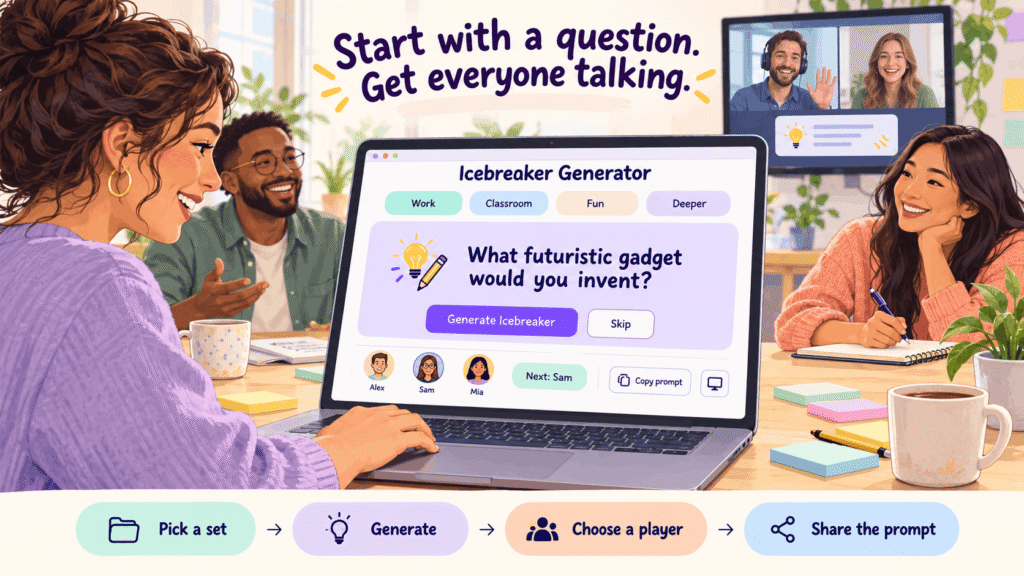
Using an icebreaker generator takes four moves: pick a set of questions, generate a prompt, decide who answers, and show the prompt to everyone.
- Draw a card from a themed set such as Work, Classroom, Fun or Deeper. AI-based tools ask for a time limit and a participant count before they suggest anything.
- Generate Icebreaker by pressing the main button, then read the prompt. If it misses the mood of the room, skip it and press again.
- Add players so the tool tracks whose turn it is, which spares you from choosing people yourself.
- Share your screen or paste the prompt into the meeting chat so remote people see the same words as the room.
The whole loop takes one or two clicks once the set is chosen, which is why I keep a generator open in a spare tab before any workshop. Nothing about it needs an account in the simpler tools.
A free AI icebreaker generator adds a planning layer on top of that loop. I once set one up for a Sprint Planning kickoff with a ten-minute window and got prompts about designing a futuristic gadget, which fit the build-something mood far better than a generic “favorite color” question would have.
Where Do Icebreaker Questions Fit Into the Workweek?
Icebreaker questions fit best at the start of recurring meetings, in a new starter’s first week, and at team events, wherever people need to talk before they can work well together.
In a standing weekly sync, one question under 1 minute per person is plenty. I keep a short list of light topics for those calls, such as favorite foods or whether someone is a coffee or tea person, because nobody needs to think hard at 9 a.m.
Onboarding sessions need a different kind of prompt. A new person needs questions that build trust without asking for personal disclosure, so I ask about a hobby rather than a family story. Bigger occasions such as mixers, work events and webinars call for prompts that work across strangers, with answers short enough to keep the line moving.
Retrospectives ask the most of a facilitator. An anonymous mood poll or a quick Team Check-In before the first question shows how the room feels. After that, prompts about a success story, a moment someone felt particularly proud, or a time a colleague went above and beyond set up an honest look at the sprint. A question about the team’s collaboration style often leads straight into the retro’s real topics.
What Are Some Good Icebreaker Questions to Start With?
Good starter icebreaker questions can be answered in a sentence or two, reveal one small detail about the person, and have no right or wrong answer.
I sort my starter questions by theme rather than by how clever they sound, because the theme tells me when to use them. The table below is the rotation I return to most, with a Christmas cookie question kept back for December and a few weird icebreaker questions saved for groups that already laugh together.
| Theme | Example question | Where it works |
|---|---|---|
| Travel and Adventure | Do you prefer the mountains or the beach for a getaway? | Monday syncs |
| Pop Culture and Entertainment | Who’s your favorite superhero, and what makes them special? | Mixed-age groups |
| Food and Culinary Preferences | Are you a fan of spicy foods, or do you prefer milder flavors? | Lunch-hour calls |
| Life Experiences and Aspirations | If you could choose a new career path unrelated to your current one, what would it be? | Teams past the first month |
| Technology and Gadgets | Do you consider yourself tech-savvy, or do you prefer simpler gadgets? | Tool rollout meetings |
| Books and Reading | If you could visit a fictional literary world, which would you choose? | Creative workshops |
| If You Could | If you could instantly master any skill, what would it be? | Any group size |
| Weird | What’s the strangest dream you’ve ever had? | Close teams |
Factual prompts beat hypothetical ones in first meetings, in my experience. Asking for a signature dish, or whether someone reads e-readers or physical books, gets a quick answer and a follow-up story almost every time.
How Should You Run an Icebreaker So Nobody Feels Put on the Spot?
Running an icebreaker well comes down to three choices: match the question to how well the group knows each other, model an answer yourself, and make passing a normal response.
The approach I trust starts easy and gets personal only as the group warms up. The table maps each familiarity stage to a question I’ve seen work at that stage.
| Familiarity stage | Example question | Depth |
|---|---|---|
| We Don’t Know Each Other at All | Share one interesting fact about yourself that nobody here would guess. | Light |
| We’ve Worked Together for Some Time | Share a work-related challenge you’ve faced and how you overcame it. | Medium |
| We Know Each Other Well | Describe a time when you and a teammate resolved a conflict. | Personal |
| The Team Is Practically Married | What’s a team tradition or inside joke everyone can relate to? | Personal |
| Almost Not Safe for Work (Total Bestie Territory) | If you could switch lives with a celebrity for a day, who would it be? | Use with care |
Group size changes the plan as much as familiarity does. With fifteen or more people, I split the room with a random group generator and run the question in breakout rooms, because waiting through fifteen answers drains the energy the icebreaker was supposed to build.
Location prompts make a safe middle step between stages. Asking about the most beautiful place someone has visited, or a spontaneous adventure they still talk about, reveals more than a fact without touching anything private.
Can Icebreakers Be Built Into Your Meeting Software?
Yes, several meeting and retrospective platforms build icebreakers straight into their agendas, so a question appears at the start of the session instead of living in a separate tab.
One platform I’ve tested says 700,000 people use it and stays free forever for up to 2 teams. The company also says its question set was checked to be inclusive for diverse groups, which matters when a team spans several countries and cultures. Built-in prompts sit next to other management software features, so nobody has to switch windows.
The built-in route suits distributed teams that already run Daily Standups and planning poker inside one product. It fits tools with a Remote-First Design, where the icebreaker is a toggle the facilitator can switch off. That default matters, because an icebreaker that can’t be skipped turns into a chore.
The trade-off is range. A standalone generator advertising 500+ unique questions across 15 question categories will outlast a short built-in list. One of those tools also lists 10K+ teams connected and a 4.8★ user rating, figures I read as marketing rather than proof.
For variety, I’ve even used a “Would you rather never need to sleep?” prompt next to “If you could change one thing about the world, what would it be?” in the same session.
What Features Separate a Good Icebreaker Tool From a Basic One?
A good icebreaker tool lets you filter by purpose, time and group size, avoids repeating prompts, and offers sets that are safe for work; a basic one just shuffles a fixed list.
Purpose filters are the feature I use most. Quick options such as Meet the Team, Project Start, Fun Day Out, Learn Together and Monday Icebreaker save typing, and free-text entry covers the odd case, like a farewell call. Mood sets running from Seasonal Themes to Future Predictions add range without extra effort.
Time and size controls come next. A participants field and a duration menu that tops out at 20 minutes let the tool size the activity to your agenda. When I skip those settings, I tend to get prompts that need fifteen minutes of storytelling in a ten-minute slot.
Delivery features matter less than vendors suggest. Being able to pick a deck, add names, go around the group, or list everyone under Players on a Zoom call keeps the session moving. A modern internet browser is the only requirement for most tools, and the ones that store team data should name their SSL encryption and promise the data is never shared.
Is There Any Science Behind Icebreakers Working?
The evidence for icebreakers is indirect: research shows teams perform better when people feel safe speaking up, and a well-chosen icebreaker is one low-cost way to build that feeling. To check in on feelings, the random emotion generator gives a feeling with an emoji and a simple meaning.
Icebreaker vendors lean on team psychology research and market their sets as Psychology-Backed Questions. I read those labels loosely. The studies behind them measure trust and cohesion across whole teams, not whether a Desert Island prompt caused any of it.
What I can say from running sessions is narrower. Asking every person to answer surfaces different perspectives, and encouraging participation in the first five minutes tends to carry into the discussion that follows. That shows up as increasing engagement later in the hour, which I track informally by who speaks unprompted.
The effect is clearest with Cross-Cultural Teams, where people may not share humor or references. A neutral prompt lets everyone in on equal terms, invites honest reflection, and doubles as a light way of assessing group dynamics. HR teams pair icebreakers with engagement surveys and broader employee engagement strategies to measure the same thing at scale.
How Funny Should an Icebreaker Be for a Remote or Hybrid Team?
An icebreaker for a remote or hybrid team should be about as funny as the meeting is relaxed: playful for social calls, plain and interesting for anything serious.
I think of humor as a dial. At the mild end sit prompts about your favorite book or a recent podcast recommendation. Turn it up and you get “Could you only eat one food forever?” or “Would you rather have a third arm or a third eye?” Choosing between unlimited money and unlimited free time sits around the middle of the dial.
Hybrid work itself is good material. “What would your ideal hybrid workday look like? Wrong answers only” gets laughs, and so does treating hybrid work as a theme park, a sitcom or a movie plot with an unexpected plot twist. Remote people enjoy sharing their home office setup hacks, odd moments from video conferences, and what they did with the time they used to spend commuting.
My contrarian take is that the funniest prompts can exclude people, because jokes depend on shared references. For diversity and inclusion, lighthearted questions beat in-jokes, and sharing a heartwarming team memory can land better than a gag. On a day with serious news, I drop humor completely.
Which Themes Make Work Icebreakers Easier to Answer?
Themes such as travel, food, childhood or work habits make icebreakers easier to answer because they point people toward a familiar corner of their life instead of a blank “tell us something.”
Funny prompts benefit from a theme too. Asking about a travel mishap, your silliest dance move, or the rules of a wacky new sport gives people a lane to stay in. Turning someone into a cartoon character with a catchphrase works because the theme narrows the search.
Broader categories do the same for quieter groups. Food & Culture and Dream Destinations suit mixed teams, Childhood Memories suits groups that already trust each other, and Creative Challenges suit design or marketing teams. Work Preferences, like where someone focuses best, give managers useful information disguised as small talk.
Hypothetical themes need one concrete hook. Superpowers work because everyone has a quick pick. Time Travel works when you ask “what year would you visit?” rather than “what would you change?” Holiday themes such as a favorite Christmas tradition or best Christmas gift suit December, though I offer a neutral option for people who don’t celebrate.
How Do You Match Icebreaker Questions to How Well a Team Knows Each Other?
You match icebreaker questions to familiarity by starting with safe, factual prompts for strangers and saving personal prompts for teams that have worked together long enough to trust each other.
The method I use is the traffic light: green prompts first, amber once people relax, red only for close teams. Telling people in advance that an icebreaker is coming, and checking everyone is on board, removes most of the dread. Begin with questions that invite fast replies, set a clear answer order, and raise the difficulty only once the group relaxes.
Green prompts are factual, like a favorite book genre or the comfort foods someone cooks on a bad day. Amber prompts move into Sparking Creativity territory: asking someone to invent something or name the character in a movie they’d be.
Red prompts reach for life goals, achievements, the most challenging obstacle someone has overcome, how they handle stress, or how they define success. I’ve seen a red question asked too early empty a video call of cameras within a minute, so I save these for teams with a year or more of history.
Which Weird, Hypothetical and Holiday Questions Actually Get People Talking?
Weird and hypothetical questions get people talking when they have an easy first answer plus room for a story, and holiday questions work best when they don’t assume everyone celebrates the same thing.
Would You Rather prompts are the fastest, because the answer is a choice and the story comes after. Getting to Know Each Other prompts like your most creative meal, the funniest thing that happened this month, or the historical figure you’d invite to dinner stretch a little further and spark memorable answers.
The strangest prompts carry their own risk. Quirky prompts create intrigue, but I keep them for the second half of a workshop, after Lightening the Mood with something simpler. A question about the best concert or live performance someone attended, or which game show they’d join, sits between weird and safe.
Community questions round out the set. Talking about the job in the world for one week someone would take, or the most inspiring quote they’ve heard, often turns into community building at work because colleagues discover shared perspectives and experiences. Holiday prompts about invented holidays let everyone join in, whatever they celebrate.
How Do You Run an Icebreaker on a Video Call?
To run an icebreaker on a video call, put the question on screen, let the tool choose who speaks, keep each answer short, and give people a way to type instead of talk.
- Low-pressure prompts come first: open with something factual so cameras stay on.
- Next question goes on the shared screen, so nobody has to scroll the chat to find it.
- Everyone gets a turn when the tool picks names, which removes the awkward pause of waiting for volunteers.
- Written responses in chat give people thinking time and suit anyone with a weak connection.
- Thanking participants closes the round and signals the agenda is starting.
Quiz-style tools built for remote teams keep gameplay to about 2 minutes per round, which matches what I aim for in Virtual Team Building calls. Asking for someone’s most-used app on their smartphone is a reliable first prompt, because everyone has an answer within reach.
How Long Does an Icebreaker Game Take to Set Up, and Is It Private?
Most icebreaker games take only a few minutes to set up, and reputable tools encrypt team data and state that they don’t share it.
Setup speed depends on how much the tool decides for you. Smart Question Selection with AI-based selection reads your team context and picks prompts automatically, while Time-Conscious Design sorts questions by time commitment so you can fill a five-minute slot without guessing.
Group size is the next setting to check. Team Size Flexibility claims of 2 to 200 participants sound generous, but in practice I split anything over thirty people. Mood-Based Categories help here, from energizing morning starters to reflective afternoon prompts, so the same tool works across a full day of sessions.
Privacy is the question I’d ask before connecting a tool to a video platform or company directory. Look for a written statement of how data is encrypted and whether it’s sold or shared. If the tool can’t answer that in one sentence, I use one that stores nothing at all.
What Is the Simplest Definition of an Icebreaker Question?
An icebreaker question is a prompt used at the start of a meeting or activity to help people connect before the main work starts.
Icebreakers are structured activities for group settings, built to create a positive atmosphere fast. Icebreakers matter most in formal settings and remote teams, where they replace some of the lost in-office camaraderie of hallway chats.
What Makes an Icebreaker Question Work?
An icebreaker question works when it pulls out small personal details that are easy to share and fun to hear.
Good prompts also reveal thinking styles, which is the idea behind Cognitive Diversity claims on icebreaker sites. A simple question like whether someone enjoys hiking or camping often does this better than an elaborate puzzle.
How Do You Ask Icebreaker Questions at Work Without It Feeling Forced?
You ask icebreaker questions at work without forcing them by keeping the first prompt simple and making the order of answers clear.
Use icebreakers to introduce people, not to test them, and keep replies under a minute. Pick someone to start, then use sequential answers for small groups and simultaneous formats such as Never Have I Ever for bigger rooms. Light prompts surface personality traits without anyone feeling examined.
Should Work Icebreakers Be Funny?
Work icebreakers can be funny when the meeting’s tone allows it, but humor should stay optional and match the mood of the day.
One question bank grades its funny prompts by humor level: Straight Shooting, Kinda Funny, Haha, and “OMG, Stop.” The last tier includes prompts like a favorite dad joke or the most bizarre conspiracy theory you’ve heard, which I keep for teams that know each other well.
How Do You Facilitate an Icebreaker Well?
You facilitate an icebreaker well by going first, letting people pass, and treating every answer as equally welcome.
Having the facilitator go first sets the length and tone. Keep participation optional, value all contributions equally, and avoid overly personal or controversial topics. Those Safe Spaces rules help introverts most, and quick answers keep the round short.
Can Icebreakers Do More Than Introductions?
Yes, icebreakers can do more than introductions, from identifying interests to improving classroom dynamics and easing social gatherings.
Beyond facilitating introductions, prompts about Hidden Talents uncover skills a team didn’t know it had. Community Building Questions, such as naming a hidden gem in your area or the fundraiser for a charity you’d organize, connect colleagues around something outside work.
When in a Meeting Should the Icebreaker Happen?
The icebreaker should usually happen at the very start of a meeting, where it sets a positive tone and helps with starting discussions.
Enhancing Team Meetings with a short opener works because people have spoken once before the hard topics. 2–3 minute icebreakers suit regular meetings, and Onboarding New Employees benefits from one from day one, since building rapport early makes the next week easier.
What Should You Do Beyond Icebreakers?
Beyond icebreakers, teams can add regular health checks, retrospectives and structured planning rituals that keep connection going after the first five minutes.
Built-in Icebreakers often come bundled with a Team Health Check, Sprint Poker, and 90+ prebuilt templates you can create and share. The reason to go further comes from Google’s Project Aristotle, which named Psychological Safety as the top factor in team effectiveness.
How Long Should an Icebreaker Last?
An icebreaker for an ordinary meeting should last a few minutes, while a team-building session can run longer.
Plan 5–10 minutes for Team Building Events, and stop within 15–20 minutes unless it’s a dedicated connection session. A quiz-style tool takes less than 3 minutes to set up, and interactive prompts like “Would you rather be 10 minutes late or 20 minutes early?” fit a tight slot.
Are Icebreakers Fair to Introverts?
Icebreakers are fair to people who prefer to think before they speak when the format offers typed answers, preparation time and prompts that don’t require sharing anything private.
Gentle introductions help, as does a tool that chooses who responds next so nobody has to volunteer awkwardly. Easing tension for quieter people often means letting long-time team members answer first and leaving room for shared stories later.
Can You Customize Icebreaker Questions for Your Team?
Yes, you can customize icebreaker questions by feeding an AI generator your purpose and audience or by writing your own prompts.
A 336 icebreaker questions bank is a good base, but custom creative prompts for brain breaks, brainstorming kickoffs land better. Taglines like “Break the Ice, Build the Team” promise that, and one site’s Engagement Boost claim is the reason vendors give for tailoring.
How Often Should a Team Use Icebreakers?
Most teams do well with a short icebreaker in regular meetings and a longer one about once a month.
Quick prompts take 30–60 seconds in standups, and consistency matters more than length. 20 ideas can cover a month of team icebreakers used throughout a meeting cycle to keep people engaged and keep a friendly tone. Some icebreaker sites claim strong Social Cohesion makes teams 50% more productive and engaged teams show 23% higher profitability, but they don’t link sources, so I treat both as unverified.
What Can a Random Icebreaker Question Generator Give You?
A random icebreaker question generator gives you a steady supply of ready-to-use prompts, from light personal questions to themed sets.
Typical results include the best piece of advice someone has received or where they’d travel anywhere in the world. You can pull as many as you want, and an AI question generator can match team culture and values. Research cited on one site suggests 1–2 times per week, mixing quick daily questions with deeper weekly ones.
How Do Online Icebreaker Generators Work?
Online icebreaker generators work by pulling a question from a stored or AI-generated set each time you press the button.
Each press builds a list of strong icebreakers you can copy, such as the last book you read, a hobby you wanted to pick up but never did, who you’d have dinner with, or your perfect day off.
Are Generated Icebreaker Questions Safe for Work?
Generated icebreaker questions are usually safe for work when you choose a work or classroom set, though you should still read each prompt first.
Prompts like what you’re most proud of, a bucket list item, a fun or unusual fact, if you were an animal, or a job you’d switch careers for a day to try are safe. An adventurous or daring story or an embarrassing moment can feel out of place with a new manager, so pick interesting questions over silly ones when unsure.
Do Icebreaker Generators Repeat Questions?
Good icebreaker generators don’t repeat a question until the whole set has been fully used.
The Classroom decks and work decks built for professional and school settings follow this rule, so a weekly class won’t hear the same quirky or unusual talent prompt twice. Repeats happen faster with small sets, so I rotate topics like your professional wrestler stage name, how you stay motivated, or what jokes make people laugh. If you can’t decide between two favourites, a quick spin on the random picker wheel settles it.