How Does a Word Scramble Generator Work?
A word scramble generator takes the words you type and shuffles the letters of each one, so players have to work out the original word. On this page you type a list or pick a ready-made one, press Scramble words, and get a numbered list you can print, copy or play one word at a time.
The puzzle itself is simple: every word is mixed up, and the solver has to figure out how the letters should be rearranged. That small exercise trains pattern recognition and problem-solving skills, and it puts letter order at the center of attention. Each word is solvable, but rarely at first glance, which is what makes it satisfying.
Word jumbles have a long history in print. A daily scrambled-word game has appeared in newspapers since the 1950s and today runs in more than 600 newspapers through Tribune Content Agency. Teachers borrowed the idea for spelling lists, and it has been a classroom warm-up ever since.
Online versions add their own tricks. Some let you click a blank slot and type, while the cursor advances to the next letter automatically. Others let you re-roll a puzzle or send friends a unique URL so they can solve it without an account. This page keeps things simple: switch to Play one by one, type your answer, and press Check. It’s a light play online mode that needs nothing more than a browser.
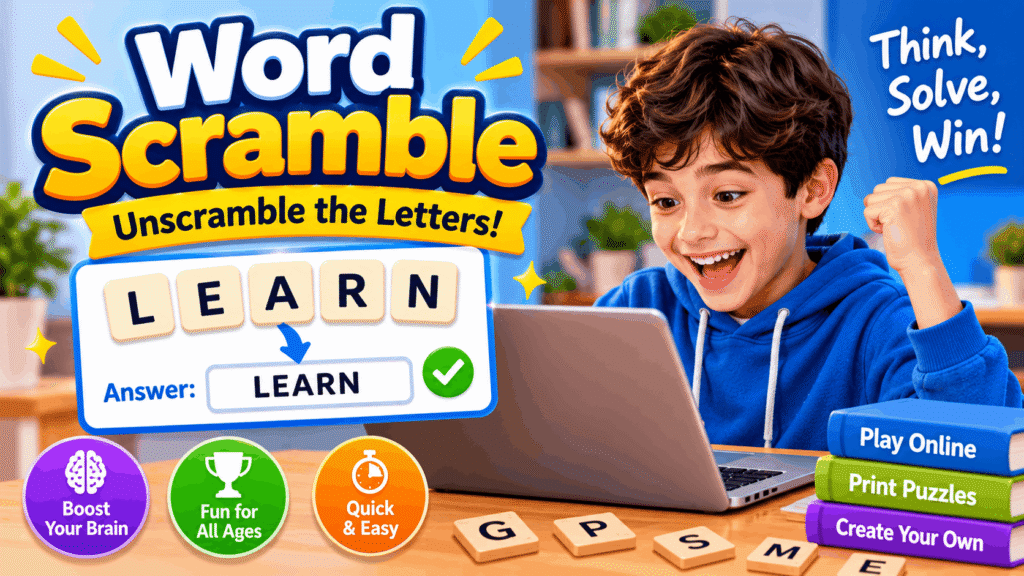
What Is a Word Scramble Puzzle?
A word scramble puzzle is a word game where the letters of each word are shuffled and the player has to put them back in the right order. It’s also called a jumble, and it has been a newspaper favorite for decades.
The best-known version began in 1954, when the comic book artist Martin Naydel created it for newspapers, as the Wikipedia article on Jumble explains. It passed to Henri Arnold and Bob Lee in 1962, who kept it going for at least 30 years, and today it is maintained by David L. Hoyt and Jeff Knurek. The classic layout gives four scrambled words, two with five letters and two with six.
In the newspaper format, some letters in each answer are circled. Those circled letters are then unscrambled again to solve a final riddle, with a drawing as the clue and an answer that is usually a pun or a homophone. Classroom scrambles skip the riddle and focus on the words themselves.
What both share is the thinking, a mix of recall and active reconstruction: spotting letter patterns, testing likely starts and endings, and moving letters around in your head. A hard word with easy letters, like rhythm, can stump adults, while a long word with familiar chunks, like butterfly, falls quickly.
How Do You Make a Word Scramble Worksheet?
You make a word scramble worksheet by typing your words, pressing Scramble words, and then printing or copying the result. Any vocabulary list becomes a custom, printable page in less than a minute.
- Type your words in the box, or tap a ready-made list.
- Tick Keep the first letter in place if you want an easier puzzle.
- Press Scramble words.
- Check the live preview on the right, which shows the numbered list with answer lines.
- Press Print, Copy or Download .txt.
When you press Print, the page opens a clean print layout and your browser’s print button sends it to paper. It works like a two-page PDF: page one holds the puzzle, and page two holds the answers as a solution page, on a separate page from the questions. If you’d rather keep a digital copy, choose Save as PDF in the print window and file it with your lesson plans, in US Letter (8.5″ x 11″) or A4 (210 x 297 mm), whichever your printer uses.
Keep each sheet to 20 items or less so it doesn’t feel crowded. Short phrases work, but spaces are dropped, so dog house becomes one jumble of the letters in doghouse. Picking a list from the puzzle library above the box takes about thirty seconds.
Which Word Lists Can You Start From?
You can start from six ready-made lists: Animals, Fruits, Spelling grades 1–2, Spelling grades 3–4, Science and Holidays. Each list has 12 words, and you can edit any of them before scrambling.
The Holidays list mixes words from several celebrations, such as pumpkin, snowman, reindeer and valentine, which makes it handy for a school party around Christmas, Easter or Halloween. Planet, magnet, volcano and fossil come from the science list. These lists also work well as an end-of-topic review, end-of-unit test prep or a five-minute recap.
Your own lists matter more than the presets. Chapter vocabulary from a novel, nature study terms, social studies words or novel vocabulary from a class reader all make good scrambles, and so do foreign-language terms. If you need ideas, AI word generation tools can suggest a themed list, and some random word tools draw on more than 100,000 English words. The random word generator is a quick way to fill a list when you have no theme in mind.
There’s no limit on how many lists you can make. You can paste in as many words as a lesson needs, scramble them, and start again with the next batch.
How Hard Should the Scramble Be?
A word scramble should be hard enough to need real thought but easy enough to finish: for young readers, keep the first letter in place, and for older students, let every letter move. Getting this balance right keeps students working instead of guessing.
Grades 1–2 do best with short words and the first letter fixed, while grades 3–4 can handle full scrambles of familiar words. Grades 5–6 are ready for longer subject terms with no hints at all. Letter case matters too. Show in capital letters is on by default, because uppercase letters are easier for early readers to tell apart, but you can switch to lowercase for older students.
In special education settings, the same list can be set at an easier level without rewriting it. A fixed first letter gives a clear starting point, and short words keep the task manageable. One list can serve a whole class at different levels, with no retyping, in under a minute. That’s the easiest form of differentiation there is.
For brain training and competitive solving with adults, turn off every hint and use longer words. Long science terms make a proper challenge, and timed rounds add pressure.
Why Do Word Scrambles Help With Spelling?
Word scrambles help with spelling because they force students to think about the order of letters instead of recognizing a word by its outline. That attention to sequence is exactly what a spelling test checks.
Most readers recognize familiar words by their word shape, the outline made by tall and short letters. A scramble takes that outline away, so the student has to rebuild the word piece by piece. That active reconstruction is useful for tricky words that look right but aren’t, like “freind”.
Spelling list practice is the classic use. Primary and elementary teachers use scrambles to reinforce weekly word lists and high-frequency words, and teachers working in early intervention keep the lists short to build confidence. The task asks students to recall a word they already know and rebuild it, which is a different skill from simply reading it.
There’s a mood benefit too. Because a scramble feels like a puzzle, students who tense up during tests often relax and keep going. For a different kind of letter practice, the random letter generator can pick starting letters for a quick word-building race.
How Do Teachers Use Word Scrambles in Class?
Teachers use word scrambles for spelling list practice, vocabulary previews, quick reviews and calm independent work. One list can serve several of these jobs in the same week.
A scramble gives students something that feels like a game rather than a test, which keeps engagement high even at the end of a long day. Teachers often describe it as a multi-channel task: students link the sound of a word, its shape and its spelling all at once. Many find that this helps spelling accuracy and supports long-term vocabulary retention, though results vary from class to class.
Subject teachers use scrambles beyond English lessons, with science, sports, music and food vocabulary all working well. For a team round, the random team generator splits the class into groups that race to solve the list. Writing short definitions next to each word turns the scramble into a vocabulary preview. Add a clue after a vertical bar in your own notes, and students who need help get a starting point while others solve without it.
Scrambles also fit around other activities. Pair one with a short writing task from the random writing prompt generator, or use the brain break wheel between rounds. The full set of tools is on the classroom tools page.
Which Students Benefit Most From Word Scrambles?
Word scrambles help most for students who are learning to spell, learning a new language, or need extra support, because they practice spelling without asking for whole sentences. They work at every age, from young children to adults.
Difficulty settings decide who a scramble suits, and they help with spelling anxiety too. Some makers offer three difficulty levels: easy keeps the first and last letters fixed, medium keeps only the first letter, and hard moves every letter. Others use a slider from 1% to 100%, where a low setting is a two-letter swap and 100% is a full jumble. A 10–20% setting suits the youngest children, while 50% sits in the middle.
One maker suggests first-letter hints for K-3 students, medium scrambles for grades 4-8, and fully randomized words for high-school vocabulary tests. The aim is to reduce frustration without giving the answer away. Easy settings also stop accidental clues, such as a word that barely changes.
Parents use scrambles at home in the same way, and a newspaper spin-off called Jumble for Kids uses one three-letter word and three four-letter words. Some print makers even offer PDF fonts for Gallaudet, an American Sign Language font, and a British Sign Language font, so deaf students can match fingerspelled letters to words.
How Do You Print a Word Scramble With an Answer Key?
You print a word scramble with an answer key by pressing Print: the page builds a layout with the puzzle first and the answers on a separate page. That keeps the answer key off the copy students receive.
The printed puzzle has a title, a name line, and the scrambled words in two columns with space to write each answer. The answers follow on their own sheet, so you can hand out the puzzle and keep the key for marking. Homework works well this way: send the puzzle home and check it the next morning.
For early finishers, keep a printed stack in a folder. They can work through it alone and check their answers against the key, which makes it a self-managed task that needs no new planning. A word search and a written task alongside the scramble make a full independent station.
Other makers offer more design options, with 31 themes in one case, including autumn leaves, an Easter egg hunt, outer space and under the sea. If you want a title or instructions, add them by hand. Plain alignment and a clear font matter more than decoration, though, because busy pages slow young readers down.
Can You Play a Word Scramble Online Instead of Printing?
Yes, you can play a word scramble online on this page by switching to Play one by one: the page shows one scrambled word, you type your answer, and Check tells you if it’s right. A score keeps track as you go.
Play mode gives immediate feedback, so students notice a misplaced letter straight away instead of after marking. If you’re stuck, Show answer gives the word, and Next word moves on. The list is shuffled each time you scramble, so you can replay the same words without memorizing their order.
On a projector, play mode becomes a whole-class race, and at literacy centers students can practice alone. At a birthday party, it works on a phone passed around the table, with words matched to each guest’s age and favorite snacks or movies. Some tools also let you right-click a word to rescramble just that one, but here a fresh scramble of the whole list does the same job.
For timed rounds, open the online countdown timer in another tab and give each player a minute.
What Makes a Good Word List for a Scramble?
A good word list for a scramble has words of a similar length, usually 3 to 12 letters, with no repeats and no pairs that are anagrams of each other. Keeping the list to 20 words or fewer also helps it fit on one page.
Very short words cause problems. A two-letter word has only one other order, and single-letter words like “a” or “I” stay unchanged, so leave them out. Very long words can be frustrating unless the first letter is fixed. If a scrambled word looks too much like the original, scramble the list again.
The animal list from one popular maker shows a sensible mix: ten animal words such as elephant, giraffe, penguin, dolphin, cheetah, flamingo, gorilla, octopus, butterfly and kangaroo, all 7 to 9 letters long. That range gives a steady challenge without giveaways, much like a good preset list.
Type one word per line, or separate words with commas. You can also paste a list from a word processor or a spreadsheet. If your page design matters, keep words a similar length so the columns line up neatly. A single word can be scrambled on its own too. Words in languages that use the Latin alphabet, such as Spanish, French and German, work as well, so lists in other languages are fine.
Where Did the Word Scramble Puzzle Come From?
The word scramble puzzle grew out of newspaper games: the most famous version started in 1954 under the name Scramble and was later renamed Jumble. Teachers, churches and libraries soon made their own versions by hand.
Long before online tools, Sunday School teachers wrote out scrambles of Bible characters and places for children’s classes and youth groups. Schools put small puzzles in newsletters as a filler activity, and libraries tucked them into holiday activity packets. Each one had to be written out by hand, and it was easy to leave a word accidentally unscrambled.
The format kept spreading because it needs so little: a list, a pencil and a few minutes. Each version kept the same core idea of a few mixed-up words and a quick win.
Online generators removed the slow part, writing out each mixed-up word, and made it possible to produce a fresh puzzle from any list in seconds.
How Else Can You Use Word Scrambles?
Word scrambles work well beyond the classroom, at parties, holiday events, clubs, and as a filler in newsletters. Any themed list becomes a ready-made activity.
For a party, a colorful printout helps. Some makers let you pick the color of puzzle from 15 options and the background from 16, change the font size, or choose fonts like Comic Sans, Courier, Helvetica, Times Roman, Georgia and Verdana. A short list of animals like monkey, tiger, zebra, koala and panda suits younger guests.
Party hosts can turn the list into a race, with party guests in pairs and the first correct answer winning. The random pair generator splits a group into fair pairs, and the main spin the wheel page can pick who reads the next word.
Jumble has gone well beyond paper, too. A television version aired in 1994, hosted by Wink Martindale on The Family Channel, and a game for the Nintendo DS followed in 2010. For adults, speed rounds with a timer turn a simple list into a proper contest. A seasonal list for Halloween or Christmas makes an easy holiday page.
Can I Add Clues or Hints to Scrambled Words?
This page doesn’t add clues automatically, but you can give hints in two ways: tick Keep the first letter in place, or add a short note next to each word after copying the list. Both help without giving away the answer.
Some other makers print a clue next to each scrambled word, which is useful for pre-teaching next week’s terms, because the clue explains the meaning while the scramble practices the spelling. A few tools also have a reveal button that shows the full word, which gives extra support when a student is stuck.
Can I Scramble Words in Other Languages?
Yes, you can scramble words in other languages that use the Latin alphabet, including Spanish, French and German. Accented letters such as é, ñ and ü are kept and scrambled with the rest of the word.
That makes the tool useful for ESL and EFL learners. Beginners can work with simple words, while advanced learners can try idioms or academic word lists. Hyphens and spaces are removed when a word is scrambled, and languages written in other scripts, such as Arabic or Chinese, won’t scramble correctly.
Is There a Limit to How Many Words I Can Scramble?
You can scramble up to 200 words at once on this page, which is far more than a printed page can hold. For a printed sheet, 20 words or fewer works best.
Other makers set different limits. One takes 5 to 25 words of 3 to 12 letters, each a single token with only ASCII letters and no spaces, and skips anything else with a warning. Another offers a form of 54 entries arranged in 18 rows. For a long list, split it across several puzzles.
Does the Generator Always Change the Word?
Yes, the generator always changes the word unless that’s impossible, such as a word made of one repeated letter. It reshuffles until the result differs from the original.
Some tools go further with a mode that makes sure no letter stays in its original position, which mathematicians call a derangement. If a result still feels too easy here, scramble the list again and every word gets a new order. A single word can also be pasted on its own and scrambled until you like the swap.
Are My Words Saved or Shared?
No, your words are not saved or shared: everything happens in your browser, and your list isn’t sent anywhere. It’s a no-login tool, so there’s nothing to delete afterwards.
To keep a list, copy the content as text or download the .txt file and save a copy on your own device. Some puzzle makers keep a generated page on their server for about two months, ask for an email address before a download, or save lists only for members. This page avoids all of that for privacy reasons.
Is the Word Scramble Generator Free?
Yes, the word scramble generator is free, with no signup, no watermarks and no usage limits. You can print as many copies as you need.
There’s no subscription, no credit card and no monthly limit on how many puzzles you make. Nothing is saved or sent anywhere, so there are no features locked to members, no email sign-up, nothing to delete, and no server keeping your page for two months. For privacy and convenience, save a copy of any list you want to reuse.
Teachers can use it in classrooms, homeschool families can share lists across siblings, and organizers can use it for events, including commercial use such as activity books. It’s unlimited in the simplest sense: open the page, type your words and print. For a quick pick of who answers first, the random name picker and the charades word generator make easy add-ons for a party round.