Brain Break Wheel: How Can One Spin Reset a Restless Classroom?
A brain break wheel is a random activity spinner that a teacher puts up on the board to pick one short physical or mental reset, such as jumping jacks or a slow stretch, the moment students start to fade.
I started using one after noticing the slump that hits about two hours into a morning block, and the spin turned out to matter as much as the activity. When the wheel decides, nobody argues, and the break starts faster than any show of hands. That small shift is a quiet piece of classroom management that rarely gets credit.
The format comes in more shapes than most teachers expect. One paid classroom download is sold as 12 Themed Wheels with 300 Pre-Linked Videos, every wheel opening YouTube clips. At the other end, a color printer and a few school supplies are enough to build a paper version that never needs a login.
Web spinners sit in between. The usual pitch frames the whole idea around intense focus fading after a long stretch of work, though that claim rarely comes with a study attached. My own aim is resetting attention, not filling time, and that holds whether the room is full of kindergartners or older students who think they are too cool to stand up.
What Exactly Is a Brain Break Wheel?
A brain break wheel is a spinner loaded with short activities, where each spin selects one task the whole class does together before the lesson resumes.
The most stripped-down version I’ve seen is a teacher-made spinner that lists ten plain moves: Arm Circles, Stand on Left Foot, Stand on Right Foot, Foot Tap, Touch Toes, Hand Presses, Seeds and Trees, and jumping jacks among them. Only two entries carry instructions. Cheetah Run means you run in place as fast as you can, and Elephant Stomps asks for high knees and a hard stomp on every step.
That list is honest about what the tool really is: a custom wheel of movement prompts, not a curriculum. Nothing gets graded or ranked, and the value sits in getting bodies out of chairs for a minute or two.
Digital versions add speed. A browser tab opens in seconds, the wheel is free on most sites, and a teacher can keep a refreshing mix ready for the week. Once the class tires of pure exercise, I swap in creativity prompts and one breathing item for days when the room runs hot.
How Do You Run a Brain Break with the Wheel?
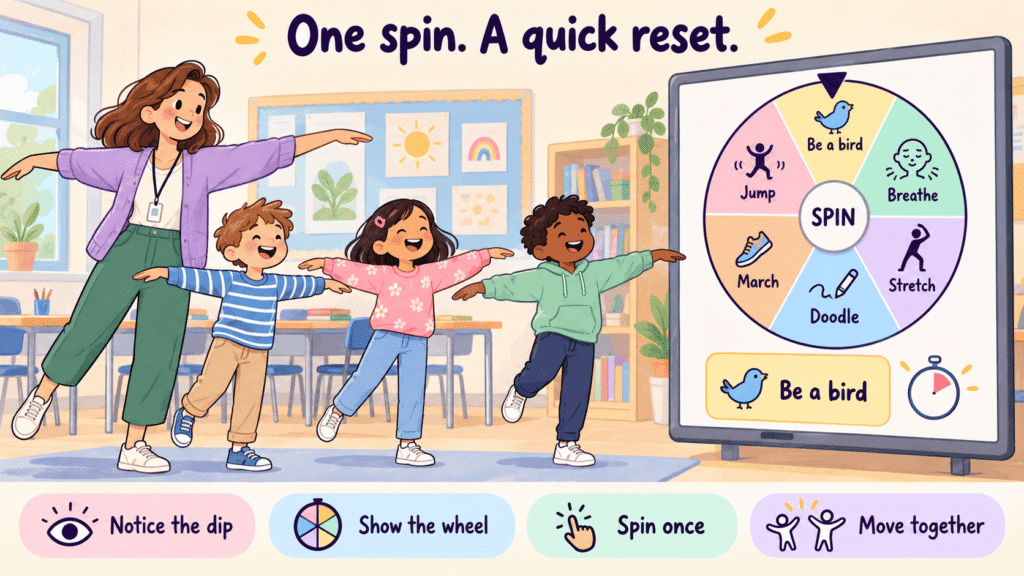
Running a brain break with the wheel comes down to four moves: catch the dip in attention, put the wheel where everyone can see it, spin a single time, and keep the activity short.
The trigger matters more than the tool. I break ideally near transitions, like packing up for indoor recess or the last minutes before the end of class, because a break there feels like relief rather than an interruption. The order below is the one I follow every time.
- Focus drifts are the cue, so open the spinner the moment heads drop instead of waiting for a fixed bell.
- Remote workers can share a screen the same way a teacher uses the board, so every person sees the same pointer.
- Quick classroom resets depend on one spin only, since a second spin invites bargaining.
- Deep breathing, a quick doodle, or a jump: whatever lands, everyone does it together and stops on time.
Last week the pointer landed on Be a bird, and the class moved like a hummingbird, then an eagle, a flamingo, a chicken, and finally a waddling penguin. On test-prep tension days I trim the list to calmer items the night before, because a bird parade is the wrong call before a practice exam.
When Should You Spin for a Brain Break?
Spin for a brain break when attention dips after a long stretch of seated work, and match the wheel’s theme to the school calendar so the breaks change with the month.
A themed wheel keeps kids curious about what the next spin will show. The monthly video set lines its wheels up with the school year like this:
| Month | Wheel theme |
|---|---|
| August | Back to School |
| September | Shows |
| October | Halloween |
| November | Fall and Thanksgiving |
| December | Christmas |
| January | Winter |
| February | Valentine’s Day |
| March | St. Patrick’s Day |
| April | Easter and Spring |
| May | Movies and Video Games |
| June | Summertime |
| July | Animals |
Timing inside the day matters as much as the month. Right after a long explanation I pick something slow, and after lunch something louder. I alternate physical exercises and mental exercises so the same kids aren’t always the ones who enjoy the break, and a printable paper wheel with six activities covers both kinds in one print.
Which Brain Break Activities Belong on the Wheel?
Brain break activities that belong on the wheel are short, need no equipment, and fit the space you actually have, which means mixing high-energy moves with gentle ones.
I sort candidates by noise. Movement-free entries like silent stretches or breathing resets go in during testing weeks, and quieter options like Silent reading keep the class next door happy. A loud entry such as Play Simon Says earns its place on Fridays, and Put your head down belongs at the end of a long day.
Length is the second filter, because longer breaks drag the room off course. Stretch for 1 minute is my default filler, and quick drawing prompts cover the kids who hate moving in front of peers. Subject-specific items, like spelling a vocabulary word with arm shapes, keep the lesson’s thread alive. I edit the list at the start of each month.
Balance across body skills is easy to check with a tagging habit borrowed from a shared Spin the wheel activity. That list is tagged Elementary and PE, and also Locomotor Skills, Non-locomotor Skills, and Balance Skills. If my wheel has nothing from one of those three groups, I add it.
How Does the Wheel Choose an Activity?
A digital brain break wheel chooses an activity with a random number generated in software, so the landing spot is decided by code rather than by how hard anyone pushes the button.
On a well-built digital wheel, every entry starts with equal odds, and that stays true by default unless a teacher sets customized weights. That design gives the class a fair way to land on a break without voting, which saves me from the same three kids lobbying for the same game. The result shows on screen for everyone at once.
Some classroom spinners go further and work as an open-ended template that keeps no scores and has no leaderboard, so nobody wins the spin. The pick there is just a pick.
A paper wheel shows the mechanical version of the same idea. A brad through the marked spot and the center lets the disc turn freely, and the activity that stops under the triangular window cut from page 3 is the one the class does. Friction makes it less even than code, which kids enjoy pointing out.
What Do the Monthly Digital Brain Break Wheels Include?
The monthly digital brain break bundle is a link-packed file of twelve themed wheels, sold as a digital download for $9.00, where each spin opens a short exercise video.
The pitch is zero prep: you open the wheel, click, and a video plays. Each wheel segment is one clip, so the teacher never hunts for a playlist in the middle of a lesson.
The listing targets Elementary classrooms and positions the clips as movement breaks spread across the school day. In my experience the dance-along format suits kids who freeze when asked to invent a move on their own.
The catch is dependency. Everything runs through an outside video host, so a blocked network takes out the whole set. My backup is the paper wheel, which needs only 8-1/2 x 11″ paper, scissors, tape, and a metal brad, the round-head fastener sold in any office aisle.
How Do You Build a Paper Brain Break Wheel?
You build a paper brain break wheel by printing a free classroom kit, cutting out the wheel and its frame, and fastening the two so the wheel turns by hand.
- PDF sheets two through seven come off the printer in color first.
- Cut the small viewing window out of the third sheet, then join the first two sheets edge to edge.
- Cut out both printed halves and join them; two extra halves stay as blank segments for ideas you write in.
- Push the fastener through the dot and the middle of the disc so it spins.
The finished wheel holds six moves of about 1-2 minute each. My class favorites are the Invisible hula hoop, done on one leg and then reversing direction, and Whispered jumping jacks, ten of them, counting in a whisper while smiling the whole time.
Paper has one edge over the digital set, with its 25 clips per wheel, 4.94 average from 119 ratings, and tags like Games and Coaching: it never needs a connection. The sheet carries a copyright line, so I treat it as a classroom resource, not something to resell.
Why Do Short Brain Breaks Help Focus?
Short brain breaks help focus because a minute of activity interrupts a long block of sitting, and a common claim says attention fades within the hour, sooner for younger kids, though that claim usually comes without a study.
I treat that as a working hunch, not a law. What I can see is that Giant breaths, in through the nose and out through the mouth, settle a room within a few cycles. That is why I lean on them for stress relief after a fire drill or any chaotic environment.
Cross-body movements are the other half of my toolkit. Touching an elbow to the opposite knee makes kids coordinate both sides of the body, and it works like mindfulness exercises with a pulse. Sensory resets, such as closing eyes and naming three sounds, do similar work without anyone leaving a chair.
When energy rather than nerves is the problem, a 30-second invisible dance party usually burns it off. Kids find it harder to sit through the next task when they skip that release, which is my observation from the room, not a measured result.
How Long Should a Brain Break Last?
A brain break should last about 1-3 minutes, and never more than a 2-5 minute window.
My own rule is to do the activity for exactly 3 minutes, then return to work, and that matches what I see in class. Past five minutes, kids treat the break as recess, so a teacher who wants to return to the lesson cleanly should call time out loud. For a feelings break, spin the random emotion wheel and have students act out or draw the emotion.
Some entries run long by nature. Silly drawing asks kids to balance a paper plate on their heads, sketch a favorite food without looking, and have a classmate guess it, so I save it for days with slack.
A figure often repeated online says focus holds for about 45 to 60 minutes, less for children, which suggests one break per lesson block rather than one per hour of the day.
Does Every Activity Have an Equal Chance?
Yes, every activity on a digital brain break wheel has an equal chance unless someone changes the weighting.
A good digital wheel picks its target from a crypto-backed random value in the browser, and with equal weights each entry has the same chance. The landing spot doesn’t depend on where a student taps or on previous spins.
In practice, a streak of three Cheetah Runs is just luck, because randomly drawn results do cluster now and then. When kids accuse the wheel of rigging the selection, I open the settings and show them the weights. That beats a teacher choosing by hand, since a human pick tends to drift toward whatever was fun last time.
Does a Brain Break Wheel Work for Older Students?
A brain break wheel works for teenagers as long as the entries are swapped for calmer, less childish picks.
The monthly video set lists grades PreK to 4th and the subjects Dance, Physical Education, and For All Subjects, so its content skews young. Middle schoolers will roll their eyes at cartoon dance-alongs.
With teens, I keep the spin and change the menu. When eyes glaze over in a double period, a stretch or a doodle gets them to engage without feeling silly, and the quick reset helps them get back to the task. The wheel still works because it removes the argument over what to do.
What If the Wheel Lands on an Activity That Doesn’t Suit the Room?
If the wheel lands on an activity that doesn’t suit the room, pass on that pick and spin a second time, or pull the entry off the list ahead of the next lesson.
I hit this most after tests and assemblies, or after noisy group work, when the job is calming the room, not hyping it up. A stomping entry at that moment undoes the point of the break.
Digital sets bring a different misfit: the clip itself won’t load. The seller’s notes for one video set say a video showing This video is unavailable usually plays after you refresh the page, that YouTube access is required, and that the clips are public videos the seller doesn’t own. Setting the wheel up in under 30 seconds before class means fixing a bad entry costs almost nothing.
Can You Add Your Own or Quieter Activities?
Yes, you can replace any entry on a brain break wheel, including swapping loud moves for calm ones.
For the monthly video set, a free account on the linked wheel tool lets a teacher add or remove clips. The seller’s tip is to delete each clip after use and redownload the original file at the end of the year. Look for a tool with unlimited free spins and no data collection, so building extra wheels costs nothing.
On a printable paper kit, you print pages 2-7 and tape pages 1 and 2 together. The printed wheel halves sit on pages 4 and 5, while pages 6 and 7 stay blank for entries you write yourself.
I keep a separate wheel for each lesson change. When a focus drop hits, I project the matching one and read aloud whatever lands. If an entry doesn’t fit the room, I skip it and spin again, and I fix the list beforehand next time.
Should a Brain Break Be Physical or Mental?
A brain break can be physical or mental, and good wheels carry both kinds, so the choice depends on what the room needs at that moment.
Physical picks suit the end of long direct instruction or screen-heavy work. A common explanation is that movement boosts oxygen and resets the nervous system, and even a brief physical movement shifts a sluggish room. The Expression walk sits between the two kinds: kids walk in place while their facial expressions move from unconcerned to hopeful, frustrated, or calm. For a calmer break, the yoga pose generator picks a beginner or balance pose for the class to try.
Mental picks fit between math and reading blocks, when kids need a change of channel more than a sweat. Ice Breaker Questions work for discussion warm-ups, and age-appropriate prompts keep teens on board. Adults using a wheel as a productivity tool can follow the Pomodoro Technique and spin during each 5-minute work break.
My rules are simple. I mix own activities with the preloaded ones and keep a few quiet options for testing weeks.