What Is a Random Dog Breed Generator and How Does It Work?
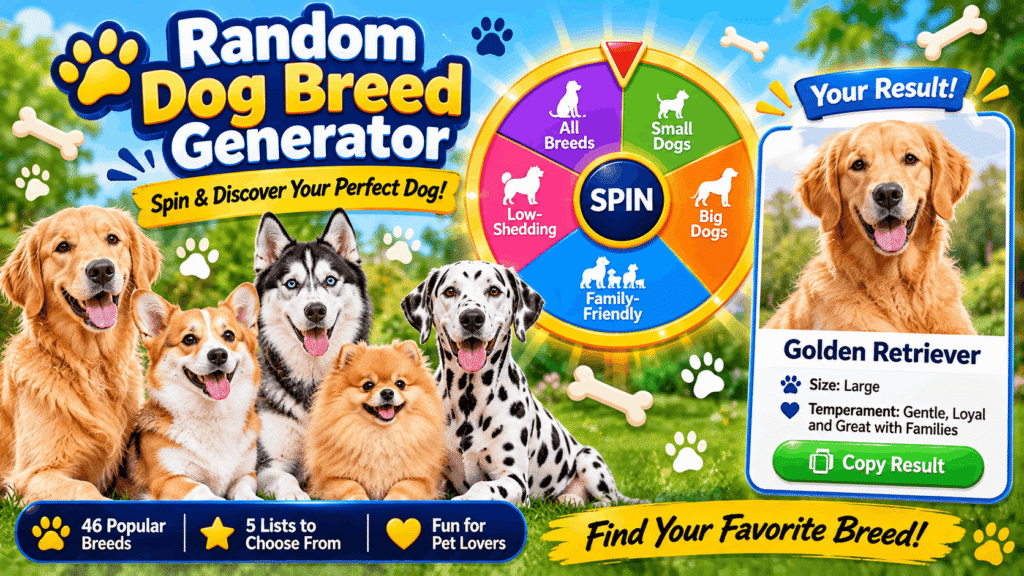
A random dog breed generator picks a dog breed for you at random and tells you its size and temperament. Click Spin, and in seconds the pop-up shows a result such as Golden Retriever, large, gentle, loyal and great with families.
The wheel holds 46 popular breeds, from the tiny Chihuahua to the Great Dane, and five lists: All breeds, Small dogs, Big dogs, Family-friendly and Low-shedding. It’s a quick way to learn about breeds, find inspiration for a drawing, or settle a debate when you can’t decide which dog is best.
Pet lovers use it for fun, students use it for projects, and future owners use it to discover breeds they hadn’t considered. Teachers use it for a trivia night or a classroom game, and artists use it to pick what to sketch next. Every breed is real, and every one descends from gray wolves, the first animal humans domesticated.
The generator is free, needs no sign-up, and works on a phone or laptop. To spin your own list of anything else, start from the main spin the wheel page.
Why Use a Random Dog Breed Generator?
A random dog breed generator helps when you can’t decide which breed to draw, study or daydream about. It also helps you discover less-known breeds you’d never search for on your own.
Most people can name ten breeds, usually the Labrador Retriever, German Shepherd and a few more. A spin takes you further, to breeds like the Basenji, the Vizsla or the Papillon, which adds variety to a project and makes it stand out. Many of these are popular in some countries and rare in others.
It works for entertainment too. Families spin at dinner and guess the breed’s size before reading the answer, and friends use it for a gift idea, such as a mug or print of the breed that lands. Teachers use it for trivia, students use it for research, and writers use it to choose a pet for a character.
Every slice has an equal chance, so there’s no favorite and no bias. Games like name that pup, a partner quiz, or a list of adjectives for storytelling all start with one spin. For a wheel that covers every kind of animal, from lions to lizards, try the random animal generator wheel.
How Do You Spin for a Random Dog Breed?
You spin for a random dog breed by choosing a list, pressing Spin or tapping the wheel, and reading the result in the pop-up.
- Pick a list by tapping its button: All breeds, Small dogs, Big dogs, Family-friendly or Low-shedding.
- Click Spin, or tap the wheel on a phone.
- Read the pop-up, headed Your dog breed. It shows the breed, its size and a short temperament note.
- Spin again for the next player, the next drawing or the next question.
- To add or remove breeds, type in the entries box, one per line. The wheel redraws as you type.
The result appears in seconds, so it works well for quick games. If you’re spinning for a group, take turns and write each breed down, or tick Remove winner so the same breed can’t come up twice.
You can also add breeds that aren’t on the list, such as an Afghan Hound, Saluki or Alaskan Malamute. Use Add entries, then Shuffle so the new slices mix in. Slice sizes work as weights, Full screen helps a group, and Remove winner acts as an elimination mode.
Which Dog Breeds Are on the Wheel?
The full list has 46 breeds, grouped here by size as the wheel shows them.
| Size | Breeds |
|---|---|
| Toy | Yorkshire Terrier, Chihuahua, Pomeranian, Maltese, Papillon |
| Small | French Bulldog, Beagle, Dachshund, Pembroke Welsh Corgi, Shih Tzu, Cavalier King Charles Spaniel, Shiba Inu, Bichon Frise, Havanese, Miniature Schnauzer, Basenji, Pug, Boston Terrier, Jack Russell Terrier, Shetland Sheepdog |
| Medium | Bulldog, Australian Shepherd, Border Collie, Portuguese Water Dog, Cocker Spaniel, Whippet, Bull Terrier, Vizsla |
| Large | Labrador Retriever, Golden Retriever, German Shepherd, Rottweiler, Siberian Husky, Boxer, Doberman Pinscher, Greyhound, Dalmatian, Akita, Samoyed, Weimaraner, Belgian Malinois |
| Giant | Great Dane, Bernese Mountain Dog, Saint Bernard, Newfoundland |
| Small to large | Poodle |
The Poodle has its own row because it comes in toy, miniature and standard sizes. Small breeds make up the biggest group, with 15, followed by 13 large breeds.
The world has 340 to 450 breeds, about 360 of them widely recognized, and one wheel online lists 373; this one keeps 46 familiar ones. Notes range from butterfly-eared and long-bodied to good in flats. Each result also shows a short temperament note, such as “smart, confident and protective” for the German Shepherd or “fast but calm and gentle at home” for the Greyhound.
Which Lists Can You Spin?
The wheel has five lists, so you can spin all 46 breeds or focus on one kind of dog.
| List | Breeds | Best for |
|---|---|---|
| All breeds | 46 | Any game or project |
| Small dogs | 20 | Apartment living and lap dogs |
| Big dogs | 17 | Active owners and big yards |
| Family-friendly | 14 | Homes with kids |
| Low-shedding | 9 | People who prefer less hair |
The Small dogs list includes toy breeds like the Chihuahua and Papillon plus small breeds like the Beagle. The Big dogs list adds the giants, from the Great Dane to the Saint Bernard. The Family-friendly list holds breeds known for patience, such as the Labrador Retriever, Golden Retriever and Cavalier King Charles Spaniel.
The Low-shedding list has nine breeds: Poodle, Shih Tzu, Yorkshire Terrier, Maltese, Bichon Frise, Havanese, Miniature Schnauzer, Portuguese Water Dog and Basenji. These lists match the filters many people use: size, kids and grooming. Low-shedding coats are often high maintenance, with regular brushing and a haircut, while the Basenji is low maintenance. Some other tools add energy and grooming filters, and you can copy that by typing your own list.
Which Small Dog Breeds Can You Get?
The Small dogs list has 20 breeds, from toy dogs that fit in a bag to sturdy small dogs with big personalities.
The toy breeds are the smallest. The Chihuahua is tiny, sassy and devoted, the Pomeranian is fluffy, bold and lively, and the Yorkshire Terrier is bold, feisty and low-shedding. The Papillon is friendly, alert and butterfly-eared, and the Maltese is a gentle, playful lap dog.
The small breeds have more variety. The Dachshund is brave, lively and long-bodied, the Pembroke Welsh Corgi is alert, smart and herding-minded, and the Shiba Inu is independent, alert and fox-like. The French Bulldog is playful, easygoing and good in flats, which makes it a favorite for apartment life.
At the extreme end, a teacup poodle can weigh just 0.46 kg, or 1.0 lb. Small doesn’t always mean calm. The Jack Russell Terrier is fearless and energetic, and the Beagle is curious and led by its nose. Spin the Small dogs list and read the temperament note before assuming a little dog is a lazy one. Many need as much exercise and training as bigger breeds.
Which Big and Giant Breeds Are on the Wheel?
The Big dogs list has 17 large and giant breeds, from athletic working dogs to the gentle giant breeds.
Large breeds include the Labrador Retriever, friendly, outgoing and eager to please, and the German Shepherd and Rottweiler, both loyal and protective. The Doberman Pinscher is loyal, alert and athletic, the Belgian Malinois is a driven, smart working dog, and the Weimaraner is energetic, friendly and silver-coated. The Dalmatian is energetic, spotted and outgoing.
The four giants are the Great Dane, a calm and friendly gentle giant, the Bernese Mountain Dog, which is good-natured and loves the cold, the Saint Bernard, patient and famous for rescues, and the Newfoundland, sweet-natured and a strong swimmer.
The Siberian Husky and Samoyed also love the cold, since both come from sled dogs bred for snowy work; dogs of 16–25 kg pulled sleds on Zhokhov Island about 9,000 years ago. Greyhound-type dogs appear in art from 3,000–4,000 years ago. At the top of the scale, a giant mastiff can reach 90 kg, or 200 lb. Spin the Big dogs list if you want a breed for running, hiking or guarding.
Which Dog Breeds Are Best for Families?
The best dog breeds for families are usually friendly, patient and playful, and the wheel’s Family-friendly list has 14 of them.
| Breed | Why families like it |
|---|---|
| Labrador Retriever | Friendly, outgoing and eager to please |
| Golden Retriever | Gentle, loyal and great with families |
| Beagle | Curious and merry |
| Boxer | Playful, bouncy and patient with kids |
| Cavalier King Charles Spaniel | Gentle, affectionate companion |
| Newfoundland | Sweet-natured and a strong swimmer |
The list also includes the Bichon Frise, Havanese, Pug, Boston Terrier, Cocker Spaniel, Bernese Mountain Dog, Shetland Sheepdog and Samoyed. These breeds are generally known for being good with young kids, but every dog is different.
A gentle giant like the Newfoundland, or the Saint Bernard, famous for rescues, can suit a calm home with space. Families with allergies may prefer a hypoallergenic, low-shedding breed with less shedding, and flat faces on breeds like the Pug can mean breathing problems and more veterinary visits. Before you adopt or buy, meet a dog in person. Breed traits are general tendencies, not guarantees, so children should always be supervised with any dog. Spin the Family-friendly list to start a family conversation.
Which Dogs Are Low-Shedding or Hypoallergenic?
Low-shedding dogs lose less hair, and the wheel’s Low-shedding list has nine of them. Some people call these breeds hypoallergenic, but no dog is completely free of allergens.
The nine are the Poodle, Shih Tzu, Yorkshire Terrier, Maltese, Bichon Frise, Havanese, Miniature Schnauzer, Portuguese Water Dog and Basenji. Most have hair-like coats that keep growing, so they shed less but need regular brushing and a haircut every few weeks.
That’s the trade-off: low shedding often means high maintenance grooming. The Basenji is the exception, with a short coat that’s low maintenance and almost odorless. The Portuguese Water Dog is an athletic swimmer with a curly coat that needs trimming.
The Bichon Frise and Havanese are affectionate, family dogs that are good with young kids, and the Yorkshire Terrier is feisty, while the sassy Chihuahua isn’t on the low-shedding list. Short coats like the silver-coated Weimaraner and the spotted Dalmatian still shed. If you have allergies, spend time with a breed before committing, because reactions vary from person to person. Spin the Low-shedding list to see the options, then read about each coat type.
Which Dog Breeds Are the Smartest?
Border Collies are often called the smartest and most trainable dog breed, with Poodles and German Shepherds close behind. All three are on the wheel.
The wheel’s notes reflect this. The Border Collie is extremely smart and needs lots of work, the Poodle is very smart and low-shedding, and the German Shepherd is smart, confident and protective. The Australian Shepherd is an energetic, clever herding dog, and the Belgian Malinois is a driven working dog used by police and military teams.
Smart dogs learn fast, but they also get bored fast. They need mental exercise, such as puzzle toys, obedience training and new tricks, as well as physical activity. A bored Border Collie may invent its own jobs, like herding children or chewing furniture.
The herding-minded Corgi and the fox-like Shiba Inu are smart too, but more independent. A veterinarian, breeder or behaviorist can tell you whether a smart breed fits your schedule. Spin the full list and rank the results by how much training they’d need. It’s a fun way to learn which breeds suit busy owners and which suit people who love daily training.
How Many Dog Breeds Are There?
There are about 340 to 450 dog breeds in the world, depending on which organization you ask. A common figure is around 360 recognized breeds.
The FCI, the International Canine Federation, recognizes about 356 purebreds and lists 339 breeds in 78 groups in its nomenclature, with 98 or 99 member countries. The American Kennel Club recognizes fewer, around 200. Some wheels online try to include them all, with one listing 373 breeds.
The first national kennel club was The Kennel Club in the UK, founded in 1873, in the Victorian era of 1830–1900, when most breeds were created in the 19th century, less than 200 years ago. Dogs are the most variable mammal on Earth, which is why so many breeds exist. The American Kennel Club followed in 1884, then the New Zealand Kennel Club in 1886, the Canadian Kennel Club in 1888 and the United Kennel Club in 1898.
A few countries created most breeds. Great Britain and France each have 57 FCI-recognized breeds and Germany has 47, so these three account for more than 40% of the total. To explore where breeds come from, the random country generator picks a country to research next.
What Are the Dog Breed Groups?
Kennel clubs sort breeds into groups by their original job. The common groups are Hound, Terrier, Working, Herding, Sporting, Non-Sporting, Toy and Miscellaneous.
| Group | Original job | Example on the wheel |
|---|---|---|
| Hound | Hunting by sight or scent | Beagle, Greyhound, Basenji |
| Terrier | Hunting vermin | Jack Russell Terrier, Bull Terrier |
| Working | Guarding, pulling, rescue | Rottweiler, Saint Bernard, Siberian Husky |
| Herding | Moving livestock | Border Collie, Australian Shepherd |
| Sporting | Finding and retrieving game | Labrador Retriever, Vizsla |
| Non-Sporting | Mixed roles | Dalmatian, Bulldog |
| Toy group | Companion dogs | Chihuahua, Papillon |
The Miscellaneous class is for breeds still working toward full recognition. Ancient breeds like the Basenji and Chow Chow, a Non-Sporting breed, are among the oldest. Grouping dogs by job goes back to The Master of Game, around 1406, and The Book of Saint Albans, from 1486. The FCI lists 339 breeds in 78 groups, recognizes about 356 purebreds and has 98 or 99 member countries. Some clubs also use a Companion group for lap dogs.
Herding breeds may nip at heels, hounds follow their noses, and terriers dig. Spin the wheel and guess the group before checking the table. For more animal facts like these, the random fact generator gives a new one with every click.
Where Did Dog Breeds Come From?
Nearly all dog breeds come from gray wolves. The dog was the first species humans domesticated, and most modern breeds are less than 200 years old.
Domestic dogs lived on Zhokhov Island in the Arctic about 9,000 years ago, where sled dogs of 16–25 kg pulled loads, close to the modern Siberian Husky. Greyhound-type dogs appear in art from 3,000–4,000 years ago, and medieval books like The Master of Game, from about 1406, and The Book of Saint Albans, from 1486, describe dogs by their jobs.
Most breeds we know today were created in the Victorian era, from 1830–1900, and genetic studies show modern breeds emerged in the 19th century. A few ancient breeds are older, including the Basenji, Saluki, Afghan Hound, Samoyed, Chow Chow, Akita, Alaskan Malamute and Siberian Husky.
The science is precise. A 2004 study of 414 dogs from 85 breeds matched 99% of them to the right breed by DNA. A 2010 study of 912 dogs found 13 genetically divergent breeds, and a 2012 study of 1,375 dogs covering 121 breeds found 16 basal breeds.
Are Mixed-Breed Dogs Healthier?
Mixed-breed dogs are often healthier than purebred dogs, thanks to hybrid vigor, though it isn’t guaranteed for every dog.
Purebred dogs tend to have more health problems and more veterinary visits, and their lifespan is shorter by about one to almost two years on average. Breeds with flat faces and short noses, such as the Pug, French Bulldog and Bulldog, often have breathing difficulties and eye problems.
A crossbreed is a mix of two breeds. Hybrid vigor, also called heterosis, is usually strongest in first-generation crosses. Mixed-breed dogs, or mongrels, aren’t bred on purpose, and there are an estimated 150 million of them worldwide.
DNA shows how distinct breeds are: a 2004 study of 414 dogs from 85 breeds matched 99% to the right breed, and later studies of 912 and 1,375 dogs, covering 121 breeds, found 16 basal breeds. The American Kennel Club now lets mixed-breed dogs compete in some events if they’re spayed or neutered. If you love a breed on the wheel but care most about health, look for a healthy mixed dog with some of that breed’s traits at a shelter.
What Are the Biggest and Smallest Dogs?
Dogs range from a 0.46 kg, or 1.0 lb, teacup poodle to a 90 kg, or 200 lb, giant mastiff. That’s why dogs are called the most variable mammal on Earth.
On the wheel, the smallest results are toy breeds like the Chihuahua, Yorkshire Terrier and Pomeranian. The biggest are the giants: the Great Dane, which is famous for its height, and the Saint Bernard and Newfoundland, which are famous for their weight.
Size affects everything from food bills to lifespan. Giant breeds need more space, bigger beds and stronger leads.
Giant breeds like the Saint Bernard, which loves the cold, also tend to live shorter lives, and purebred lifespans run one to almost two years shorter than mixed dogs on average. Size doesn’t predict brains: the Papillon is clever and trainable, Poodles are among the most intelligent, and the Border Collie needs lots of work, mental exercise and obedience training. For a quick game, spin twice and compare the two breeds’ height and weight. A Chihuahua next to a Great Dane shows just how far dog breeding has gone.
Can You Use the Wheel to Choose a Dog to Adopt?
No. The wheel is for fun and learning, not for deciding which dog to adopt or buy. A random result can’t know your home, your schedule or the individual dog.
Breed traits are general tendencies, not guarantees, and every dog has its own personality. Before adopting, think about energy level, grooming needs, the size of your yard and how much time you have each day. Talk to a veterinarian, a reputable breeder or a behaviorist, and always meet a dog in person.
The wheel can still help you start. Spin the Family-friendly or Low-shedding list to get ideas, read about each breed, and then visit a shelter. Many shelters have dogs with the traits you like, including mixed-breed dogs and mongrels, of which there are about 150 million worldwide. A first-generation crossbreed often shows hybrid vigor, also called heterosis.
Shelter volunteers also use breed wheels for fun events and kids’ activities, which help people learn about dogs before they commit.
How Do Teachers and Artists Use It?
Teachers and artists use the wheel for drawing prompts, quizzes and writing games.
For drawing, spin and sketch the breed in 2–5 minutes. A popular exercise is the silhouette challenge: spin three breeds, draw only the outline, ear shape, coat and proportions, then swap with a partner quiz to guess which breed is which.
For name that pup, spin a breed and invent a fitting name, then use the random name generator for more ideas.
Older students can sort results into Sporting, Non-Sporting, Toy group, Miscellaneous or hunting breeds, and learn that The Kennel Club began in 1873, followed by the American Kennel Club (1884), New Zealand Kennel Club (1886), Canadian Kennel Club (1888) and United Kennel Club (1898). Compare each breed’s height, and if students add photos, check image licenses; every breed is Canis lupus familiaris, whatever its origin. In the classroom, students can spin a breed and list adjectives that describe it, or use it in storytelling. Pair it with the creative writing prompt generator for a full story, or with the trivia questions page for a wider quiz. For a fun twist, the random spirit animal generator works the same way.
Which Wheel Settings Should You Use?
The settings that matter most are Add entries, Remove winner and Slice sizes, because they decide which breeds can land and how often.
| Setting | What it does | When to use it |
|---|---|---|
| Add entries | Type your own breeds | Adding rare or local breeds |
| Remove winner | Takes the result off the wheel | Class projects with no repeats |
| Shuffle | Mixes the order of the slices | After adding many breeds |
| Slice sizes | Makes one slice bigger than another | Giving weights to favorites |
| Full screen | Fills the screen with the wheel | Classrooms and streams |
Remove winner works like an elimination mode, so every student gets a different breed. Other tools show 1, 3, 5 or 10 results at once with no repeats, or 5, 10 or 15 with Show All and Download buttons. Some wheels let you spin up to 6 wheels at once or make share links. Here you spin one at a time, which keeps things simple.
Streamers can add the wheel to a broadcast with the OBS wheel, so viewers see each breed land.
Does the Wheel Show Pictures?
No, this wheel shows the breed name, size and temperament, not photos. That keeps it fast and works well for guessing games, where players picture the breed themselves.
If you want pictures, search the breed name after you spin, or use a breed gallery. Some other tools show photos of up to 10 breeds at once with origin, lifespan and the scientific name, Canis lupus familiaris, which every breed shares. If you use images for a project or a post, check the image licenses first.
Without photos, drawing games get harder and more fun: spin a Whippet, sketch it in 2–5 minutes, and focus on the silhouette, outline, ear shape and proportions. Many breeds trace their origin to Great Britain, France or Germany; Great Britain and France have 57 FCI breeds each and Germany 47, more than 40% of the total. You can see how the spins are checked on the randomness audit page. For cat lovers, the warrior cat name generator offers a feline twist.
Is the Random Dog Breed Generator Free?
Yes, it’s completely free. There’s no sign-up, no account and no download, and it works in any browser on a phone, tablet or laptop. Spin as often as you like for games, drawings, projects or just for fun. Pick a list, tap Spin, read the pop-up headed Your dog breed, and spin again whenever you want. Type names in the entries box, one per line, and the wheel redraws instantly.
Pet lovers use it for entertainment, future owners for inspiration, and friends for a gift idea or a less-known breed to read about. Some other tools offer no repeats with 1, 3, 5 or 10 results, or 5, 10 or 15 at once with Show All, and some wheels spin up to 6 wheels at once or make share links. This one keeps it to one quick spin, with photos, pictures, images and a gallery left to your own search. It is one of our free random idea tools, all in one place.