How Does a Would You Rather Generator Work?
A Would You Rather generator is a free web tool that serves up a random two-option question on demand, so a group can choose a side, explain the pick, and move on without anyone having to invent balanced options.
I’ve run this conversation game at work lunches, sleepovers and long car rides, and the generator changes the mood more than people expect. Instead of one person stalling to build a fair pair, the tool forces a choice on everyone at once. That either/or framing matters, because a vague question lets people mumble while two fixed options make them commit. For a spinning version of a classic party game, try the truth or dare spinner.
Most Would You Rather generators sort their questions by mood. You’ll usually see Kids, Funny and Deep sets, which run from absurd hypotheticals about superpowers to everyday dilemmas about money, sleep and work. Matching the mood to mixed company is half the job of whoever is hosting.
The practical side is simple. A good Would You Rather tool is completely free to use, runs in a browser on mobile devices and desktops, and needs nothing more than one press to deal a fresh pair. Where the tools really differ is in how they handle group play, printing and repeats, which is where the details below come in.
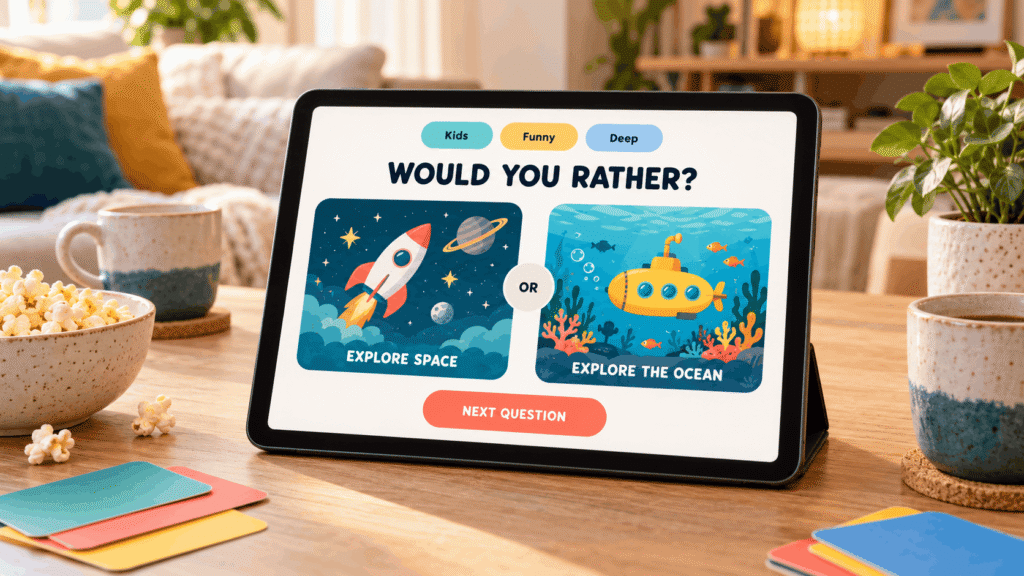
How Do You Play Would You Rather With a Generator?
You play Would You Rather with a generator by loading a random question, letting every player choose one of the two sides, and having each person say why before you load another.
The usual minimum is two people, one asking and one answering, but I find the round only starts to breathe once you have 3 players or more. This is the loop I run when I’m hosting:
- Tap the generate button; most tools deal a fresh pair per click, shown as Question A and Question B.
- Pick a side silently first, or write answers down if your group tends to copy the loudest voice.
- Reveal them together, so nobody can switch sides after reading the room.
- Volunteer one person to argue their pick for 30 seconds, then load a new pair once everyone has finished.
The order of those steps matters more than it looks. When people announce answers one by one, later players drift toward the majority and the round goes flat. A hidden pick followed by a joint reveal keeps every position honest.
Take the classic pairing of being able to fly or being invisible. Nobody gets to shrug that one off, and the entertainment comes from defending your choice, whether that means skipping airport security or overhearing what your coworkers really think.
What Rules Make a Would You Rather Question Work?
Would You Rather has one firm rule: every question must offer exactly two options, and a question plays best when those options are so evenly matched that there is no easy answer.
Everything else is house style. I’ve watched groups add timers, scoring and vetoes, but none of that rescues a lopsided pair. If one side is plainly better, the round ends in a second and nobody learns how they think. A proper dilemma needs two choices that pull with roughly the same force.
That pull can run in either direction. Having hiccups for a year against feeling like you need to sneeze for a year is a pair of small miseries, while a photographic memory against an IQ of 200 is a pair of gifts. Both are tricky for the same reason: no option wins on obvious merit.
A useful test is the timer in your head. When the table splits close to 50/50 and someone explains why at length, you’ve found the kind of question a Hard filter is supposed to deliver. The most controversial pick of the night is usually one where the reasoning matters more than the pick itself, and that is what makes a pair thought-provoking rather than a coin toss.
Pairs built on arguable propositions, such as whether fame beats wealth, tend to survive longer than pure gross-out choices.
How Many Players Do You Need for Would You Rather?
Would You Rather needs only two people, has no upper limit on group size, and can even be played by one person with a generator, so the real question is which format suits the size of your crowd.
Group size changes the game more than the questions do. With two people it feels like a private chat; with twelve it becomes a loud discussion where a few voices dominate unless you add structure. These are the formats I match to headcount:
- Couples predict: two partners answer, then guess each other’s pick and score correct guesses.
- Predict-your-friend: in a small circle, each player guesses a neighbor’s answer for a point.
- Classic circle: everyone answers the same pair, then one person has to defend the choice out loud.
- Guess the split: mid-sized groups predict what percentage will choose option A, and the closest guess scores.
- Chain rule: whoever ends up on the smaller side reads the following pair, which keeps quiet players involved.
- Majority rules: big groups vote, and the outnumbered side has to justify itself.
- Four corners: students walk to a wall labeled A or B, which doubles as an ESL speaking exercise.
For a party of eight I default to guess the split, and for two people on a long drive couples predict wins every time. Matching the format to headcount is what keeps every person talking instead of watching.
Why Use a Generator Instead of Making Up Questions?
A generator beats making up questions on the spot because it supplies two options that are already balanced, which takes the hardest job away from whoever is asking and keeps the game moving.
I learned this the slow way. Hosting without a tool, I’d spend half a minute building a pair, and it usually came out lopsided. Writing two choices that feel equally interesting or equally difficult is a craft, and few people can do it live, again and again, for an hour.
Library size is the next factor, and the numbers vary widely. One tool advertises 1000+ questions in its page title yet says over 500 in its body text, a printable builder draws from a bank of 1,000, another tool promises hundreds of questions, and a hand-picked deck stops at 60+. Bigger is not automatically better, because a small curated set of strong pairs can outlast a huge bank of filler.
Speed is where a generator pays off. If a pair falls flat, you can skip it and load another instantly, so the round runs without pauses, and one card-style tool simply reshuffles once its deck runs out. That steady flow of prompts is what helps a quiet table spark conversation and settle into real back-and-forth, which loose open-ended prompts rarely manage because they let people dodge.
What Are Fun Ways to Play Would You Rather?
The most fun ways to play Would You Rather add one small twist to the basic round, such as banning a middle answer, making the outvoted side argue its case, or turning the questions into a card game.
The twist I use most is a flat ban on “neither.” Every player commits, and the minority side then defends its pick briefly after a vote. That tiny rule turns a quick poll into a short debate, and it is where groups get to know each other, because people reveal opinions they would never raise unprompted.
Pace is the other lever. Immediate answers tell me a pair is too easy, so I swap it out; long deliberation tells me to slow down and let more perspectives surface. A pair like being able to teleport anywhere instantly or read minds at will can run ten minutes at the right table.
Card versions suit icebreakers and table games. Printing Cut-Out Cards lets guests draw from a pile, and I keep a few edgier pairs, like having your browser history public versus your bank balance public, for adults-only nights.
Which Question Topics and Decks Can You Pick From?
Would You Rather generators let you choose from topic filters, themed sets or tone styles, and picking the right one is what keeps a question set suitable for the people in the room.
Tools split their libraries in different ways. Some use mood tags, others keep just three decks, and printable builders sort questions by occasion. I treat the theme as the “where” and the tone style as the “how much chaos,” and the table below shows how I pair them:
| Tone style | Themes I pair with it | When I reach for it |
|---|---|---|
| Clean Family | Mixed Family Fun, Classroom, Christmas | Sunday dinners, family nights, morning warm-ups and holiday get-togethers |
| Funnier | Party, Road Trip, Outdoors | Birthdays, long drives with a phone passed around, camping trips |
| Extra Silly | Animals, Rainy Day, Halloween | Younger players, stuck-inside afternoons, October sleepovers |
Theme alone doesn’t settle the tone, though. A pair like a dragon the size of a cat versus a cat the size of a dragon lands well with eight-year-olds, while one horse-sized duck against a hundred duck-sized horses works on kids and adults alike. If you’re playing just for fun with no audience to worry about, mixing themes keeps the evening unpredictable.
What Kinds of Dilemmas Fill a 60-Question Deck?
A 60-question Would You Rather deck mixes three kinds of pairs, namely silly hypotheticals, life trade-offs and impossible food choices, each written so both sides feel equally appealing or equally unappealing.
The hand-curated list I tested runs from superpowers and animals to money, careers and travel. A good share of its pairs are pure nonsense, the Silly and Crazy material that rescues awkward silences. The rest ask about habits, comfort and ambition, which is why the same dedicated deck holds up in sleepy classrooms and on long road trips.
Two-option pairs outperform open questions for a simple reason: a pair gives people a frame. Ask what someone would change about their life and you get blank faces; offer two concrete swaps and you get an argument. The deck also carries no adult themes, so it can be shuffled into almost any crowd.
Facilitator tip: if you like having paper on the table, use the Print deck option or the companion printable list of 80 questions, then star the pairs that split your group, because those are the ones worth replaying.
How Do You Print a Would You Rather Question Set?
You print a Would You Rather question set by choosing a theme, a question count and a layout, generating the list, and then sending it to your printer or exporting it as a PDF file.
Printable builders work differently from on-screen tools that show one question at a time. Instead of a single pair, they produce printable question sets pulled from a built-in library, and a builder that removes duplicates saves you from proofreading the sheet for duplicate questions yourself.
Before generating, I settle the count. Screen-based tools often give you a Number of Questions field and a Copy button, so you can paste pairs into a document and mix topic filters such as All General, Teens, Weird, Food or Fun into one handout.
Paper also changes how people play. A printed sheet means every pair offers one of two options with no screens in sight, and in my tutoring groups the kids grab the challenging ones first. I print a short stack as a bell-ringer, and the same layout works smoothly on tablets if you’d rather skip the printer.
What Is the Would You Rather Game?
Would You Rather is a talking game in which one player poses a question with two alternatives and everyone else says which one they would prefer and why.
The only rule is the two-option format. There is no board, no built-in winner and traditionally no points: one person reads a question, the circle answers, and the entertainment lives in the explanations that follow.
Scoring is optional, and I’m firmly in the camp that adds it for competitive groups. Award a point for the most convincing answer, or have the outvoted side perform a small forfeit chosen by the majority. Teachers can stretch the same format into one paragraph of written argument, which shows the game works on paper as well as out loud.
Are Would You Rather Generator Questions Clean Enough for Kids?
Most Would You Rather generators aim for clean, family-friendly questions, but tone settings vary, so check which set is selected before playing with young children.
The decks I’ve used are party-safe by design. Their gross-out end tops out at pairs like swimming in a pool of chocolate or a pool of cheese, or whether you’d rather sneeze glitter or cry maple syrup.
Deeper sets are aimed at teens and adults, not because they are crude but because questions about death dates and career regrets land better with older players. My rule as a host is to preview five pairs before handing a phone to a nine-year-old, which takes less than a minute and avoids awkward moments.
Do Would You Rather Questions Repeat?
Well-built Would You Rather generators show no repeats until you’ve worked through the whole deck, and printable builders strip duplicates out of each set they make.
On a card-dealing tool, you Choose a deck and press for the next question. A pair like always being 10 minutes late versus always being 20 minutes early won’t come back until every other card has been dealt, which makes the tool fine for daily use with the same group.
Printable builders handle it another way. Each press of Generate Questions builds a fresh set, Shuffle Again reorders it, and Clear Printable wipes the page back to the “Your questions will appear here” placeholder. Once your group has played through everything, adding custom questions is the fastest way to keep things new.
Can Teachers Use a Would You Rather Generator in Class?
Teachers can use a Would You Rather generator as a quick starter, a writing prompt or a speaking drill, and the two-option format works with a full classroom as easily as with a small group.
For writing, I treat one pair as a persuasive-writing prompt or a classroom writing prompt, where learners pick a side and defend it. A strong question, such as winning an Olympic gold medal or a Nobel Prize, gives them real material to argue. A Classroom debate seed works the same way, and argument generators can supply the follow-up topic.
For speaking practice, ask each learner to answer in a full sentence. There is no maximum class size, and larger groups bring a wider range of answers to compare.
Printable builders help with prep. A Question List layout fits classroom warm-ups, set sizes run 10, 20, 30, 40, 50, 75, 100, and you can Show Numbers for easy reference or Hide Numbers for a tidier sheet.
How Is a Would You Rather Generator Different From Other Question Tools?
A Would You Rather generator differs from other question tools because every result is a two-option dilemma, while general prompt tools hand out single questions that people can answer any way they like.
That narrow format is the whole point. Because nobody is inventing questions, the game moves faster and keeps the pace up, which in my experience makes it more fun than an open prompt that invites a ramble. Some tools add no-repeat cycling, so nothing returns until the full deck has been seen, and a button like “Generate Another Random Question” keeps the next pair one press away.
You also get a clear quality signal. Watch how long players take, because a quick answer marks a weak question. At least one site invites visitors to submit questions and send suggestions for improving the tool, and you can still play alone or turn a pair into a persuasive writing warm-up.
Is a Would You Rather Generator Free to Use?
Yes, Would You Rather generators are typically free, and the ones I use run in the browser with no sign-up and nothing to install.
That makes it a genuinely free online game for family game nights, since nobody needs an account to ask whether they’d want unlimited money or unlimited free time.
Printable builders keep the extras free as well. You can add a printable title and subheading, hit Print / Save PDF, and pass the setup along with Share Generator Link without paying anything. In my experience the only cost is printer ink, and keeping the PDF on a phone avoids even that.
Does a Would You Rather Generator Work on a Phone?
Yes, Would You Rather generators work on phones, as long as the browser has JavaScript turned on, which most browsers do by default.
On a phone or tablet, I copy pairs straight into a group chat; asking friends whether they’d give up your phone for a month or give up showering for a week gets replies within seconds. Playing solo on a commute is a decent way to test your own thinking, especially with pairs like whether you’d never lose your phone again or never lose your keys again.
Printing from a phone works too. Choose Save as PDF in your browser’s print options, then pick A4 or US Letter paper so the sheet matches your printer. Shortlist your best results, then let the wheel spinner pick the winner.
Where Can You Find More Would You Rather Questions?
You can find more Would You Rather questions by using a generator, which gives you hundreds of prompts right away, or by working from a complete list like the 60-question deck below.
Every question generator I’ve tried draws on pairs like these, and I keep this full set as my baseline when I’m checking whether a new tool’s library is any good:
| # | First choice | Second choice |
|---|---|---|
| 1 | Be able to fly | Be invisible |
| 2 | Always be 10 minutes late | Always be 20 minutes early |
| 3 | Have unlimited money | Have unlimited free time |
| 4 | Live without music | Live without movies |
| 5 | Fight one horse-sized duck | Fight a hundred duck-sized horses |
| 6 | Be the funniest person in the room | Be the smartest |
| 7 | Never use social media again | Never watch another TV show |
| 8 | Speak every language fluently | Play every instrument perfectly |
| 9 | Have a rewind button for your life | Have a pause button |
| 10 | Always know when someone is lying | Always get away with lying |
| 11 | Live in a big city forever | Live in a small town forever |
| 12 | Lose the ability to read | Lose the ability to speak |
| 13 | Eat your favorite meal every day forever | Never eat it again |
| 14 | Be famous but poor | Be unknown but rich |
| 15 | Teleport anywhere instantly | Read minds at will |
| 16 | Never have to sleep | Never have to eat |
| 17 | Have hiccups for a year | Feel like you need to sneeze for a year |
| 18 | Time travel to the past | Time travel to the future |
| 19 | Give up coffee forever | Give up dessert forever |
| 20 | Work your dream job for average pay | Work a boring job for double pay |
| 21 | Be able to talk to animals | Be able to speak to plants |
| 22 | Always have to sing instead of speak | Dance everywhere you walk |
| 23 | Know the date of your death | Know the cause of your death |
| 24 | Relive the same perfect day forever | Live a normal changing life |
| 25 | Have a photographic memory | Have an IQ of 200 |
| 26 | Be stuck on a desert island alone | Be stuck there with someone you dislike |
| 27 | Never be stuck in traffic again | Never wait in line again |
| 28 | See 10 years into your own future | See 100 years into the world’s future |
| 29 | Have free flights for life | Have free food for life |
| 30 | Accidentally send a text to your boss | Accidentally send it to your ex |
| 31 | Live without air conditioning | Live without heating |
| 32 | Have a personal chef | Have a personal driver |
| 33 | Only whisper for the rest of your life | Only shout |
| 34 | Be a master of every sport | Be a master of every board game |
| 35 | Wake up as a new random person every year | Stay yourself forever |
| 36 | Have every red light turn green | Always find a parking spot |
| 37 | Swim in a pool of chocolate | Swim in a pool of cheese |
| 38 | Be feared by all | Be loved by all |
| 39 | Never lose your phone again | Never lose your keys again |
| 40 | Have summer all year | Have winter all year |
| 41 | Live in a treehouse | Live in a houseboat |
| 42 | Have to say everything you think | Never speak your opinion again |
| 43 | Be an average player on a championship team | Be the star of a losing team |
| 44 | Redo your teenage years | Skip straight to retirement savings |
| 45 | Own a private island | Own a private jet |
| 46 | Always smell like onions | Always have spinach in your teeth |
| 47 | Be a famous villain in movies | Be an unknown hero in real life |
| 48 | Give up your phone for a month | Give up showering for a week |
| 49 | Understand every language’s jokes | Be hilarious in your own |
| 50 | Explore deep space | Explore the deep ocean |
| 51 | Have unlimited books | Have unlimited streaming |
| 52 | Sneeze glitter | Cry maple syrup |
| 53 | Rewatch only one movie forever | Never rewatch anything |
| 54 | Be your own boss working 80 hours | Be an employee working 40 |
| 55 | Have a dragon the size of a cat | Have a cat the size of a dragon |
| 56 | Win an Olympic gold medal | Win a Nobel Prize |
| 57 | Taste everything you smell | Smell everything you taste |
| 58 | Live 200 years in good health | Live 3 extraordinary lifetimes of 60 |
| 59 | Have your browser history public | Have your bank balance public |
| 60 | Befriend your favorite celebrity | Befriend your childhood hero |