What to Wear Wheel: How Can a Spin Choose Your Outfit Today?
A what to wear wheel is a spinner filled with outfit ideas, colours, or pieces from your own wardrobe, and one spin picks one look so you can stop debating and start getting dressed.
The reasoning behind that answer runs backwards from the mirror. Getting dressed is a daily decision, and it usually lands at the hour when you are least patient: coffee half made, bus due, one sock missing. Picking the colour or overall direction is the hard part of getting dressed; once that is settled, the shoes and the jacket sort themselves out.
I started using an outfit wheel during a stretch of early shifts, mostly as a joke. What surprised me was how quickly the joke became a habit. The wheel never chose anything I hated, because every slice was one of my own acceptable choices, written in plain words I could read half asleep.
A what to wear wheel also fixes a quieter problem. Most of us cycle through a handful of familiar outfit combinations while perfectly good real clothes sit untouched at the back of the rail. A spin pulls those pieces back into rotation without any style lecture attached.
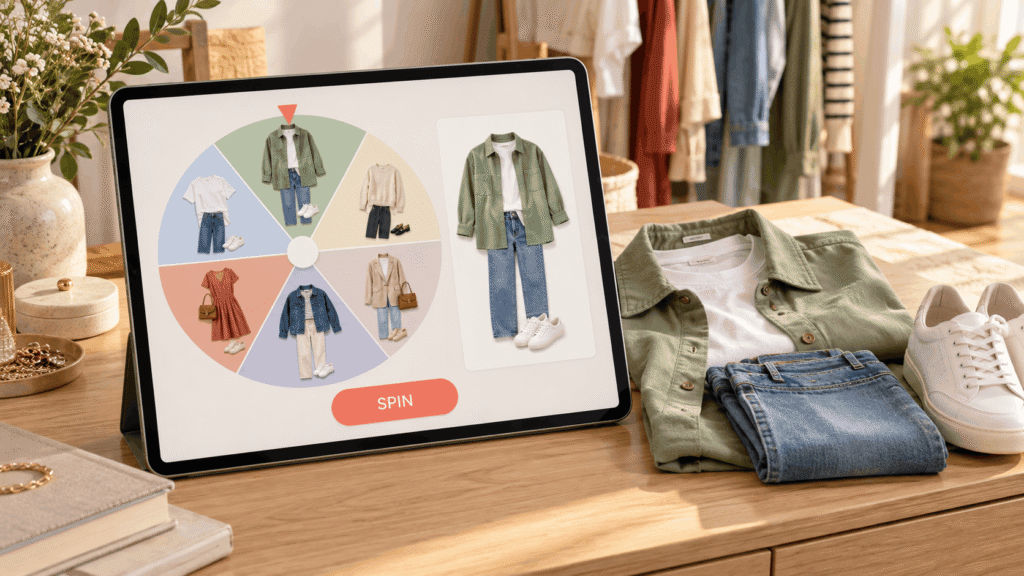
How Does a What to Wear Wheel Work?
A what to wear wheel works by dividing a circle into slices, each holding one outfit idea, and the pointer’s stop is randomly generated, so the slice it lands on becomes your outfit for the day.
In practice the setup takes moments, and the spin itself happens in seconds. You type each item on its own line, the circle refreshes, and a tap shows which item comes up next. Some ready-made versions load 41 outfit style options from the start, while a homemade list might hold only five or six favourites.
The more useful versions behave like a layered random outfit generator. You spin once for an outfit style, again for a main color, then a third time for footwear. Working in layers means a single result never has to describe a whole person.
My own routine is simpler: I spin three times, one wheel each for top, bottom, and shoes, and every slice on those wheels names something hanging in my room. A wheel built from clothes you already own stops being a novelty and turns into a quick way to shop your own rail.
What Outfit Ideas Come on a Starter Wheel?
A starter what to wear wheel usually comes with broad outfit ideas that mix everyday basics such as a denim look with statement looks like a retro mix or a leather look, so the first spin works before you have customised anything. Once the outfit is set, the makeup wheel can pick the look, eyeshadow color or lip shade to match.
The size of starter wheels varies a lot. One common version randomly selects from 11 outfit slices that describe comfort levels and weather, while another begins with just eight options written loosely enough to cover most wardrobes. Several style-led wheels go further and name aesthetics such as urban style.
Loose labels are a feature, not a weakness. A slice that says “smart” leaves you room to interpret the result with whatever is in your drawers, which matters more than precision at 7 a.m. The full starter lists, matched to real morning situations, sit in the table in the faster-dressing section below.
How Do I Pick an Outfit Colour by Spinning?
You pick an outfit colour by loading a random color wheel spinner with default colours or your own shades, spinning once, and building the outfit around whichever shade wins.
A typical default set spreads ten basic hues across 10 slices, which keeps the odds simple: each colour has a one-in-ten chance per spin. You can keep the wheel colour-only or replace generic colours with actual garments once you trust the habit.
I like to pick a colour first and treat everything after as a filter. If the wheel lands on a warm shade, half the rail drops out of consideration instantly. The same trick works for today’s theme colour at a family portrait day or a team outing.
Colour wheels also blend into pattern wheels. Mixing palette and print options on one circle gives color or print ideas in a single spin, though I find two small wheels easier to read than one crowded one.
When Is a What to Wear Wheel Worth Using?
A what to wear wheel is worth using whenever the morning decision keeps eating time you would rather spend elsewhere, or whenever you want an outfit choice to feel like a game instead of a chore.
Is a wheel needed every day? For most people, probably not. The tool earns its place on days built from quick decisions: school runs, early flights, or the third wedding of the summer. Teachers already use classroom pickers and team drafts with removal switched on so the class gets unique winners, and the same wheel can run a dress-up day.
Elementary classrooms get a lot out of simple clothing wheels. Slices like a backpack for school or a mini backpack for accessory turn getting ready into a silly guessing round that kids actually enjoy.
Creators use the format too. With OBS Streamer Mode and a Green Screen background, a streamer on Twitch, YouTube Live, or TikTok can let viewers watch the wheel decide tomorrow’s outfit, and the overlay works with Streamlabs as well.
How Do I Make the Wheel Match My Own Closet?
You make a what to wear wheel match your closet by deleting the sample slices and typing in garments or outfits you genuinely own, so every possible result is something you can put on today.
The fastest route is Text Mode: you paste one style idea per line, and the list replaces the default entries in one go. If you prefer clicking, you can replace the entries slice by slice, or delete style entries that describe looks you never wear.
Each time you add your own clothes, write them in the familiar language you use in your head. “Navy hoodie” beats “relaxed athleisure layer” because you will recognise it instantly when the pointer stops.
I load it once on a Sunday, then leave it. A personal wheel stays useful only when it reflects the rail as it is, so the occasional polish after a shopping trip or a charity-shop drop-off keeps the list honest.
How Do I Trim Outfit Choices by Removing Winners?
You trim outfit choices by switching on the setting that removes each winning slice after it lands, so the wheel shrinks with every spin until one clear outfit remains.
The setup is simple: remove winning slices after each result, and the wheel redraws immediately with fewer segments. Outfit planning for a week works especially well this way, because a chosen look won’t repeat during the week until you reset the list.
Removal also works inside a single morning. I sometimes remove slices for everything that clashes with the weather, then spin once each for the top and the next piece. The shrinking wheel turns a vague mood into a short list fast.
Kids’ clothing wheels show the method clearly. A wheel holding a pink shirt with any design, a blue shirt with any design, a shirt with stripes, and a clean shirt can drop each winner, leaving the last slot as any design for your choice. The approach only feels fair when every option is acceptable before the first spin.
Is a What to Wear Wheel Really Random?
A what to wear wheel is random when every entry occupies equal-sized segments and no setting tilts the odds, which is how outfit spinners behave unless you change them.
The engine is the same one behind a Wheel of Names or a food wheel: random selection from a list, with each outcome equally likely. Nothing about clothing changes the maths. If you see the same hoodie twice in a row, the wheel is behaving normally, since every spin is a fresh draw.
Randomness changes when you switch on weighted choice. That setting makes chosen slices more likely to win, and on an outfit wheel it is useful but should be a conscious decision. I keep mine unweighted, because a quietly rigged wheel defeats the reason for spinning.
Wildcard slices test how much you trust the result. A kids’ wheel might mix shoes with a cool design and shoes but have a different style with slices like choose whatever you want or any shirt or pants of your choice. Even just a normal spin wheel treats those entries exactly like the rest.
Why Does a Wheel Make Getting Dressed Easier?
A wheel makes getting dressed easier because it narrows the first decision to one direction, and once that direction is fixed, the remaining choices take moments instead of minutes.
The logic comes from habit design rather than fashion. When every slice is pre-approved, there is no bad result to second-guess, and no outcome is a bad one to regret on the train. A wheel of six to eight outfit combinations is plenty to keep the week varied.
I noticed the effect most on the days when mornings drain you before the kettle boils. Deciding before you’re fully awake usually ends in the same jeans and the same safe staples. Handing the call to a wheel at seven in the morning breaks that loop without any willpower.
How Can a Wheel Get Me Out of an Outfit Rut?
A wheel gets you out of an outfit rut by forcing pieces you skip into the running, so the same three outfits stop winning by default.
The classic sign of a rut is the full closet with nothing to wear feeling. The problem is rarely a lack of clothes; it is that ignored pieces never get a turn. Rotating through your wardrobe on a wheel spreads wear more evenly, which also means the favourites last longer.
I tested the idea with a box of cozy knits I had stopped reaching for. Putting each one on a slice, plus an oversized coat I had written off, gave them a guaranteed appearance within a fortnight. Two of them are back in weekly use.
Children’s wheels make the same point with concrete examples. Slices such as shorts but jeans, shorts that have a cool color, pants with a cool design, and pants any choice you want give a reluctant dresser a specific starting point instead of an open drawer.
Should I Pick a Bold Outfit or a Low-Key Everyday One?
You should pick a bold outfit when the day has room for attention and a low-key one when comfort or blending in matters more, and a wheel can split those two moods onto separate slices.
Loud slices tend to be texture and print: animal print, plaid, polka dots, or a velvet fit. Quiet slices lean on calm foundations such as a clean monochrome base, a soft floral print, a satin piece under a plain jacket, or a silk touch at the collar.
I balance mine by context, not by taste. A work wheel carries mostly quiet slices with one loud wildcard, while a weekend wheel flips that ratio. A third cold-weather wheel handles the months when texture matters more than pattern.
Splitting by context beats cramming weather or occasion options onto one circle. Each wheel stays short, readable, and honest about the day you are actually having.
How Do I Match My Outfit to My Mood and Confidence?
You match an outfit to your mood by grouping slices around feelings, such as comfort, focus, or confidence, and spinning only the group that fits the day ahead.
A comfort group might hold a favorite hoodie, a reliable cardigan, or anything knitted. A focus group leans tailored: tailored pants, a blazer, or a crisp monochrome set that asks nothing of you. A brighter group can carry a floral print, a bit of lace, or a silk scarf.
Light and timing shape the choice too. Outfits that suit relaxed afternoons often have a soft glow about them, with warmer tones and gentler fabrics, while a big presentation calls for structure.
Mood wheels taught me one thing I did not expect. On low-confidence days the wheel removes the extra step of judging myself in the mirror, because the decision already belongs to the spin, not to me.
How Can I Get Dressed Faster on Busy Mornings?
You get dressed faster on busy mornings by spinning a short, situation-specific wheel the night before or at the wardrobe door, so the first choice is already made when you are in a hurry.
Speed comes from fewer slices, not more. Separate wheels for different mornings beat one long list, because thirty entries turn quick choices back into browsing. When you can’t decide which wheel to use, the weather usually settles it.
The table below groups starter slices into morning situations and pairs each with pieces to reach for. The slice names come from two ready-made wheels; the pairings are my own.
| Morning situation | Starter slices to spin | Pieces to reach for |
|---|---|---|
| Slow day at home | Your Normal, Comfy Clothes, The Comfy One, PJs (Pajamas) | Oversized Shirt/Hoodie, soft joggers |
| Errands and coffee | Casual Clothes, Jeans and a Shirt, Jeans and a Tee, Whatever Is Clean | Cargo pants, an oversized top |
| Gym or active day | Sports Wear, Shorts and Short-Sleeved | A zip jacket over the kit |
| Hot afternoon out | Crop-Top & Ripped Jeans | Breathable linen or a one-piece jumpsuit |
| Cold snap | Warm/Cozy Clothes, Cold-Weather Clothes, Layers, Layered Fit | Trench coat, puffer jacket, winter layers |
| Dinner or meeting | Something Smart, All Black, Dress It Up | A sharp jacket and good shoes |
How Does a Wheel Turn Vague Outfit Ideas Into Real Looks?
A wheel turns vague outfit ideas into real looks by replacing abstract style words with specific details you can find on a hanger, such as neon accents, leather details, or earthy tones.
“Retro” means nothing until it becomes retro pieces you can point to. I write slices as objects: a knitted layer over a plain tee, a polished blazer set, one tailored piece with jeans, a velvet texture for evenings. Fans of vintage-inspired outfits can fill a whole wheel with older pieces from markets.
Prints work the same way. A slice should name the actual garment rather than a category, so the spin produces an outfit, not homework.
Children’s wheels are the clearest model of the idea. Slices like a cool Zoo shirt, a going on an adventure shirt, an ice cream shirt, shoes with a cool donut, a favorite design, or simply be a rockstar give a kid a picture to chase, and the same specificity helps adults.
How Does the Spin-Until-Fully-Dressed Game Work?
The spin-until-fully-dressed game works by spinning one wheel of mixed clothing types again and again, keeping only the first result in each category, until you have a complete outfit.
The rule in the title is the whole game: only 1st of each type counts. Party games like this run fine in mobile browsers, so a group can pass one phone around. A round usually goes like this:
- Your own lists come first: load a single wheel that mixes upper layers, lower layers, dresses, and underlayers.
- Fair draw: spin with every slice at equal odds and note the category of the first result.
- Repeat results in a filled category are skipped; because the wheel keeps no memory of earlier spins, doubles are normal.
- Spin until fully dressed: keep going until every category is filled, apply any special slice such as a skip or a respin, then get dressed.
The full slice list for one 25-slot version is in the table under the whole-outfit question below. Building the list yourself means nothing lands that you would not wear in front of friends.
What Does a Kids’ What Should You Wear Wheel Look Like?
A kids’ what should you wear wheel looks like a short list of fun, specific clothing prompts, written in a child’s own words, that a young dresser can spin before school.
The best ones I have seen read like a game card rather than a dress code. A playful way to start is letting the child write the slices: sneakers in two colours, a comfy hoodie fit, light colors for a sunny day, or a simple skirt for a party.
Format matters more than looks here. A random what to wear picker that runs without an app or account suits classroom screens and shared family devices, since nobody needs to sign anything in.
The wheel’s job for children is ownership, not fashion. A kid who spun the result is far less likely to argue with it at the door, which, in my experience, saves more minutes than any outfit laid out the night before.
What Extra Features Can an Outfit Wheel Have?
An outfit wheel can have extra features such as removal modes, memory between visits, and verifiable randomness, and those extras decide whether the wheel stays a toy or becomes a daily tool.
Most outfit spinners begin life on a free online wheel maker built for custom spin wheels, giveaways, and raffles, which is why the feature lists look so similar. Elimination mode is the most useful extra for clothing: the winner is automatically removed, so a week of outfits never doubles up.
Memory comes next. A good tool lets you paste a full wardrobe list once, and the list is stored locally or saved in your browser, ready the next morning without an account. Still torn between two outfits? The yes or no wheel gives a quick answer.
Fairness is the quiet feature. Some wheels advertise true randomness through browser-native RNG using crypto.getRandomValues(), which means the result is generated on your own device with no server-side rigging. I check for that line before trusting any wheel with a decision people might argue about.
What Style Aesthetics Can an Outfit Wheel Choose Between?
An outfit wheel can choose between everyday staples, sharp workwear, and loud statement styles, with slices such as suit up, chic dress, stripes, or a soft pastel tone.
Most wheels sort aesthetics into statement pieces and quiet everyday looks. Bold results grab attention, while tailored shapes keep things calm and work-appropriate.
I keep the ratio roughly two quiet slices to one loud slice. That mix gives the wheel personality without turning every Tuesday into a costume party, and any slice you outgrow can be deleted with one tap. If a slice keeps landing and you keep groaning, that is the clearest sign it no longer belongs on your wheel.
Can an Outfit Wheel Pick Clothing Colours or Patterns?
Yes, an outfit wheel can pick clothing colours or patterns as long as the slices name shades or patterns instead of whole outfits.
Start broad with families like neutrals, brights, or pastels, then move toward specific items such as black jeans or a green sweater once you know what you own. Concrete slices beat vague style ideas, because “something patterned” gives you nothing to grab.
Pattern-only wheels suit people who already dress in a set silhouette. If your shape is always jeans and a knit, a spin that says checks or dots is all the variety you need. I keep a twelve-slice colour wheel and a six-slice pattern wheel and spin both on the same morning.
How Do I Add My Own Wardrobe List All at Once?
You add your own wardrobe list all at once by switching the wheel to its bulk text editor and pasting your full list, with each garment on a separate line.
Typical entries look like green linen shirt, white sneakers, or “navy chinos”. If the bulk editor is hidden, click Edit on the wheel and look for a text or list toggle. The tool needs JavaScript turned on, so a locked-down work browser may show a blank circle.
After the paste, spin and build your outfit around the result. The list stays on that browser, so the next morning you skip setup completely. I paste mine from a notes file, which doubles as a simple inventory when I clear out the closet each season.
Does an Outfit Picker Wheel Work on a Mobile Phone?
Yes, an outfit picker wheel works on a mobile phone through the regular web browser, with no signup or download required.
On a small screen the outfit decision spinner behaves the same as on a laptop. Tap to spin, read the result, and get on with the morning while you are still undecided about coffee.
Removal settings work on phones too. A mode that removes choices one at a time shrinks the wheel after each spin, which feels natural with a thumb. One source claims chosen styles stay gone all week while also saying the wheel has no memory of past spins, so I treat cross-day memory as a setting to test, not a promise.
Can the Wheel Pick a Whole Outfit?
Yes, a wheel can pick a whole outfit if you split the outfit into slots and give each slot its own spin or its own wheel.
A simultaneous multi-wheel setup makes this quick: some tools spin up to 6 wheels at once, the same feature people use for a Truth or Dare round. One wheel per slot means one tap dresses you.
The single-wheel alternative is the spin-until-dressed game, where one version spreads 25 slices across these slots (one adult-only slice is left out here):
| Slot | Slices on the wheel |
|---|---|
| Tops | T-shirt, tube top, dressy shirt, blouse |
| Dresses (count as top and bottom) | Long dress, short dress, costume dress, sundress |
| Bottoms | Short shorts, miniskirt, midlength skirt, long skirt, jeans |
| Top under | Bikini top, bra, halter top, sports bra |
| Top or top under | Tank top |
| Bottom under | Thong, boyshorts, bikini bottoms, briefs |
| Special | Pick one category to NOT wear today, respin any 1 item you choose |
Whichever method you use, keep every slot filled with garments you would happily wear.
How Do I Make a What to Wear Wheel Actually Useful?
You make a what to wear wheel useful by filling it only with outfits you have already approved, so any result is one you will happily wear.
- Pre-committing: decide the night before which wheel you will spin, so the morning starts with a tap instead of a debate.
- Narrow down the slices to outfits that fit this week’s weather and plans.
- Automating the pick: spin once and accept the result without a respin.
- Final outfit: add shoes and a layer, then leave the house.
That routine removes that friction at the point where most outfit indecision begins, which in my experience is the drawer, not the mirror.
Usefulness fades when the list drifts away from the closet. I prune slices whenever something goes to the donation pile for good or a new piece earns a place.
Can a Wheel Handle Weather and Different Occasions?
Yes, a wheel can handle weather and different occasions when you keep a small wheel for each situation and choose the wheel before you spin.
Weather is the easiest split. Colder days call for one set of slices, warm weather for another, and a dedicated summer outfit wheel with a soft summer vibe saves you from rolling a wool coat in July. Occasions follow the day’s plans: an office style wheel for weekdays, a dressier one for an event.
For formal events, a wheel works best as a tiebreaker between two or three approved options, and a guest outfit guide still sets the dress code. A group heading out for photos can spin a shared colour so everyone matches.
I also keep a tiny wheel for how the day feels, which overrides everything else on rough mornings.
Is a Wheel Too Much for Just Getting Dressed?
A wheel is not too much for getting dressed if it saves you minutes or stress, but it is unnecessary for people who already enjoy choosing clothes.
The tool pays off most on busy mornings and for anyone running a capsule wardrobe, where every combination already works and only the choosing is tedious. On slow mornings, I often skip the spin entirely.
The wheel only supplies the shape of a look. You still control fit, comfort, and details, and even a complete look in one piece still needs the right shoes.
The wheel also helps on days of uncertain confidence, when deciding feels heavier than it should. Since the wheel runs on phones and tablets, it is always within reach of the wardrobe.
What Colours Are on a Default Outfit Colour Wheel?
A default outfit colour wheel usually includes ten everyday shades: red, purple, blue, black, pink, green, yellow, orange, white, and grey.
Those ten shades map onto most clothing without much stretching. Every slice holds one hue, so a spin gives you a starting point rather than a full outfit. The neutrals in that set are safe landings, while the bold colours act as rare wildcard options if you shrink their slices.
Is customising the palette worthwhile? I think so. Swapping a shade you never wear for one you own in three pieces makes the colour wheel feel like yours, and it cuts the number of respins on a tired morning.
Can I Make Some Colours Come Up More Often?
Yes, you can make some colours come up more often by giving their slices higher weights, so everyday neutrals appear more often than loud shades.
By default nothing is weighted and each colour gets an equal slice, which is fair but not always practical. Tilting the odds borrows from prize wheels, where tiered prizes and rare drops are the whole point.
On my own colour wheel I give neutrals twice the pull and leave one bright shade at normal odds. The result still surprises me now and then, without sending me to work in head-to-toe neon. If a shade starts winning too often, I simply dial it back.
How Do I Keep or Share My Customized Wheel?
You keep or share a customized wheel by saving it to a shareable URL or exporting its settings, so the same list loads again whenever you need it.
Most tools that let you customize the wheel also offer share links: one shareable link sends your exact slices to a partner, a roommate, or a class. Auto-save & sync keeps the wheel in Local Storage on the same device, which is convenient until you clear your browser.
For anything you care about, use import / export. Saving the wheel as JSON gives you a backup file, and you can restore a wheel in one click on a new phone. The same export option exists on tools built for a custom raffle wheel, so it is not an outfit-only extra.
Once the list is safe, the rest is easy: open the link, tap once, and let the colour decide.