Bingo Number Generator: How Does an Online Caller Pick Fair Bingo Numbers?
A bingo number generator is an online caller that picks bingo numbers at random, one per click, from a 75-ball or 90-ball set, takes each called number out of play so it cannot come up again, and logs every call on a board so a winning card can be checked in seconds.
Working backwards from that answer, the job it replaces is older than most people think. For generations a caller cranked physical balls out of a cage or pulled them from a bucket, while someone kept track by hand. Software replaces that equipment with one button, and the 75-ball version covers B1 through O75 in the same letter order a printed card uses.
What I notice after running a lot of games is that the draw itself is the easy part. The hard part is the record. A good generator keeps a running history, shows a visual board that lights up each called square, and guarantees no number is repeated until the next game starts.
That record settles arguments faster than any human caller I have worked beside. With all 75 bingo numbers on one screen, players glance up and confirm a call themselves, and the host spends more time talking and less time hunting for a ball that rolled under a table. That is the real gain of the modern approach with WheelySpin.
How Do You Call a Bingo Game With a Number Generator?
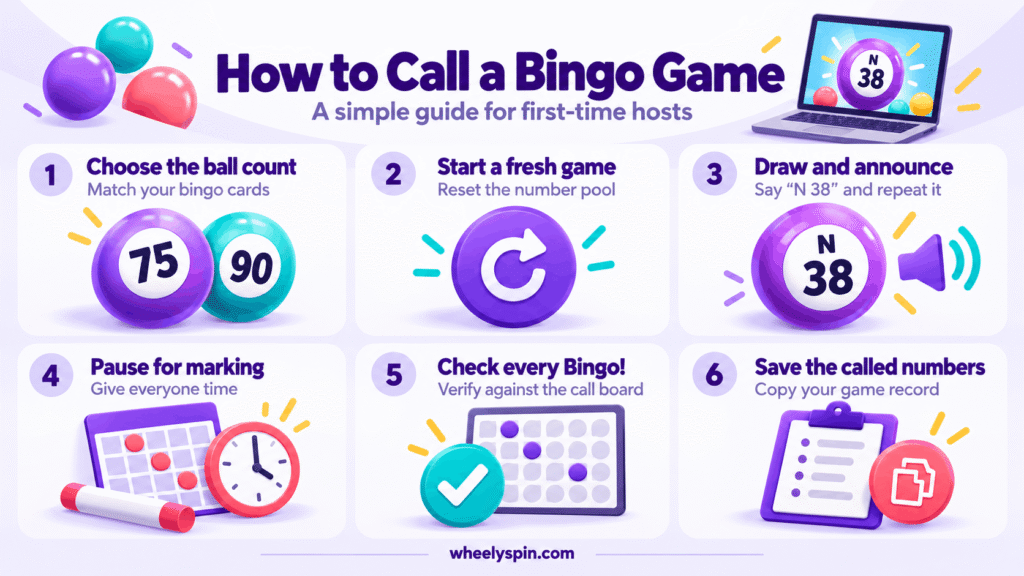
You call a bingo game with a number generator by choosing the ball count, starting a fresh game, pressing the draw button for each call, announcing the letter and number, and checking any claimed win against the board.
Button names differ from one caller to the next, and that trips up first-time hosts more than the game itself. One tool says Draw Ball, another says Call Number or Call next number, and a third asks you to Choose a Bingo Ball. They all do the same job, so this order works on any of them:
- New Game (or Restart Game) comes first, which resets the pool so every ball is back in play.
- Correct letter plus number is the call format for 75-ball, such as “N 38”; say it, then repeat it once.
- Time to mark matters, so wait before the next press and let slower players catch up.
- Bingo Call Board checks come next whenever a player shouts, comparing their card with the lit squares.
- Copy numbers called at the end if you want a record of the whole game.
With printed cards on the tables, I read aloud each call slowly. In screen-only games the board does half of the announcing for you, so the pace can be quicker.
Which Numbers Go Under Each B-I-N-G-O Letter?
In 75-ball bingo, B covers 1–15, I covers 16–30, N covers 31–45, G covers 46–60 and O covers 61–75, so every letter holds exactly 15 numbers.
That split is the whole logic of the standard 75-ball bingo format, and it explains why 5×5 cards look the way they do. Each of the five letter columns on a card can only hold numbers from its own band. A generator that shows B1-O75 calls is simply attaching the right one of the B.I.N.G.O. letters to the number it drew.
One caller also color-codes the bands, which helps players who scan by color rather than by letter:
| Letter | Range as called | Color on one caller’s board |
|---|---|---|
| B | B 1–15 | Blue |
| I | I 16–30 | Red |
| N | N 31–45 | White |
| G | G 46–60 | Green |
| O | O 61–75 | Orange |
The bands also make a bad claim easy to spot. If someone claims a diagonal line and one marked square shows 52 sitting in the I column, the card is wrong before you even open the call list.
How Does a Bingo Generator Keep Each Draw Fair?
A bingo generator keeps each draw fair by picking only from numbers still in play, taking every called number out, and showing how many are left, so no ball can come up twice in one game.
Fairness starts with a full set of balls. One caller shows the counter Called: 0 / 75 beside Remaining: 75 before the first press, and those two figures move in step with every draw. If they ever disagreed with the board, something would be broken, and I have not seen that happen.
The picking itself happens one at a time. One tool uses the Web Crypto API, which gives each remaining number an equal chance of coming next. Because called numbers leave the pool, no repeats are possible, and the list of called numbers grows by exactly one per draw.
The game ends automatically once the last ball is out. Long before that point, the strip of recent calls is the first place players look when they think they missed one, and it saves the host from answering the same question all night.
What Buttons and Settings Does a Bingo Caller Have?
A bingo caller usually has a draw button, a reset button, a board of called numbers, a history list, and optional settings for timed calling, voice and ball count.
The current ball is the star of every layout. It sits big in the middle, and one tool puts the previous call right beside it so latecomers can catch up. Underneath, numbers drop into letter headers, so you scan B through O instead of one long list.
Settings are where the tools split apart. Some let the caller fire every few seconds without anyone touching the mouse. Others lean on the device’s built-in voice, which means checking the volume before guests arrive; I learned that one the awkward way. One caller even lists offline play, handy in a venue with weak Wi-Fi.
A reset button that will clear the board sits on every version I looked at. The callers themselves do not print cards, and one says so outright, so pair yours with a card app or a printed set. Several of them state they are completely free to run.
What Kinds of Bingo Games Can You Play?
The kind of bingo game you play is set by the shape a player must complete, from a single line on a 75-ball card to a fully covered ticket in 90-ball, and the number generator stays the same for all of them.
That is the point many guides skip: the caller does not know or care what pattern is in play. It just draws. The pattern lives under your game’s rules, announced before the first call. A classic card has 25 numbers with a free space in the center, and the simplest win is a full line run horizontally, vertically or diagonally.
From there, hosts invent. One caller app claims 1,000+ patterns, and in practice I rotate three or four per night so regulars stay interested. A new shape every round also stops the same quick players from winning everything.
When someone calls bingo, the check is identical whatever the shape: read their marked numbers back against the board, one by one. The named shapes most hosts use are set out in the section on how bingo is played and won.
Can a Bingo Generator Use Smaller or Bigger Number Ranges?
Yes, a bingo generator can use number ranges other than 75 or 90, and one tool offers eleven ranges running from nine numbers up to 150.
The classic game stays the default, but a Game Mode dropdown lets you change variants in one click. I treat the mode selector as a pacing tool rather than a novelty. A smaller range means cards fill sooner and wins come faster, which is exactly what speed-bingo variants need.
Ninety numbers is the Housie setting, and the bigger ranges suit large rooms where you want a round to last. Younger classes get a lot out of the tiny ranges, because a straightforward range of single digits turns bingo into math practice for kids still learning their numbers.
These variations are flexible enough that I keep a short list taped to the laptop: small for kids, standard for adults, big for charity nights. Picking the range before anyone sits down saves a restart later.
Why Use an Online Bingo Generator Instead of a Ball Cage?
An online bingo generator is worth using over a ball cage because it runs on a screen you already own, never loses a ball, and keeps an exact record of every call.
I still like the clatter of a ball cage at traditional bingo, but cages jam, balls roll under tables, and somebody has to store the thing. A browser caller works on any device with no equipment to carry and no downloads to install.
For quick game nights at home, that means nobody digs through the cupboard for old bingo sets with half the balls missing. On a laptop connected to a wide screen, the Show Landscape option on one caller spreads the board across the whole display.
Even venues that keep their cages benefit from a digital backup caller. When a mechanical machine fails mid-session, switching to a browser tab keeps the game going without a long wait.
How Is Bingo Played and Won?
Bingo is played by marking called numbers on a card and won by the first player who completes the pattern announced for that round and proves it against the caller’s record.
The game has deep roots. It grew out of an Italian lottery from the 1500s, and the appeal has not changed: anyone at the table can win regardless of skill. That is why a grandparent and a nine-year-old can play friends and family style on equal terms.
The pattern is what changes from round to round. These are the 75-ball shapes one bingo reference lists:
| Pattern | What the player must cover |
|---|---|
| Regular Bingo | Five in a row across a row, column or diagonal |
| Four Corners | The four corner squares of the card |
| Outer Edge | The border running around the card |
| Multiples | More than one line at the same time |
| Full House | Every square on the card |
| Letter Patterns | Shapes such as E, H, I, L, T, W, X, and Z |
In my experience Four Corners is the best opener for a new crowd. It ends fast and teaches everyone how a claim gets checked.
How Do You Host a Bingo Game That Runs Smoothly?
You host a smooth bingo game by putting the caller where everyone can see it, pacing the draws, and settling every claim from the caller’s record rather than from memory.
Most hosting trouble I have seen comes from pace, not from the tool. Live calling feels rushed if you press too fast, so build in a pause between draws of a few seconds. This is the order I follow, whether the room is real or a video call:
- Projector first: put the board up large on screen before anyone sits down.
- Last 5 Numbers: point players to that strip whenever they miss a call.
- Show History: open it as soon as a player wants you to verify a winning card.
- Take a break at the halfway point; the caller holds its place, so you can step away without losing anything.
For virtual bingo, keeping a visible history in view of every webcam saves half the questions. One caller exports the full list of calls, which makes checking winning cards after the session simple.
Is a Bingo Number Generator Good for Classrooms, Parties, and Fundraisers?
Yes, a bingo number generator suits schools, celebrations and charity events, because one screen gives a whole group the same calls at the same time.
The 75-ball game is the version used in most US classrooms, and a clear display for groups is the feature that matters there. Classroom games move quickly when thirty kids can read the call off the wall instead of asking a neighbor. Themed word and picture cards stretch the same idea into spelling or picture-matching rounds.
At home, family game nights and birthday parties run on the same setup. Bingo is a social game first, and a generator keeps the host free to chat instead of fishing for balls.
In my area, bingo at the local church has traditionally been one of the steadier fundraisers. Community games of that kind need a caller nobody can accuse of favoring a friend, and a logged, on-screen draw answers that worry before anyone raises it.
What Else Can a Bingo Number Generator Be Used For?
A bingo number generator can be used for any task that needs one fair number from a fixed range, because the same draw-and-remove logic works with or without bingo cards.
The set of ranges one tool offers shows how far that goes: 1-9, 1-15, 1-20, 1-25, 1-30, 1-50, 1-75, 1-80, 1-90, 1-100 and 1-150. I have used the small end to pick a seat number in a room of twenty, and the large end for a ticket-stub draw at a school fair.
Bingo callers are also handy for random assignments, where each person gets a number and the number decides the order. If you need several numbers at once, a plain number generator is faster; a bingo caller hands them out one by one, which builds suspense.
Small prizes keep those side games fun, though nothing says there must be a jackpot. The draw works just as well for chores, seat swaps or deciding who presents first.
How Do You Customize a Bingo Number Generator?
You customize a bingo number generator by saving your own copy of a game, then changing its colors, sounds and pace before you share it with co-hosts.
One bingo tool works this way: save a copy into your account, change colors to match the event, then save and share the finished version with whoever is calling next week. The basic use costs nothing, and your edits only touch your copy, never the original.
Seasonal looks add excitement for very little effort. I keep orange and black for Halloween, warm browns for Thanksgiving, and red with green for Christmas, and players do notice the change.
Speed is the other lever. Faster versions of bingo work when the caller draws new balls quickly, and choosing a game mode with fewer numbers helps them along. A few small edits turn a shared template into your own bingo game rather than a copy of somebody else’s.
What Other Bingo Resources Pair With a Number Generator?
The resources that pair best with a bingo number generator are a card maker, themed card sets, and a separate 90-ball caller for ticket-style games.
Themed card packs are where I spend most of my prep time. Word cards turn a caller into a vocabulary drill, and picture sets suit review games with younger groups. Seasonal packs make themed bingo nights and holiday events feel planned rather than improvised.
The bigger trap is mixing formats. A ticket with three rows and 15 numbers belongs to a 90-ball game, known as Tambola in some places and popular in the UK, and it needs a separate caller with 90 balls.
The winning goals on that ticket run from one line up to the whole thing, so a 75-ball tool cannot serve it, however good it is. Check the ticket before the guests arrive, not after the first call.
What Is the Difference Between 75-Ball and 90-Ball Bingo?
75-ball bingo draws from 75 numbers on a five-by-five lettered card, while 90-ball bingo draws from 90 numbers on three-line tickets with no letters at all.
The 75-ball game follows the standard 75-ball American format and is common in the US, with draws from 1 to 75. The 90-ball game is common in the UK and draws from 1 to 90. On a 90-ball call you call only the number, because there is no letter to attach.
The 3-row tickets used for 90-ball have nine columns, with five numbers and four blanks in each row. Players chase one line first, then two rows, then the full ticket, so a single game has several winners.
If your group is unsure which version it plays, a comparison guide helps, but counting the lines on a ticket answers it in two seconds.
Where Do You Get Bingo Cards to Use With a Number Generator?
You get bingo cards from a free card maker or a printed pack, since a bingo number generator calls numbers and leaves the cards to a separate tool.
A Bingo Card Generator can produce as many unique 75-ball cards as you have players. You can make printable cards for the room or share them digitally for remote rounds. Unique matters, because two identical cards mean two winners on the same call.
Teachers often print a class set once and laminate it, which is what I recommend for anyone running weekly games. Dry-erase markers wipe off, and the cards last a whole term. For older players, large-print layouts are worth the extra paper.
Is a Bingo Number Generator Free to Use?
Yes, the bingo number generators I compared for this guide are free to use, five of them say so outright, and several run without ads, accounts or signups.
No signup required is common, and at least one caller promises no ads on top of that, which matters on a projected screen. Some ask for no account even to keep your progress. They run in a browser on a phone, tablet or computer.
Free tools also suit the spirit of home bingo. Families often play for sweets or chores, and money doesn’t have to change hands for the game to work. Where real prizes are involved, check your local rules, since that sits outside what any caller handles.
How Does a Bingo Number Generator Pick the Next Number?
A bingo number generator picks the next number by choosing at random from the numbers not yet called, then showing it with its letter and marking it on the board.
Each press randomly draws one number from what is left, so the choice gets narrower as the game goes on. On the last call of a 75-ball game there is only one possible result, which is why a generator never needs a “last ball” check the way a cage does.
Some spin-based number generators add a short animation before the result appears. In a class of seven-year-olds that moment of suspense is half the fun. The trade-off is speed, so for a long adult session I turn animations off and let the number appear the instant I press the button.
What Number Range Does Each Bingo Letter Cover?
Each bingo letter covers a block of 15 numbers: B is 1–15, I is 16–30, N is 31–45, G is 46–60 and O is 61–75.
Those five letter groups of fifteen numbers each add up to 75, which is why a call always pairs a letter with a number, such as B7 or O72. If you hear “N 12”, the caller has slipped, since 12 belongs under B.
I teach new players a quick trick: the letter tells you which column to look at, so you never scan the whole card. On a 75-ball card the N column holds only four numbers, because its middle square is the free space.
Can You Use a Bingo Number Generator for a Live Event?
Yes, a bingo number generator is built for live events, whether players sit in one room or join remotely.
For in-person nights at local clubs or halls, I connect a laptop to a TV and switch on full-screen mode, the setting one caller suggests to help everyone see the board from the back row.
Virtual games work the same way: share your screen on Zoom or any video app, and the shared screen becomes the board for every player at once. Community organizations running both formats can use one caller for each, because the board looks identical either way. Test the screen share before guests join, since a frozen video feed looks exactly like a slow caller.
Is a Bingo Number Generator Actually Random?
Yes, a bingo number generator is random in the practical sense, because each draw comes from a computer randomness source and only from numbers not yet called.
One calculator-style tool describes itself as a pseudo-random number generator, or PRNG, which means an algorithm produces the sequence. For a game where the result is decided entirely by chance, that is more than enough, because no player can predict the next call.
Purists sometimes argue that a physical cage is more unbiased. My view after a lot of hosting is the opposite: worn balls and sticky cages have quirks, while software is a fast, fair way to draw with no moving parts to wear out.
Can a Bingo Generator Avoid Repeating Numbers?
Yes, a bingo generator avoids repeating numbers by taking each called number out of the draw for the rest of the game.
One of the most important rules in bingo is that a number is called once per round, and the software enforces it. The draw will pick and remove a ball in one step, and the caller removes them from play until you reset.
To prove it, each caller covered here shows previously drawn numbers somewhere. One lists All Numbers Chosen So Far under each letter; another keeps a Call History sorted oldest to newest, so you can read the calls in order. That list is how I resolve a dispute in seconds.
Can You Pause and Resume a Bingo Game?
Yes, you can pause and resume a bingo game, because called numbers stay on the board until you choose to reset.
On one caller the game state persists, and on another the game is saved in the browser, so refreshing keeps the calls in place. That is convenient when a laptop goes to sleep mid-round, since you do not have to start over.
I pause most often when players need extra time to mark their cards or to verify numbers after a close call. Tea breaks, fire drills, a toddler’s meltdown: the board simply waits until you press the draw button again.
Can a Bingo Number Generator Read Numbers Out Loud?
Yes, some bingo number generators read numbers out loud through the device’s speech feature, so the host does not have to announce each call.
On one tool you tick Say each number out loud, and another describes itself as an audible caller. Pair voice with automatic calling at a set interval and the game runs hands-free. A third caller has a Draw Timer measured in seconds for the same purpose.
Voice suits care homes and classrooms, where a steady, even delivery helps. Even with the voice on, I still call each number clearly myself for the first few rounds, so players learn to trust the machine.
Can You Customize a Bingo Number Generator for Your Own Game?
Yes, you can customize a bingo number generator for your own game by making a copy of the setup and changing how it looks and sounds before you play.
Duplicate the original setup so the default stays untouched for other hosts. On your copy you can swap the color scheme to suit a theme night and add sound effects that play with each new call.
A word of caution on changes: in real bingo every number should keep the same odds, so I only change looks, sounds and the number range. Whatever you change, tell players before the first call, so nobody feels the game was set up against them.
What Can You Use a Bingo Number Generator for Besides Bingo?
Besides bingo, a bingo number generator can run raffle draws, number-guessing games, and the fair assignment of turns, teams or tasks.
For raffle draws, give each ticket a number up to 75 and draw until you reach a winner. Number-guessing games work well with kids: someone guesses, and the generator answers. Assigning turns in a board game, or picking teams and tasks for a clean-up crew, all run on the same idea.
What makes a bingo number generator useful outside bingo is that every result is visible to the whole room and cannot repeat. Nobody can say the host picked a favorite, which is the same reason the generator works for a bingo call in the first place.