What Is a Magic 8 Ball and How Do You Use One Online?
A Magic 8 Ball is a yes-or-no fortune toy that replies to any question with one of 20 fixed answers, and an online Magic 8 Ball works the same way: you type your question, press the shake button or tap the ball, and read the single reply that appears.
I have owned two plastic versions and tried a good number of browser copies, and the reply list never changes between them. The set is lopsided on purpose, with 10 positive, 5 noncommittal and 5 negative lines, so the ball leans toward encouragement before you have even asked anything.
The full list is short enough to learn by heart, which is half the fun of owning one. Here is every reply grouped by tone:
| Tone | Replies |
|---|---|
| Positive | It is certain, It is decidedly so, Without a doubt, Yes definitely, You may rely on it, As I see it, yes, Most likely, Outlook good, Yes, Signs point to yes |
| Noncommittal | Reply hazy, try again, Ask again later, Better not tell you now, Cannot predict now, Concentrate and ask again |
| Negative | Don’t count on it, My reply is no, My sources say no, Outlook not so good, Very doubtful |
The toy itself is still very much in production. Mattel makes the plastic Magic 8 Ball today and sells more than one million units of it annually, so a physical ball is easy to find if the screen version feels too weightless. Either way, it stays a harmless desk toy rather than a forecasting device.
What’s Actually Inside a Magic 8 Ball?
Inside a Magic 8 Ball sits a 20-sided die floating in fluid, and each face of that die carries one printed reply that presses up against a small window when you turn the toy over.
That die did not arrive in its finished form. The inner design went through several rounds of trial and error during the 1940s, and the early attempts read like a prototype log:
| Year | Design | What was inside | What happened |
|---|---|---|---|
| 1940 | Concept by Alfred Carter, based on a psychic tool used by his mother, a clairvoyant | Idea only | Carter died before the first patent was approved |
| 1944 | Syco-Seer, patented with Abe Bookman (one account calls him Carter’s brother) | A 7-inch tube with a 6-sided die in each half | Max Levinson and Bookman, an engineer, helped mass-produce it through Alabe Crafts |
| 1946 | Syco-Slate, sold as the Pocket Fortune-Teller | One viewing window in a smaller, cheaper, compact body | A commercial failure |
| After the Syco-Slate | Crystal Ball Fortune-Teller | A redesign with a new outer ball | It sold poorly |
| 1950 | Brunswick Billiards of Chicago commissioned a billiards-style version | The same die in a pool-ball shell | Sold first as an advertising product and paperweight, later as a toy |
The jump from tube to sphere matters more than it looks. A tube with two dice makes you read two ends, while a sphere with one window shows exactly one reply, and that single verdict is what makes the modern toy feel decisive.
From the user side, the mechanics also explain the occasional blank reading. When the die settles on an edge, no face sits flat against the window, and a slow tilt lets a full reply that floats up settle into place.
How Do You Ask a Magic 8 Ball a Question Online?
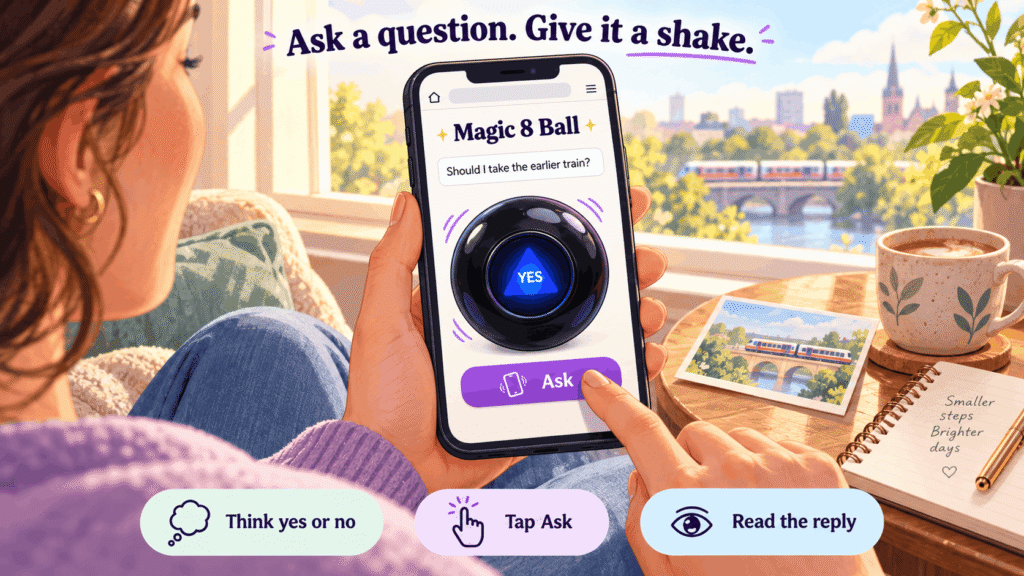
To ask an online Magic 8 Ball a question, frame something with a yes-or-no shape, trigger the shake, and read the one reply the tool returns.
Browser versions copy the physical ritual closely. Most of them run on JavaScript, so scripts have to be enabled before anything moves, and typing the question into the box is not required by the tool itself. My routine looks like this:
- Concentrate on one question that can only go yes or no, such as whether to take the earlier train.
- Ask button: press it, or use the keyboard shortcut if the page offers one.
- Animation: let the ball tumble for a second instead of firing off a second press.
- Printed response: read the line in the window and decide whether you want another round.
Each reply has the same chance of appearing on every press, so keeping a running log of your results is a nice way to see streaks that mean nothing at all. On phone apps the button often disappears, and finger control over the ball’s rotation takes its place, which feels much closer to holding the real toy.
What Are the 20 Classic Magic 8 Ball Answers?
The 20 classic Magic 8 Ball answers split into ten yes-leaning replies, five evasive replies and five no-leaning replies, and that 10-5-5 ratio is the same on the plastic toy, in apps and on web versions.
Inside the toy, the multi-sided die floats in alcohol, and once the ball is shaken the uppermost face drifts to the clear window as a mystical answer. Exactly half of those faces lean yes, which gives a 50% shot at a positive reply, while a quarter dodge the question entirely.
That ratio is why a repeated question so often lands on a different answer. With five evasive faces in play, I have watched a friend shake the same question four times and get “come back later” twice before anything useful showed up.
The ratio also powers my favourite party use. In the simple yes / no method, everyone drops 5-10 written questions into a bowl, and players guess whether the ball will lean yes or no before each shake. Wrong guesses earn a drink penalty in the adult version, or a silly forfeit at a family table. For a plain 50/50 answer, toss a coin instead and let heads mean yes.
Can a Magic 8 Ball Answer Questions About Love, Career or Spirituality?
Yes, some online Magic 8 Ball versions add themed answer sets for love, work and spiritual questions, and each themed set swaps the classic 20 replies for its own list.
Those themed sets give the web version a larger answer range than any plastic toy can hold, because a single die only has twenty faces. The prepared answers are still fixed lines written in advance, so a themed ball is just a different pool of text, not a smarter one.
The appeal is obvious when you look at what people actually type. A free online tool is anonymous, so it gets questions that nobody would say out loud at a party, and a themed set at least gives replies that sound like they belong to the topic.
I treat these sets as a fun way to poke at life’s big mysteries without pretending the screen knows anything. A love-themed reply that sounds specific is still a line drawn from a fixed list by the same chance that drives the classic ball.
How Did the Magic 8 Ball Go From Fortune-Telling Tube to Toy?
The Magic 8 Ball started in the 1940s as a tube-shaped fortune-telling device and only became a ball after a billiards company asked for a pool-ball version, which turned a slow seller into a lasting toy.
The design was named for its resemblance to the 8 in pool, and the round, black shell copies a billiards ball closely enough that billiards players still get it as a tattoo. People who see the toy that way read it as a symbol of luck at the table, and some go further and say it can symbolize fate itself.
The toy has been popular since the 1950s, and pop culture kept it visible. It turns up in TV shows and movies, and the best-known cameo is in Friends, where Ross consults one on camera.
The newest chapter of the history lives on phones. One app listing shows a 4.6 stars average from 5.3K reviews and 500K+ downloads, last updated August 20, 2026, with the update note reading only Minor improvements.
Where Have You Seen the Magic 8 Ball on Screen?
You have most likely seen the Magic 8 Ball as a prop in sitcoms and films, where a character shakes it to settle a choice on camera and the reply becomes the punchline.
Screen writers use the toy the same way the Ouija board was used for much of the 20th century: as a shorthand for asking the unknown something it cannot really answer. The joke works because everyone in the audience already knows the ball’s replies are pure luck.
Off screen, the toy shows up in party games, and one fan site even claims several thousand people use its digital ball every day, a figure I can’t check. At gatherings I have seen it used as a warm-up before dinner, for settling disagreements about the playlist, and for plain everyday fun.
The second method I’ve seen at parties hands the toy more power. Someone asks whether a named participant should perform an action, such as singing the next song, and the ball’s verdict stands.
How Can You Turn a Magic 8 Ball Into a Party Game?
You can turn a Magic 8 Ball into a party game by collecting yes-or-no questions from everyone in advance and letting the ball rule on each one, with points or forfeits for whoever predicts its reply.
Themed question banks keep the rounds from getting repetitive. Splitting the slips by topic works well:
- Original: general questions such as Do I look good today? or Will it rain later?
- Love & Relationships: Does he/she love me? and, for bolder groups, Is my partner cheating on me?
- Divination: questions about life’s meaning or your inner energy, which some tools file under Spirituality
- Career & Finance: Will I receive a bonus soon?, Should I apply for a new job? or Is now a good time to make an investment?
My one firm house rule is to keep stakes silly. Points, dares and snacks are fine, but no real money, because betting cash on a toy that runs on luck turns a party round into gambling, which was never the intent of the game.
What Should You Look For in a Magic 8 Ball App?
A good Magic 8 Ball app lets you shake your phone for a reply, lets you restyle the ball to suit your taste, and is upfront about ads and how it treats your data.
The motion controls matter most to me. The better apps react when you shake the device, and they fall back to a simple prompt to tap the screen when you are holding a coffee in the other hand. One listing pitches its ball as a reliable adviser that knows it all, with questions ranging from destiny to what to eat for breakfast, which is marketing worth smiling at.
If you would rather skip an install, the web route is lighter. Some browser versions offer a compact version that loads just the tool when you add ?embed=1 to the address, and they hand you a copyable snippet with an adjustable height for your own page.
Can You Embed a Magic 8 Ball on Your Own Website?
Yes, you can embed a Magic 8 Ball on your own website, because several browser versions offer an embed mode with ready-made code you paste into a page.
Before embedding, it helps to remember what the widget is. Every browser ball is software that imitates the plastic toy, and older fan pages openly describe theirs as an homage. One of them notes that the Magic 8 Ball name is a registered trademark and credits Tyco Toys as the holder at the time.
An installed app is the alternative when you want more polish than a widget gives. On Google Play, one listing offers 97 ball skins, 12 replaceable backgrounds and custom backgrounds pulled from Google Photos or Google Drive. It is tagged Simulation, Casual, Single player, Realistic and Offline, so it works with no connection at all.
Should You Make Real Decisions With a Magic 8 Ball?
No, a Magic 8 Ball should not decide anything that matters, because every reply is pulled from a fixed list by luck and has no link to your situation.
The career-themed replies on one site even state plainly that they are not financial advice. Religious readers sometimes ask whether the toy is haram, and the answer offered there rests on how it is used, which tells you the toy is only as safe as the decision you hang on it. Nothing it says should be taken too seriously.
Data and ads are the practical side of trust. One app listing is Rated for 3+ but contains ads, and its safety notes say no data is shared with third parties, no data collected, data is encrypted in transit, and data can’t be deleted.
My own view is that the ball’s whole job is to make you notice how you feel about a reply. A truthful read on a choice comes from your personal belief about it, and a positive attitude helps more than any shake.
Is a Magic 8 Ball Accurate?
No, a Magic 8 Ball is not accurate in any predictive sense, because its replies are chosen by chance from a short fixed list.
One old fan page says its ball reaches into the future, and a psychic site claims its spiritual set was handwritten by expert psychics and can feel eerily accurate. Those are claims, not tests, and each reply is still randomly selected, so it is not necessarily true.
A reply is picked at random regardless of wording, so whatever you ask gets the same odds, which is why a how-to infographic on one site spends more space on asking style than on reading results.
How Does an Online Magic 8 Ball Pick Its Answer?
An online Magic 8 Ball picks its answer by running a random routine in your browser that selects one line from its stored list the moment you trigger the shake.
There is no liquid or die involved, so nothing physical can stick or land on an edge. You click the ball, press a button, or hit Space, and the code chooses a line.
Themed versions simply swap the list. One site runs four themed tabs with 20 answers each, adding lines such as Keep your secrets well, Create a plan first and Give it a shot.
What Are the Odds of Getting a Yes From a Magic 8 Ball?
The odds of getting a yes from a Magic 8 Ball are 10 in 20, because ten of the twenty classic replies are positive.
A web version uses a random number generator to pull each line, so every reply has an equal chance on every shake. The other ten replies split evenly between evasive and negative lines.
If you get an evasive reply, you can ask again right away; there is no need to wait for the ball to settle the way the plastic toy needs.
Does the Question You Ask Change the Magic 8 Ball’s Answer?
No, the question you ask does not change a Magic 8 Ball’s answer, because the reply is chosen without reading your words at all.
Typing is optional on most tools, and you can just think it instead. Many sites draw the reply from a secure random generator built into the browser.
Some fans still insist the first answer counts, that later replies are influenced by earlier ones, and that you should ask only once. A History section with a Clear option shows how little the wording matters across many tries.
What Does a Magic 8 Ball Symbolize?
A Magic 8 Ball mostly stands for fortune-telling and luck, and its pool-ball look has made it an emblem of cue sports too.
Online versions still market it as the ultimate fortune-teller, and that framing goes back to the 1950 billiards version, which was first pitched as a fortune-teller before it was sold as a toy. Today it reads more as a fortune-telling toy with a wink than as a serious oracle, and that mix of mystery and humour is exactly why it suits a desk, a dorm shelf or a pool hall.
Is Using a Magic 8 Ball Haram?
The view given on one site is that using a Magic 8 Ball is permissible as a toy, as long as no stakes or wagers are attached to its replies.
Trouble starts when the ball drives a game for prizes. One party game uses it to decide whether a player may take a package from a pile before a timer runs out, a way to replace dice. Keep rounds like that prize-free, and never lean on the toy solely for important life decisions.
Is an Online Magic 8 Ball the Official One?
No, most online Magic 8 Balls are not the official toy, because they are a fan version that is not affiliated with the toy’s maker.
These free versions exist for entertainment only. The sites state they are not responsible for actions taken on the strength of a reply, and they point anyone with a serious question toward professional advice instead. A fan copy can match the classic 20 replies line for line and still be an unofficial tribute, so the plastic ball in the toy aisle remains the only version made by the company behind the name. For a fair final choice, add your shortlist to the online wheel and spin.