What Is a Pokémon Type Wheel and How Does It Work?
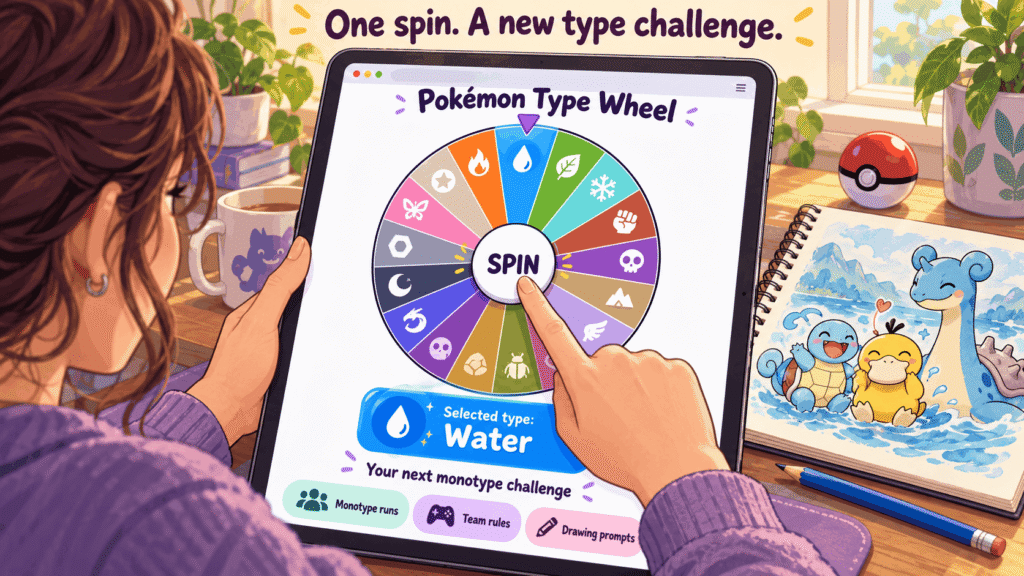
Spin for one of the 18 Pokémon types, from Normal to Fairy. Each slice uses its type color, so you can see the result at a glance. It’s the quickest way to set up a monotype run or a random-type team rule. Want a Pokémon instead? Use the random Pokémon generator.
A Pokémon type wheel is a fan-made randomizer cut into 18 slices, one for each type in the current games, and every press lands on a single type with a 1 in 18 chance, which you then use to lock in a mono-type challenge, a Gym leader team or a drawing prompt.
I started using one after my third replay of the same region felt stale. Picking a type myself always drifted back to old favourites, and the wheel took that choice out of my hands. The board lays out the default wheel items with each type in one slice of equal size, so nothing gets a head start.
The type list on these wheels mirrors how the games grew. Today’s set includes two types introduced in Gen 2 and one introduced in Gen 6, and a good type wheel lets you strip those back out when you want an older feel. With the slices colored in each type’s classic color, you can read the outcome from across a room.
Behind the animation, the pick comes from the device’s secure random generator, not from where the pointer seems to slow down. That detail matters more than people expect once a group is assigning teams and someone suspects the result was rigged.
How Do You Spin a Pokémon Type Wheel and Apply the Result?
You spin a Pokémon type wheel by choosing your type set, pressing the centre control once, and treating whatever type it lands on as a fixed rule for the run, team or prompt you have planned.
The order below is the one I settled on after a few messy group sessions where people argued about rerolls:
- All 18 types or the Original 15: keep the full set, which most boards load by default, or switch to the smaller set for a retro playthrough.
- Color-coded board check: scan the slices before the first press so the result is easy to read and nothing was renamed or removed.
- Results panel: let the pointer stop fully, then read the type from the panel rather than guessing from the slowing animation.
- Modify lock: write the type down before anyone opens the edit screen, so the team build can’t quietly change after the fact.
- Elimination mode for groups: switch it on before drawing multiple types, so randomly assigned types never collide between players.
The fourth step is the one people skip. A rule that lives only in someone’s memory tends to soften by the second gym, and having it written down keeps the challenge honest.
What Challenges Can You Build Around a Random Pokémon Type?
The most rewarding challenges built around a random Pokémon type restrict which Pokémon you may catch, train or sketch, then let the wheel’s result set that limit for one run, one session or one creature.
Most of my favourites come from layering rules. Under dual-type rules, a second type joins the first, and only Pokémon carrying both count. In a group, each player gets a different type, and the old strengths and weaknesses chart suddenly decides real battles between friends.
When a single type feels too plain, I add one twist from the table below. These are house rules from my own sessions, not anything the games define:
| Type | Twist I pair with it |
|---|---|
| Normal | No evolution stones, so plain types stay plain |
| Fire | Starter must match the type, even if one shows up late |
| Water | Every catch must come from fishing or surfing |
| Electric | No healing items during battle, only centre visits |
| Grass | Status moves only until the first badge |
| Ice | Team capped at four members until the midpoint |
| Fighting | No switching out mid-fight |
| Poison | First encounter on each new route only |
| Ground | No fly-travel shortcuts; walk every route |
| Flying | At least one bird must reach the final team |
| Psychic | No held items on any team member |
| Bug | Evolve only through levelling, never trading |
| Rock | Fossil revivals only after the third badge |
| Ghost | Night-time catches only where the game tracks time |
| Dragon | Face the champion five levels under |
| Dark | Nicknames required for every catch |
| Steel | No healing at all inside gyms |
| Fairy | Only one evolved member allowed before the fourth badge |
A good test for any twist is whether it changes decisions you make on the route. People who replay games they already know get the most from this, since the map is familiar and only the rules feel new. The core idea stays simple: you build a team that shares one type, and the twist just sharpens it.
Which Generations Gave the Wheel Its Full Set of Types?
The full set on a Pokémon type wheel comes from three generations: 15 types date back to Gen 1, two arrived with the second generation, and one more was added in the sixth.
That history is why some boards come preloaded with a toggle between the modern and the classic list. Pulling the later three out turns the spinner into a time machine, giving you the original elemental affinity layout the very first games used.
The expansions changed balance as much as variety. As I understand it, Game Freak, the studio behind the main series, added the second-generation pair partly to rein in one dominant early type, and the sixth-generation addition was aimed at checking dragons.
Ownership of the brand sits with Nintendo and The Pokémon Company. A fan-built roulette borrows only the type list from them, which is why the type set is the one thing these tools never change on their own.
Which Settings Change How a Pokémon Type Wheel Behaves?
Three settings change how a Pokémon type wheel behaves: weighting changes how often types appear, a removal option stops repeats, and a link option lets other people load your exact board.
Most people never open the editor, which is a shame. On nearly any free online wheel maker, you click Edit to reach these controls, and a board customized for your group plays very differently from the stock one, whether it’s for solo adventures or a themed night with a particular vibe.
| Setting | What it does | When I reach for it |
|---|---|---|
| Weighted items | Lets you raise or lower the odds of particular types | Making a rare type show up more on a themed night |
| Remove-winner option | Takes each landed type off the board | Drafting so that players avoid repeats |
| Shareable URL | Lets you send your setup to others | Running identical rules across a group chat |
Weighting is where I’d urge caution. Once you adjust the odds, the board stops being an even draw, so tell the group before anyone commits to a run.
Can a Pokémon Type Wheel Work as a Classroom Activity?
A Pokémon type wheel works well as a classroom activity because the result is a single word with a clear meaning, which gives students an instant, shared starting point for writing, drawing or sorting tasks.
Teachers in classrooms I’ve helped tend to use it as a warm-up. No sign-up is needed on many tools, and an Embed a wheel option drops the board straight into a lesson page. A type also works as a creative constraint, which students often find easier than a blank page.
A simple lesson flow that has worked for me:
- Assign types: one press per table group, so each team has its own type for the session.
- Draw a new Pokémon: students design a creature that fits their type, using habitat and colour as clues.
- Art or writing prompts: the same type feeds a short field-guide entry or a poster.
- Players or rounds: split the lesson into turns so quiet students also get a go at the wheel.
Because every slice is the same size, the wheel is a fair way to hand out roles, and the format slips easily into friendly drafts or other creative prompts later in the term.
Is the Result Truly Random, and What Do You Need to Run a Type Wheel?
The result on a well-built Pokémon type wheel is random in practice, because each type is equally likely and the pick is generated by code rather than by the physical drag of a pointer.
Beyond that, you need very little: a device and a page that loads. Some education platforms run the same idea as an open-ended template where you press to see which item comes up next. The leaderboard on one version I tried was private and disabled by the owner, and the template produced no scores at all.
Feature gates are the other thing to watch. A login is sometimes needed for saved boards, while plain type pickers usually open straight away. One type board I checked was last updated on October 14, 2026, so the active tools do get maintained.
My advice is to let randomness decide and resist rerolling. If you change the odds or reroll until you like the answer, the wheel is only repeating your own preference back to you.
How Many Pokémon Types Are There?
There are 18 Pokémon types in the current main-series games, and a complete type wheel shows them as 18 options of equal size. The count was lower at launch and grew in two steps, so older-generation challenges may use a trimmed set. If you want a specific Pokémon rather than a whole type, a random Pokémon generator is the better pick. Both kinds of tool usually need JavaScript switched on, but there is nothing to install.
Does Every Type Have the Same Chance of Landing?
Every type on an unedited Pokémon type wheel has the same chance of landing, since each holds an identical share of the board. That holds until someone adds weight to a slice, so on shared game nights it’s worth a quick look at the settings first. Some sites publish a fairness test you can run in your own browser to check the spread. The same tools also handle giveaways and everyday decisions, so the randomness is built for more than games.
Who Makes a Pokémon Type Wheel, and Is It Licensed?
A Pokémon type wheel is made by independent fans and wheel sites, not by the companies behind the games, and it carries no licence from them. That is why careful tools show only type names and colors and leave out Pokémon artwork entirely. These boards sit alongside general random pickers built for quick decisions, so the type list is just one preset among many. Treat any rule set you find on one as community-made, not a ruling from the series.
What Is a Monotype Run?
A monotype run is a playthrough where you catch and use only Pokémon of a single type, chosen before the adventure starts. The usual goal is a full six-Pokémon team of that type by the end of the game. Groups often turn it into random-type team rules so they can challenge friends and compare finishes. It differs from loose team themes because there are no exceptions, which is exactly what makes a weak type painful. For another game built on elements, the Genshin Impact character wheel picks a random character or element for challenge runs.
Why Are the Slices on a Pokémon Type Wheel Different Colors?
The slices on a Pokémon type wheel are different colors so players can recognise the landed type at a glance, before reading the label. Each type appears each in its own color, matching the shades fans know from the games. That helps Elementary age players who read slowly, and it helps in drawing challenges where the shade hints at a palette. Some platforms lock visual style and fonts behind a subscription, but the type shades are usually part of the free board. For random picks in other games, browse all our game wheels.
How Do You Stop the Same Type Coming Up Twice?
You stop the same type coming up twice by turning on the setting that takes each landed type off the board before the next press. With that on, every press of the spin button shrinks the board by one, and you can spin again for the next person on draft night without any manual cleanup. If your tool lacks it, a quick tweak to delete the landed slice by hand works in seconds. It also helps anyone who can’t decide between two leftover types, because the board narrows the choice for them.
Can You Share Your Custom Pokémon Type Wheel With Friends?
You can share a custom wheel with friends by copying its link, and they will open the same types, odds and settings you saved. When you share the link with a removal setting on, the board still removes each winner for them, so types don’t repeat in their draft either. Keep in mind that a shared board is not official and is not affiliated with the companies behind the series. It is a fan setup, and friends can edit their copy freely.