What Is a Tambola Number Generator and How Does It Work?
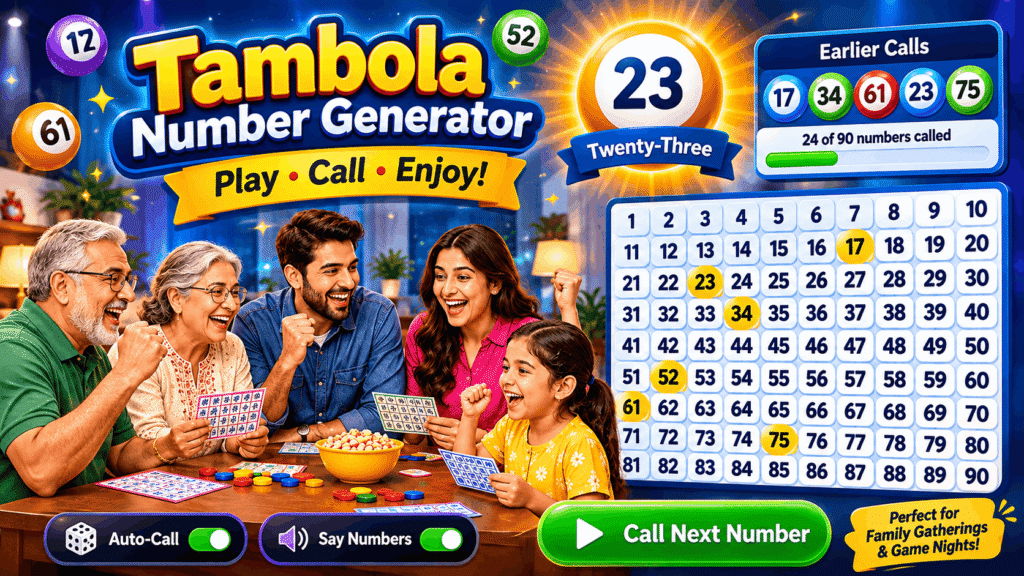
A tambola number generator calls the numbers 1 to 90 at random, one at a time, so you can host tambola or housie without a number bag. Press Call next number, and the big ball shows the number, its traditional call, and lights it up on the board.
Every number comes up once, with no repeats, until all 90 have been called. The screen shows the last five numbers under Earlier calls, a progress line such as “24 of 90 numbers called”, and a 1 to 90 board that players can use to check claims. You can call by hand or switch on Auto-call, and the generator can say each number out loud.
It’s built for family gatherings, a birthday party, a game night or a classroom treat. Put it on a laptop or a TV, hand out tickets, and the caller’s job takes care of itself. Players still mark their tickets and shout to claim Early Five, a line or Full House, just like the traditional game.
The generator is free, needs no sign-up, and keeps your game saved in the browser. To spin a wheel of your own options instead, start from the main spin the wheel page.
Why Use a Tambola Number Generator?
A tambola number generator makes the game quick, fair and easy to follow. It replaces the number bag, the container of tokens or the draw machine, so the host doesn’t need to shake, draw and read every number by hand.
It’s fair because each number has an equal chance and no number can repeat. Nobody can accuse the caller of picking favorites, and there’s no risk of losing a token under the sofa halfway through a game.
It’s also clearer for players. With the board on a TV or laptop, everyone can see which numbers have been called, so claims are checked in seconds, and the board lights up each call. You can call manual or automatic, at an interval from every 5 seconds to 20 seconds. The traditional call under each number, such as Kelly’s eye for 1 or Two fat ladies for 88, keeps the fun of a live caller.
Hosts love it because they can play too. Turn on Auto-call and the voice, and the generator runs the game while you mark your own ticket. For a quick tie-break between two winners, the coin flip settles it fairly.
How Do You Call a Tambola Game With This Generator?
You call a tambola game by handing out tickets, pressing Call next number for each draw, and pausing to check claims. These steps take you through a full game.
- Hand out tickets to every player, and agree on the prizes, such as Early Five, Top Line and Full House.
- Say “Eyes down” and press Call next number. The ball shows the number and its traditional call.
- Keep calling. Players mark or strike each number they have on their ticket.
- When someone claims a prize, pause, check and verify their ticket against the board before the next number.
- When Full House is won, or all 90 numbers are called, press New game and confirm to start a new game.
You can call every number by hand, or set Auto-call to keep the game moving. If you’d like to share the full list of calls at the end, press Copy numbers called and paste it into a chat.
The steps are the same whether you play with paper tickets, printed booklets or a ticket app. The generator only replaces the caller, so you can keep any house rules you like.
What Does the Caller Screen Show?
The caller screen shows everything players need to follow the game: the current number, its call, the last few numbers and the full board.
| Part of the screen | What it shows |
|---|---|
| Ball | The latest number in large type |
| Call | The traditional nickname, such as Legs eleven |
| Earlier calls | The last five numbers before the current one |
| Progress | A line such as “40 of 90 numbers called” |
| Board | All 90 numbers in nine rows of ten, with called numbers lit up |
| Copy numbers called | Copies the full list of calls in order |
| New game | Clears the board after you confirm |
The board is laid out from 1 to 90 in nine rows, with ten numbers in each, so numbers 1 to 10 sit on the first row and 81 to 90 on the last. The most recent number is highlighted, which helps when two players claim at once.
Your game is saved in the browser as you go. It’s stored in local browser storage, so if you refresh, reload or close the page, the numbers called so far are still there, which is handy if a phone screen locks mid-game.
How Does Auto-Call Work?
Auto-call draws the next number on its own at a set interval, so the game runs without anyone pressing a button. Choose a speed from the Auto-call menu.
| Setting | Best for |
|---|---|
| Call by hand | Hosts who like to call at their own pace |
| Every 5 seconds | Fast games with experienced players |
| Every 8 seconds | Most family games |
| Every 12 seconds | Mixed ages and young kids |
| Every 20 seconds | Slow games, big groups or video calls |
When a player claims a prize, set Auto-call back to Call by hand to pause, check the ticket, then choose a speed again to carry on. Automatic and manual calling work the same way otherwise: each number still comes up once, and the board updates every time.
Auto-call stops by itself when all 90 numbers have been called. Many hosts start manual for the first few numbers, then switch to automatic once everyone is settled. A slower speed suits grandparents and kids, while 5 seconds keeps an expert table on its toes. Pair it with text-to-speech so remote players hear each call read aloud. For a separate countdown during breaks, the online countdown timer works well alongside it.
Can the Generator Read Numbers Out Loud?
Yes. Tick Say each number out loud, and the generator uses your browser’s speech voice to read the traditional call and the number, such as “Legs eleven, 11.”
Text-to-speech works in most modern browsers on phones, tablets and computers. The voice depends on your device, so it may sound different on a phone and a laptop. To mute it, untick the box, and the numbers still show on screen.
Reading aloud is useful when the screen is far from some players, when you play on a video call, or when the host wants to mark a ticket too. It also helps players who find it hard to read small numbers, and for virtual parties, share your screen with the voice on.
Some other callers use an Indian English voice, announce single digits as “Single number Seven”, or read two-digit numbers digit by digit, such as “Four Two, Forty Two”. This generator keeps it simple: the call, then the number. If you prefer to call in your own style, leave the voice off and read the ball yourself. The voice is fully optional, and your choice is saved for the next game.
What Are the Traditional Tambola Calls?
Traditional tambola calls are nicknames for numbers, often rhyming or based on the number’s shape. This generator shows a call for 77 of the 90 numbers.
| Number | Call |
|---|---|
| 1 | Kelly’s eye |
| 2 | One little duck |
| 3 | Cup of tea |
| 7 | Lucky seven |
| 8 | Garden gate |
| 9 | Doctor’s orders |
| 11 | Legs eleven |
| 13 | Unlucky for some |
| 16 | Sweet sixteen |
| 21 | Key of the door |
| 22 | Two little ducks |
| 33 | All the threes |
| 45 | Halfway there |
| 50 | Half a century |
| 55 | Snakes alive |
| 66 | Clickety click |
| 88 | Two fat ladies |
| 90 | Top of the shop |
Some calls describe shapes, like Legs eleven for two straight legs and Two fat ladies for the curves of 88. Others rhyme, like Cup of tea for 3.
Some callers add Single number for 1 to 9, or read digit by digit, as in Four Two, Forty Two, often in an Indian English voice. Other games use Both the fives for 55 or Two and three for 23, and families invent calls like lone ranger, rainbow or valentine. The calls are part of the fun, and many families add their own. Numbers without a call are simply read out.
What Are the Rules of Tambola?
The rules of tambola are simple: players mark called numbers on their tickets, and the first to complete a winning pattern claims the prize.
A game has a caller, who calls the numbers, and often a dealer, who checks claims and hands out prizes. In a small family game, one person can do both. Each player gets at least one ticket and a pen, then strikes or marks each number as it’s called.
When you complete a pattern, claim it straight away, before the next number is called. The dealer verifies your ticket against the board. If it’s correct, you’re the winner of that prize. If it’s wrong, the claim is invalid, and in many games that ticket can’t win anything else for the rest of the game.
The game goes on until Full House, the whole ticket, is won, or until all 90 numbers have been called. Most groups play several prizes in one game, from Early Five to Full House. Prizes like Middle Line, Bottom Line and Four Corners follow the same rule: the last number called must complete them. Agree on the house rules before you start, so nobody argues later.
How Is a Tambola Ticket Laid Out?
A tambola ticket has 3 rows and 9 columns, making 27 spaces. Each row has five numbers and four blanks, so every ticket holds 15 numbers.
| Column | Numbers |
|---|---|
| 1 | 1–9 |
| 2 | 10–19 |
| 3 | 20–29 |
| 4 | 30–39 |
| 5 | 40–49 |
| 6 | 50–59 |
| 7 | 60–69 |
| 8 | 70–79 |
| 9 | 80–90 |
Some tickets shift the ranges slightly, putting 1–10 in the first column and 81–90 in the last. Each column holds up to three numbers.
Tickets often come in a strip of 6, designed so that every number from 1 to 90 appears once across the six tickets. A player with a full strip marks a number on every call, which makes the game exciting.
With 15 numbers in three rows, a ticket supports more than 22 patterns, from two lines and three lines in Super Housie to custom patterns. The caller’s board is different: nine rows of ten, not a ticket. You can buy ticket booklets, print them, or use a ticket app. The generator works with all of them, since it only calls the numbers.
What Are the Winning Patterns in Tambola?
The most common winning patterns are Early Five, Top Line, Middle Line, Bottom Line, Four Corners and Full House.
| Pattern | How to win |
|---|---|
| Early Five | The first five numbers marked on any ticket |
| Top Line | All five numbers in the top row |
| Middle Line | All five numbers in the middle row |
| Bottom Line | All five numbers in the bottom row |
| Four Corners | The first and last numbers of the top and bottom rows |
| Full House | All 15 numbers on the ticket |
Some games add two lines on one ticket, and New Zealand Super Housie games may pay three lines. There are more than 22 known patterns, and many families make custom patterns, such as a star or a pyramid, with bigger prizes for harder ones.
In most rules, the last number called must complete the pattern. Claim quickly, because an invalid claim can cost you. A Top Line can hold numbers from 1–9 and 10–19 in the first columns up to 80–90 in the last. Patterns use a ticket’s 3 rows and 9 columns, 27 spaces with four blanks per row, and with a strip of 6, every number from 1 to 90 appears once.
How Do You Host Tambola at a Party?
You host tambola at a party by choosing a caller, setting the prizes, and putting the generator on a screen everyone can see. It suits family gatherings, birthdays and festive get-togethers.
Pick a host with a loud, clear voice, or turn on the read-aloud option. Choose a dealer to check each whole ticket, and invite friends as well as family. Set up the TV or laptop where all players can see the board, and keep spare pens and tickets nearby.
For prizes, think small and fun: gift vouchers, movie tickets, gadgets, snacks or chocolates. Give smaller prizes for Early Five and the lines, and save the best for Full House. Family games work best with prizes for everyone, so kids and grandparents both have something to win.
Plan a short break between games for snacks, and switch hosts each round so everyone gets a turn calling. If you’re planning a whole celebration, the birthday ideas wheel gives more ideas, and our party games list has games to play between rounds. To decide who calls first, use the random name picker.
How Do You Play Tambola Online on a Video Call?
You play tambola online by sharing your screen on a video call, calling numbers with the generator, and letting players mark their own tickets at home.
Send tickets to everyone before the call, either as printable files or from a ticket app that uses digital tickets or QR codes. Start the video call, share your screen with the board visible, and turn on the read-aloud option so remote players hear each number.
Use a slower Auto-call speed, such as every 20 seconds, to allow for internet connection delays. When someone claims a prize, ask them to hold up their ticket or send a photo, and check it against the board.
Post the prizes up front, such as gift vouchers, movie tickets or gadgets, and tell everyone to keep snacks nearby; the voice option stands in for a loud, clear voice. Virtual parties work well for families spread across cities or countries. After the game, press Copy numbers called and paste the list into the chat, so anyone can double-check their ticket. The generator needs an internet connection to load, then runs in the browser.
What Is the Difference Between Tambola, Housie and Bingo?
Tambola, housie and bingo are the same family of game. Tambola and housie use 90 balls and a 3 by 9 ticket, while American bingo usually uses 75 balls and a 5 by 5 card headed B-I-N-G-O.
| Name | Where it’s used | Numbers |
|---|---|---|
| Tambola | India and South Asia | 1 to 90 |
| Housie | India, Australia and New Zealand | 1 to 90 |
| Housey-Housey | Traditional British name | 1 to 90 |
| Bingo | UK (90-ball) and US (75-ball) | 1 to 90 or 1 to 75 |
| Tombola | Italy and parts of Europe | 1 to 90 |
| Kinzo | Quebec, Canada | Varies |
In South Asian countries such as India, Pakistan, Bangladesh and Nepal, the game is mostly called tambola or tombola. British 90-ball bingo follows the same rules as tambola, with lines and Full House. The names trace back to Italy’s Il Giuoco del Lotto d’Italia of 1530, France’s Le Lotto, loved by the aristocracy, Britain’s 18th century games and Germany’s Tombola, a 19th century classroom game for multiplication, spelling and history.
This generator is for the 90-ball game only. For 75-ball bingo with B-I-N-G-O columns, use our bingo number generator.
Where Did Tambola Come From?
Tambola comes from Italy, where a lottery called Il Giuoco del Lotto d’Italia began around 1530. Over centuries it spread across Europe and the world.
From Italy, the game reached France as Le Lotto, a favorite of the French aristocracy. It arrived in Britain and other parts of Europe in the 18th century. In 19th-century Germany, a similar game called Tombola was used to teach children multiplication, spelling and history.
In the United States, the modern version appeared at carnivals and fairs in the 1920s, and Hugh J. Ward is credited with popularizing it there. In 1942, Edwin S. Lowe received a patent for the modern bingo card design.
The 90-ball version stayed popular in Britain and spread through the Commonwealth, where it became housie and tambola. Today it’s a classic at family gatherings in India and across South Asia. Its local names, from Housey-Housey in Britain to Kinzo in Quebec and tambola in Pakistan, Bangladesh and Nepal, show how far it spread. In Britain, the Betting and Gaming Act 1960, in force from 1 January 1961, turned it into a national pastime. For more number games with a history, the lottery number generator picks numbers for any lottery-style draw.
How Did Bingo Calls Start?
Bingo calls started as bingo lingo, rhyming nicknames that British callers used for each number from 1 to 90. Many are decades old, and players often join in with call and response.
Callers say “Eyes down” to start a game, then use calls like “Both the fives, fifty five” or “Two and three, twenty three.” Some clubs use “blind” calls for numbers ending in zero, such as “three-o blind 30.”
In 2003, Butlins introduced modern calls written by a professor of Popular Culture, to make the lingo feel fresh. Families invent their own too: some call 1 lone ranger, 8 rainbow, or 14 valentine.
Classic examples include One little duck, Cup of tea, Lucky seven, Unlucky for some, Sweet sixteen, Key of the door, Two little ducks, All the threes, Halfway there, Half a century, Clickety click, Top of the shop, Doctor’s orders, Garden gate and Snakes alive, and this generator shows 77 calls in all. It keeps the tradition alive by showing the call under each number. If you’d like a trivia round between games, our trivia questions page has plenty, and you can invent new calls as a group.
How Big Is 90-Ball Bingo Today?
90-ball bingo is still a big business in the UK, worth around £1.3 billion, even though the number of clubs has fallen.
The modern boom began with the Betting and Gaming Act 1960, which took effect on 1 January 1961 and allowed large cash prizes. Mecca Bingo, led by Eric Morley, brought bingo into 60 dancehalls, including the Lyceum Ballroom, and the Blackpool Odeon hosted games too.
Clubs fell from nearly 600 in 2005 to under 400 by 2014, and about 260 remained in May 2023. Big names include Mecca Bingo, part of the Rank Group, and Buzz Bingo, which runs about 97 clubs. The National Bingo Game has paid a record of more than £1,100,000, and some clubs run a Double Bubble game on numbers like 11 and 22.
In the United States, the 1920s carnivals linked to Hugh J. Ward and Edwin S. Lowe’s 1942 patent shaped 75-ball bingo instead. Commercial bingo halls are only for adults, and entry is illegal for anyone under 18 in the UK. This generator is different: it’s for fun at home, with no money involved. Read more about the British game on the 90-ball bingo Wikipedia page.
Is the Tambola Number Generator Fair?
Yes. The generator uses your browser’s crypto.getRandomValues function to pick each number, so every remaining number has an equal chance and there’s no bias.
Once a number is called, it’s removed from the draw, so the next pick comes only from the remaining numbers. That works like a perfect shuffle of 1 to 90: no repeats, no missed numbers, and no way to guess what’s next. It’s fairer and quick compared with a draw machine or a container of tokens, where numbers can stick together or get lost. Auto-call at 8 seconds or 12 seconds draws from the same fair pool as calling by hand. When the board is full, press New game to start a new game, and follow the same steps again. For other quick random picks, browse all our dice, coin and number tools.
You can see how the site’s randomness is checked on the randomness audit page. For other games, the random number generator picks numbers in any range you choose.
Can You Use It for 75-Ball Bingo?
No. This generator only calls the 90 balls used in tambola and housie. For 75-ball bingo, use the bingo number generator, which adds B-I-N-G-O letters and a 75-number board.
90-ball is also the standard in UK halls. Mecca Bingo, launched by a group led by Eric Morley, ran bingo in 60 dancehalls such as the Lyceum Ballroom, and the Blackpool Odeon hosted games too. Today Mecca is part of the Rank Group, and Buzz Bingo runs about 97 clubs. UK clubs fell from nearly 600 in 2005 to under 400 in 2014 and about 260 by May 2023, yet the industry is still worth around £1.3 billion. The National Bingo Game has paid more than £1,100,000, and a Double Bubble game doubles prizes on numbers like 11 and 22. Those halls are for adults only, and anyone under 18 can’t enter; this generator is just for home fun. Check that you’re on the right page before you start.
Does the Game Save If You Refresh?
Yes. Your game is saved in your browser on the same device, so the numbers called stay if you refresh, reload or close the tab. Press New game to clear them.
Your speech setting, whether on or mute, is saved too, so you don’t have to set it again. The save lives only on the device you’re using, so a game started on a phone won’t appear on a laptop. If you clear your browser data, the saved game is cleared as well.
This makes it safe to pause a long game for dinner, switch off the TV, and come back later to carry on calling from the same number. Players can keep their tickets and continue where they left off. If two households play on two devices, each one keeps its own saved game, so agree on one main screen as the official caller to avoid confusion during the game.
Is the Tambola Number Generator Free?
Yes, it’s completely free. There’s no sign-up, no account and no download, and it works on a phone, tablet, laptop or TV. It’s for entertainment only, with no money involved.
Each number is drawn with crypto.getRandomValues, so there’s no bias and every remaining number has the same chance, much like a shuffle; the randomness audit explains how that’s checked. It also keeps the bingo lingo tradition, with its call and response, alive at home. In 2003 Butlins added modern calls by a professor of Popular Culture, and some clubs still use blind calls like three-o blind 30. Whether you use paper, digital tickets or QR codes from an app, all you need is an internet connection to load the page. Play as many games as you like, with as many players as you can fit around the screen, and never pay a thing, on any phone, tablet, laptop or smart TV.