What Does a Spirit Animal Generator Do?
A spirit animal generator picks one animal at random from a fixed roster, which can run from a couple dozen entries to over 160 animals, and pairs it with a brief trait reading you can reflect on, play with, or skip past; the result is a light game, not a diagnosis. For another quick personality game, the Hogwarts house sorter spins a house and its traits.
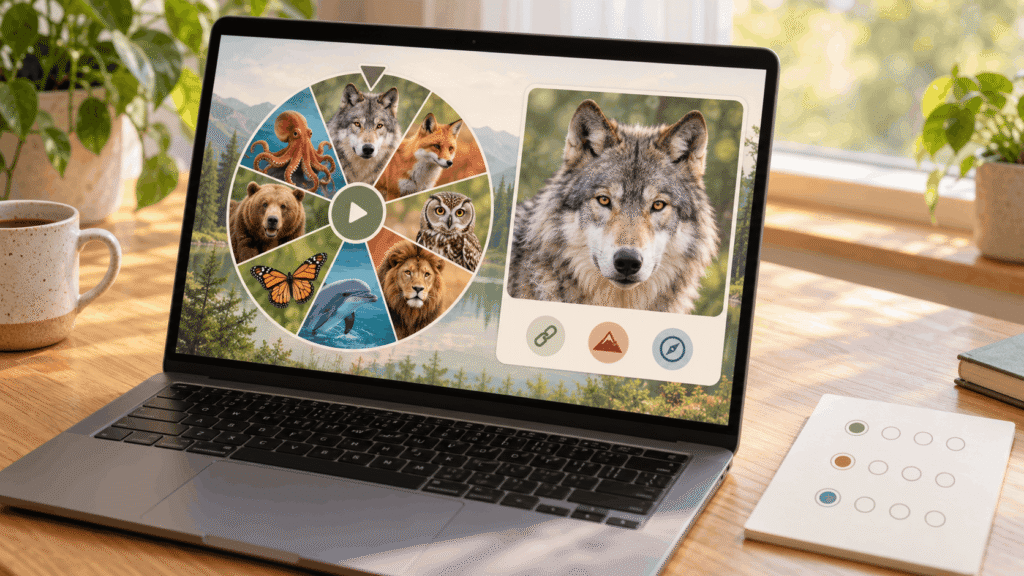
Two quite different tools share that name, and I stopped mixing them up only after using both side by side. Wheel-style pages ask you to press spin, then read the animal’s trait that lands, and most let you add your own animals to the slices. One wheel I tested ranged from wolf to octopus, while a long-running totem site started out with 64 animals and kept adding pages for years. For a real pet match, the dog breed generator can filter by small, big, family-friendly or low-shedding dogs.
Quiz-style generators reverse the order: they ask first and assign later. One runs 15 questions on a four-point agreement scale, another gets through 6 questions, including your favorite leisure activity, with options such as watching TV, hanging out at the beach, relaxing with friends, or exploring. The longer quiz feels thorough, yet neither shows how its scoring works.
Setup is short either way. One wheel page lists 4 steps, while one totem page walks through 5 steps that open with a grounding exercise. Neither format claims any science behind it, and one wheel page says outright that the spin is random and just for fun, which is how I read every result.
How Do You Use a Spirit Animal Generator?
You use a spirit animal generator by starting one spin or quiz, letting a single animal land, and then reading its trait against how you feel right now.
Pacing is where most people rush. On a wheel the whole job is to spin the wheel and watch which item comes up next, and the page gives a short note on what that animal is said to stand for. That is a straightforward way to get a prompt, but in my experience the reading sticks better with a slower routine:
- At peace with yourself first: sit for a minute before starting, without a set schedule or plan running in your head.
- Observing before acting: watch the slices slow down and resist the urge to restart the moment a dull animal appears.
- Current energy check: treat the trait note as clues about your mood today rather than a permanent label.
- Everyone spins once when you play in a group, and each person says whether the animal fits them and why.
The totem-site version of this routine frames the result as the animal spirit that is most prominent in you at the moment, the one residing within you predominantly right now. I like that wording because it builds in an expiry date. Spin again next month and a different animal is a normal outcome, not a contradiction.
Which Animals Can a Spirit Animal Generator Give You?
A spirit animal generator can only give you what its roster holds, which ranges from 24 animals on a compact wheel to over 100 animals behind one quiz’s results, mixing pets, farm stock, sea life and big predators.
The roster tells you who built the tool. A classroom wheel tagged Elementary sticks to creatures a seven-year-old could draw from memory, while totem-focused sites pull species from around the world and lean on their symbolic meanings. Writers naming characters tend to prefer the second kind, because an obscure creature gives a fresher hook than a household pet.
Geography explains most of the gaps I notice. A list made by someone dreaming of Africa carries the elephant and its savanna neighbors, a Yellowstone National Park fan would add bison and elk, and a Hawaii trip suggests reef life. City animals almost never appear, so nobody lands on a London pigeon or a Paris rooftop sparrow, even though both are tougher than they look.
Predators at the top of the food chain show up on nearly every roster I have checked, and they usually get the longest descriptions. Smaller creatures often get one line each. I would enjoy more variety at the bottom of the list, which is exactly where a group round tends to get people talking, because nobody walks in expecting to be a salmon.
What Questions Does a Spirit Animal Quiz Ask?
A spirit animal quiz asks about your temperament, habits and tastes, then matches the pattern of your answers to an animal; one quiz says it maps responses across 28 unique traits.
The six-result quiz I took was open about where it was heading, even though it never showed the scoring. The bee stood for a hard worker who can work well in a team and plays a vital role, while the dolphin was smart and friendly, the life of the party who makes others feel welcome. The eagle chased the big picture, values freedom, and likes making its own decisions.
The other results drew sharper contrasts. The tiger came out strong and silent, preferring solitude, and the Panda Bear liked lounging, eating and sleeping, yet would still know when to work hard. The elephant profile was the steady one: strong and dependable, with a good memory used to help other people.
Before answering, one totem guide suggests you ground yourself by picturing tree roots growing from the bottom of your feet, then focus on the questions. I tried that once and my answers came out noticeably less jokey. Another quiz teases “Who doesn’t want to find out if they’re an arctic fox?” even though no such result exists in its set.
Every quiz page I read sells itself as a free tool for self-discovery that will help you discover an answer to “what is your spirit animal.” The questions themselves deliver less than that promise, but they are a decent mirror for a quiet evening.
What Does Your Spirit Animal Result Mean?
A spirit animal result means whatever useful prompt you take from it: a trait to reflect on, loosely tied to the answers you gave, rather than a fixed identity.
I read results by working backward from my own answers. The longest quiz I took opens with your favorite natural element and then a run of agreement statements, so I check which ones I marked Very Accurate or Fairly Accurate and which I pushed down to Somewhat Inaccurate or Very Inaccurate. The strong answers usually explain the animal better than the result text does.
The table below is my own reading key for less common totem animals, grouped by the element a quiz taker picks and the statement they most likely agreed with. It reflects how I pair them, not any quiz’s official scoring.
| Element picked | Totem animals worth reading about | Statement you probably marked high |
|---|---|---|
| Air | Hummingbird, Waxwing, Secretary Bird, Great Green Macaw | Always seeking new experiences |
| Earth | Bighorn Sheep, Pika, Antelope, Echidna | More down-to-earth than head-in-the-clouds |
| Fire | Mongoose, Monitor lizard, Stink Bug, Crocodile | Living a fast-paced life |
| Water | Cod Fish, Pufferfish, Sea Snake, Oyster, Turtle | Needing lots of alone time to recharge |
| Wood | Squirrel, Porcupine, Orangutan, Parrot | Ideas arriving out of nowhere |
| Space | Owl, Praying Mantis | Seeking the secret of the universe |
Some totem readers treat an unfamiliar result as a newly emerging side of you rather than a miss. I close each reading with a line of gratitude for the help and guidance, even if it is only to myself, then spend five minutes journaling about where that trait already shows up in my week.
How Do You Use a Spirit Animal Generator as an Icebreaker?
A spirit animal generator works as an icebreaker when each person takes one spin and answers a single follow-up question about the animal, which keeps every turn short and personal.
I have run this with new work teams and with kids’ group games, and the trick is the follow-up, not the animal. A playful prompt only works if people can answer within ten seconds, so I keep questions concrete: food, color, mornings, noise levels. Here is the follow-up sheet I keep for the common wheel animals:
| Animal that lands | Follow-up question |
|---|---|
| Cat | What is your morning drink, and do you need it before anyone talks to you? |
| Dog | Coffee or tea for a long road trip? |
| Fish | Do you start the day with orange juice or plain water? |
| Horse | What is your favorite color, and where would you paint it? |
| Panda | Red or yellow for your front door? |
| Wolf | Would your pack wear green or blue jerseys? |
| Rabbit | Do you keep to yourself at parties or hop between groups? |
| Monkey | Are you more outspoken or reserved in meetings? |
| Octopus | Can you be loud but enjoy quiet? When does each side show? |
| Kangaroo | Have you ever been the loudest person in every room? |
| Lion | What’s for dinner after a big win? |
| Fox | Steak or lasagna on a cold night? |
| Frog | Would you trade dessert for a garden salad? |
| Giraffe | Fried chicken: plate or bucket? |
| Alligator | Which pink item do you secretly own? |
| Cheetah | What do you do faster than anyone here? |
| Shark | What topic makes you circle back in every conversation? |
| Seal | What trick could you perform for an audience right now? |
| Otter | Who would you hold hands with so you don’t drift off? |
| Zebra | Do you prefer things black and white or full of gray areas? |
| Lizard | Where is your favorite sunny spot to warm up? |
| Sheep | When did you last follow the crowd and regret it? |
| Camel | How long can you go without your phone? |
Quieter players get the most from this format, since a question about breakfast lets them approach others on their own terms. I let anyone retake one spin if the animal feels off, and on video calls the host shares a screen and handles every click. Of all the icebreakers I have tried, this one is the easiest to have fun with, and it often shows who in the room is quietly useful to others.
Is a Spirit Animal Generator a Personality Test?
No, a spirit animal generator is not a personality test: the wheel version picks at random, and the quiz versions match answers to animals without any published scoring.
Questions about conventional ways feeling like a betrayal of yourself, or whether you like to impress others, sound psychological, but nothing I have seen explains how those answers are weighted. Free-time choices like hiking outdoors, creating something, gaming, watching movies at home, going out with friends, or reading in bed or on the couch read more like a lifestyle poll than an assessment.
A wheel is plainer still. Landing on hamster, lobster, goat, cow, pig or duck says nothing measurable about you, and some quizzes admit as much by telling you that you have more than one spirit animal. Decide whether the result fits you, or spin for a friend and compare notes. Used that way, the tool gets people talking about themselves without putting anyone on the spot.
Where Does the Idea of Spirit Animals Come From?
The idea of spirit animals comes from the deep traditions around animal guides held by many Indigenous cultures, and online generators borrow the concept loosely without speaking for those communities.
When I look into a result, I keep three layers apart. The first is those cultural traditions themselves, which belong to specific peoples and are not mine to summarize. The second is the modern animal totem website, where each animal page offers a quotation box of messages to reflect on. The third is the grounding ritual some of those sites suggest, moving the colors of the chakras or a rainbow through your body before bringing out your animal.
That ritual, in my reading, mixes ideas from several practices rather than one source. A generator is a game, and one wheel page says plainly that it does not represent those traditions. I use the tool as play and a journaling nudge, and when someone asks about the real history, I point them toward Indigenous voices rather than a spin result.
Can You Add Your Own Animals to the Spirit Animal Generator?
Yes. The wheel starts with 24 animals, from the wolf and owl to the koala and octopus, but you can edit the list in the entries box. Type one animal per line to add a new one, or delete any you don’t want on the wheel.
Custom lists work well for themes. A class studying oceans could keep the dolphin and octopus and add the shark, whale and sea turtle. A family could keep only pets, or a fantasy fan could add the dragon, phoenix and unicorn.
Animals you add won’t come with a trait note, so write your own. A short line like “Quiet and patient, you wait for the right moment” is enough to start a conversation.
Tick Remove the winner after each spin if everyone in a group should get a different animal. Save wheel keeps your list for next time, and Share sends it to friends so they can spin the same wheel. For a bigger room, open the wheel in full screen on a TV or projector so everyone can see the result land.
How Can You Use a Spirit Animal Result for Writing or Art?
A spirit animal result makes a quick creative prompt. The animal gives you an image, and its trait gives you a theme to work with.
For journaling, spin once and write for five minutes about where you see that trait in your life. The turtle’s “slow progress is still progress” might lead to a page about a long project, while the hummingbird might lead to a list of small moments that made you happy this week. If you want more starting points, the journal prompts page adds reflection, gratitude and goal questions.
For stories, give a character a spirit animal and let its trait shape how they act. A fox character solves problems with tricks, and a bear character protects their friends.
For art, draw the animal in a setting that shows its trait, such as an eagle above a city or a panda resting in a quiet garden. Pair the result with the drawing prompt generator for a style or setting to go with it.
What Group Games Can You Play With a Spirit Animal Generator?
The wheel works for more than a one-time icebreaker. Here are a few games that keep a group spinning.
- Guess the match: each person spins, keeps the result secret, and acts out the animal while others guess.
- Agree or disagree: friends vote on whether the animal fits the person who spun it.
- Animal teams: spin a few animals, then split players into teams named after them, like Team Wolf and Team Owl.
- Story chain: each player spins and adds a line to a group story starring their animal.
- Swap test: two people trade results and explain why the other animal fits them better.
These games suit sleepovers, family nights, youth groups and team meetings. They take only a few minutes, need no supplies and give quieter people an easy way to join in.
Keep the mood light. If someone doesn’t like their animal, let them spin again or choose one from the list. The goal is a laugh and a chat, not a verdict on who they are.
Is the Spirit Animal Generator Free and Random?
Yes, it’s free, with no sign-up, no account and no download. It works on a phone, tablet or laptop, so you can spin from anywhere.
Each spin is random. The wheel uses your browser’s crypto.getRandomValues function, so every animal on the list has the same chance of landing. You can see how spins are checked on the randomness audit page.
Because each spin is independent, the same animal can come up twice in a row. That’s normal. If you want a different animal for each person, tick Remove the winner after each spin.
A random result also means the wheel doesn’t know anything about you. It doesn’t ask questions or track answers, and it isn’t a personality test. The result is a fun prompt, and you decide whether it fits.
That makes it a fair tool for groups too. Nobody can pick their favorite animal for a friend, and everyone gets the same odds, whether you’re spinning once at a party or every day as a journaling habit.