How Does a Random Fruit Generator Pick a Fruit for You?
A random fruit generator pulls one fruit name from a stored list the moment you click a button or Press Spin, so you get an unbiased answer for a snack, a lesson, a sketch or a shopping list. Wheel tools land on a single result, while list-style tools can hand you a dozen names at once.
Under the hood, every one of these tools is a dataset with a trigger attached. One list tool files its entries under Food > Fruits and serves a fresh batch with one tap, while a typical wheel holds 30 fruits running from apples and bananas to lychee and dragon fruit. Card-style tools go further and attach facts to each name.
I have run fruit draws for my own kitchen and for a room of eight-year-olds, and the size of the list shaped the experience more than any animation did. A short list of mango, watermelon, pineapple and cherry feels safe. A list that stretches to durian turns the same click into a small adventure, and sometimes into a trip to a specialty grocer.
The useful question, then, is not whether the tool is clever but what sits on its list and what it does with the answer. The sections below take those two questions apart, from list size and fairness to calories, odd names and classroom routines.
How Many Fruits Does a Random Fruit Generator Hold?
A random fruit generator holds anything from eight fruits to well over a hundred, and that list size sets both your odds and how surprising the answer feels. A short ready-made list suits people paralyzed by choice over a snack, while the long ones exist to introduce fruits you have never tasted.
Small lists make the math easy to see. On a random wheel with eight fruits, each one lands one time in eight on average, so a craving for pineapple has a 12.5% chance per go. The biggest card tool, by contrast, spreads its odds across about 100 distinct fruits, so any single favorite is a long shot.
List length also changes the kind of decisions you make with the result. A pick from eight familiar names is a snack prompt; a pick from a hundred is a discovery prompt, and you may need to look the fruit up before you can buy it.
Fairness depends on the engine as much as the list. One wheel says its True Randomness comes from an RNG called through the browser function crypto.getRandomValues(), and another relies on a secure random generator and publishes a fairness test page you can run yourself.
How Do You Get a Random Fruit in One Click?
You get a random fruit by opening a generator page and pressing its main control, either a spin on a wheel or a generate button on a card tool, then reading the name it shows. The steps below cover the common flow, since order matters when you want a clean draw:
- Sort or Shuffle the entries first so you can see exactly which fruits are in play before anyone starts.
- Spin the wheel, or press Generate Fruit on a card-style tool, and leave the result alone once it appears.
- Rerun a list tool when you want variety, since it shows 12 fruits at a time and every click gives a new combination.
Card tools need no wheel at all, and a single tap replaces the spin. Wheel tools, on the other hand, need scripting turned on in the page, so a blank wheel usually means a blocked script rather than a broken site.
In my experience the second step is where people cheat. They spin, dislike the answer, and spin again until the wheel agrees with them. I now settle the rule before anyone touches the button: the first result stands, and a second go only happens if the first fruit is not in the house.
What Does a Fruit Result Card Tell You?
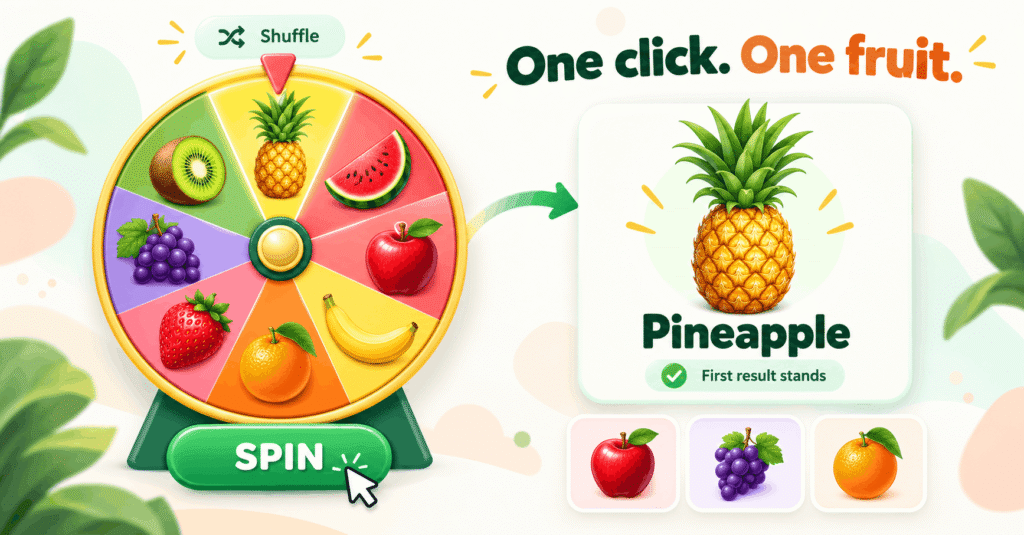
A fruit result card tells you the fruit’s name, shows a photo, lists its calories per 100 g, and adds a one-line Best For tip, so one result teaches you more than a name on a wheel can. The card is ready on load, which makes it an instant pick for anyone who does not want to wait for an animation.
The image is what turns a card into a sketching aid. I use it for Drawing drills with kids: draw the fruit whole, then halved, then as a cartoon. The pictures matter most for fruits nobody in the room has seen, because a name alone gives a child nothing to copy.
The text lines carry the facts. Even when the image lags, the name, the energy figure and the short tip still appear, so the card stays usable on a weak connection.
Card tools are pitched at Games and classrooms as much as at kitchens. A teacher can project one card, hide the name, and let the room work out the fruit from the picture and the tip, which takes about a minute per round.
What Can You Do With a Random Fruit Once You Have It?
A random fruit works best as a prompt for meal ideas, a quick snack, a sketch or a market run, because it removes the moment of indecision without forcing anything on you. The result is a nudge, and I treat it as one.
Shopping is where I lean on it most. Before a market trip I spin once to decide what to buy at the store beyond my usual bananas and apples, and that habit has brought feijoa and persimmon into my kitchen.
For creative projects, pineapple is a gift. Its card line describes it as Spiky outside, sweet and juicy inside, which reads like a sketching brief. Durian, rambutan and salak offer the same kind of texture puzzle for anyone practising shading.
Smoothies are the other common use. You can spin two or three times and blend whatever lands, which works well with soft fruits and less well with anything you need to peel with a knife, so I keep a short smoothie-only version of my list for mornings.
How Do You Customize a Fruit Wheel?
You customize a fruit wheel by editing its entry list, adding or deleting fruits, and choosing what happens to a winning slice after it lands. Most custom wheels start from a wheel of names template, and the editor lets you add or remove fruits in seconds or create a fresh wheel from a blank one.
Winner handling is the setting that changes the game. If you tick Remove the winner, each fruit leaves after it is drawn, which suits taste sessions where nobody should get the same fruit twice. Leave it off and you can let the wheel do the work all week with the full list intact.
Saving matters once you customize a long list. Auto-Save & Sync keeps the wheel in local storage on your device, Share Links let a friend open the same version, and Import / Export moves wheel configurations in and out as JSON files.
I keep two versions. One holds only what is in my fruit bowl, and the other holds everything I want to try this season, which stops the long list from producing fruits I cannot get.
Is a Fruit Spinner Truly Random, and What Else Can It Do?
A fruit spinner is random in the practical sense: on an unweighted spinning wheel, every slice has the same chance, so a fair pick depends on equal slices, not on how hard you spin. With eight slices, each fruit gets one chance in eight on every turn.
Some pages ask you to Hold to Spin, and the length of the press feels like it should matter. On the tools I have tested it only changes the animation, while the result comes from the randomizer underneath. The page also needs JavaScript enabled, or the wheel will not move at all.
Equal odds only hold until someone edits them. A Weighted Choice setting lets chosen fruits come up more often, and a viewer has no way to see that from the wheel’s face, so I always ask whether anything was set to appear more often before a group draw.
The extras are mostly about display. Fullscreen helps when the wheel is projected, Advanced panels hold the extra options, and most tools are free with no sign-up, which keeps quick decisions quick.
Which Lesser-Known Fruits Can a Generator Surprise You With?
A broad fruit generator can surprise you with fruits such as kiwi, star fruit, lychee, rambutan, mangosteen, feijoa, durian, cape gooseberry, rose apple, salak, mamey sapote and cherimoya. One card tool shows those twelve as sample results, each with its calories and a short note on the example cards.
Most of these names are unusual only outside the regions where it grows, which is the angle I find most useful. A Geography round pairs a random place with a fruit people there might eat, and the twelve above give that round plenty to work with.
The practical test comes at the shop. My Weekly shopping rule is to buy one fruit from the list I do not usually eat, and a good fruit stand stocks lychee or rambutan more often than people expect.
These fruits also make better quick snack ideas than the usual apple. Kiwi needs only a spoon, lychee peels by hand, and star fruit slices into shapes that children will actually eat.
Why Does the Same Fruit Show Up Under Different Names?
The same fruit shows up under different names because trade names and regional names travel with it, so a generator may print pitaya where you expected dragon fruit. That gap confuses players more than any rare fruit does, and it is worth knowing before a round.
The common pairs are easy to learn once you see them together. Dragon fruit is also Pitaya or Pitahaya, star fruit is Carambola, sapodilla is Chico Sapote, and mamey sapote is sold as Yellow Sapote or Mamey Colorado.
The berry and apple names cause the most mix-ups. Cape gooseberry also goes by Goldenberry, Uvilla and Poha Berry, sugar apple is the Custard Apple, java apple is the Wax Apple, Surinam cherry is Pitanga, bael is the Wood Apple, and mombin is the Hog Plum.
One tool keeps these in an alias table to show multiple names for one fruit, which is handy for learning about fruits in a mixed group. I match labels to that table before printing cards, so nobody argues that two names mean two fruits, and any fruit name generator list I build uses the most common name first.
Which Random Fruits Have the Fewest and Most Calories?
Across one generator’s sample results, rose apple sits at the bottom with 25 kcal in every 100 g, while durian tops the list at 147 kcal, so the spread is close to six times. The table below collects every figure from the tool’s sample cards and real picks, which I find handy when I want to snack on something light:
| Fruit | Energy per 100 g | Shown as |
|---|---|---|
| Rose apple | 25 kcal | Sample pick |
| Star fruit | 31 kcal | Sample pick |
| Pineapple | 50 kcal | Example card |
| Apple | 52 kcal | Example card |
| Cape gooseberry | 53 kcal | Sample pick |
| Feijoa | 55 kcal | Sample pick |
| Kiwi | 61 kcal | Sample pick |
| Lychee | 66 kcal | Sample pick |
| Rambutan | 68 kcal | Sample pick |
| Persimmon | 70 kcal | Example card |
| Mangosteen | 73 kcal | Sample pick |
| Cherimoya | 75 kcal | Sample pick |
| Salak | 82 kcal | Sample pick |
| Pomegranate | 83 kcal | Example card |
| Mamey sapote | 134 kcal | Sample pick |
| Durian | 147 kcal | Sample pick |
The table doubles as number practice for students, who can rank, round or chart the figures. For a vitamin boost with few calories, the top half of the table is the better pool to spin from.
These sixteen figures are not the extremes of the tool’s full data set. Miracle fruit sits well below rose apple and coconut sits far above durian, because both come from a separate list rather than from the sample cards.
Which Random Fruits Need Extra Care Before You Eat Them?
Four results from a broad fruit generator need extra care before you eat them: ackee, quince, plantain and breadfruit. None of them works as a grab-and-go result, so I flag them before a group draw rather than after.
Ackee is the one to take seriously. It carries 151 kcal per 100 g in the tool’s figures, and it must be fully ready before anyone eats it, so I only keep it on a wheel for adults who already know how to handle it.
Quince is the patient one. Raw quince is hard and sour, so it belongs in a cooked dish, which makes it a better prompt to prep for lunch or dinner than a snack on the spot.
Plantain and breadfruit act more like side dishes. Plantain lists 122 kcal per 100 g, and both fit meal planning far better than fruit-bowl spins, so I tag them on my own list with a small pot symbol.
Can a Fruit Generator Give You a Vegetable Instead?
A fruit generator will not give you a vegetable, because its list only holds fruits; for a vegetable you need a separate tool, or a custom wheel where you add any items you like. That limit is a feature, since it keeps the odds honest for fruit-only rounds.
The line between the two is blurrier in the kitchen than on the list. Plantain is a cooking banana, and breadfruit is starchy and cooked like a vegetable, yet both stay on the fruit side because they are fruits in the botanical sense.
When I plan a full meal, I run two tools side by side, one for fruit and one for vegetables. That pairing gives a balanced plate without anyone arguing about which side of the produce aisle tonight’s dinner comes from.
Where Can You Find Fruit Wheels Online, and Are There Apps?
You can find fruit wheels on general wheel-maker sites, where they sit in a Food and Drink category next to recipe and snack wheels, and some of those makers also offer a phone app. Most run in a web page with no installation at all.
The public wheels vary a lot in size. One Public fruit wheel carries 30 options, though its editor shows 25 of 30 items at once, and another lists 18 entries without naming them in its page text.
Streamers use the same wheels for giveaways and chat challenges. An OBS Streamer Mode adds a green screen background so the wheel can sit over a live feed, which I have seen used for “eat what the wheel says” streams.
Looks are the last layer. Some makers let you Browse Styles and switch Styles in one click, which matters more for streams and classrooms than for a quick kitchen spin.
Can You Get a Fruit Instantly Without Spinning?
Yes, a card-style fruit generator gives you a fruit instantly: when you open the page, a result appears automatically, and each further press brings a new one. No wheel animation is involved.
I use that speed as a Snack helper. The rule is to commit to whatever shows first, which turns the card into a lucky fruit of the day and also works for settling debates at home over the last mango.
The wheel apps on the iOS App Store and Android are slower by design, since the spin is part of the fun, so I reach for the card tool when speed matters.
How Many Different Fruits Can a Generator Choose From?
The largest fruit generator in this group holds more than 120 names, and the rest range from eight to thirty fruits. Several of those names are alternates for the same fruit, which is why the distinct count is lower than the name count.
That tool sorts its list grouped by type into Everyday, Berries, Citrus and Melons, Tropical, and Rare and Exotic. Every result is a real and edible fruit, not a made-up word.
The grouping is handy for Science practice. Students can Classify each result as a berry, a citrus, or a stone fruit, and the odd ones that fit none of those make the best discussion.
Does a Fruit Name Generator Only Give Real Fruits?
Yes, a fruit generator of this kind only returns fruits people actually eat, with no invented names mixed in. That makes it safe for teaching, unlike word tools that mix genuine and made-up terms.
The names still have uses beyond the kitchen. People use the list to name a pet or a band, or to seed a story, and the alternate names give a second option when the first sounds too plain.
I also use it for Spelling rounds, since jabuticaba and mangosteen test older students better than any word list I have bought. A ten-name round takes about five minutes and leaves everyone with a few new words.
Which Fruit Has the Fewest Calories?
Miracle fruit has the fewest calories in one generator’s data, at 14 kcal per 100 g. It sits at the very bottom of the lowest group, well below lemon and watermelon.
At the other end of the tool’s data, the highest values belong to coconut at 354 kcal, date at 282 kcal and tamarind at 239 kcal. For lower-calorie snacks, the tool suggests keeping picks under about 60 kcal in every 100 g.
Every figure is listed in kcal per 100 g, so portions change the real numbers. A card may also mention a health benefit, which helps with healthy eating goals, but I treat those lines as prompts, not advice.
Can You Add Vegetables to a Fruit Wheel?
Yes, you can add vegetables to most custom fruit wheels by typing them in as new entries, though card tools with fixed lists cannot be changed. For those, a Random Vegetable Generator is the cleaner route.
Some pages suggest running both and taking time to compare the two cards. A related list tool presents its vegetable generator as complementary produce, which is the way I use it for planning a plate.
The custom-wheel route suits mixed rounds better. I keep one wheel with fruit and vegetable entries side by side for a weekly cooking challenge, and the rule is simple: whatever lands goes into the next dinner, raw or cooked.
Does a Random Fruit Generator Show Pictures?
Yes, card-style fruit generators show a photo with every result, and one tool sources its images from Wikipedia and Wikimedia Commons. If an image loads slowly, the text still appears.
You can Download the card as a PNG, and the image stays in the saved file. That makes each result a ready drawing subject or reference for artwork, and children can paint it or use it for Art homework.
Wheel tools work differently. Some slices use an emoji, some let you Add image to each entry and change Colors, and on one wheel the labels come straight from image filenames, which leaves odd text on the slices.
What Are the Strangest Fruits a Generator Can Pick?
Miracle fruit, ice cream bean, jabuticaba, canistel and baobab fruit are among the strangest results one generator lists. They make good challenges because few people have tasted, or even seen, any of them.
A fun Taste test or quiz works with these: read the note aloud and let players guess the fruit before you reveal it. Lúcuma, at 120 kcal per 100 g, often stumps the room, and it adds a Geography angle since most players have never heard where it comes from.
Some rare results need care. Ackee must be ripe to eat safely, and quince is cooked before eating, so a strange pick is a prompt to read first and taste later.
Can You Use a Fruit Wheel to Plan Smoothies?
Yes, a fruit wheel is a good smoothie planner: spin a few times and use each result as a smoothie ingredient. I keep a separate list of soft fruits for this, so the results always work in a glass.
The Smoothie builder idea is simple. Run several spins, write the results as an ingredient list, and you have smoothie combos you would never have planned yourself. A Simultaneous Multi-Wheel setup, with up to 6 wheels at once, gives you a whole recipe in one go.
Light picks keep the drink lean, and the fruit with the lowest calories overall, miracle fruit, is better as a tasting trick than a base. Lemon sits at 29 kcal, lime at 30 kcal and strawberry at 32 kcal per 100 g, and a Drink pairing wheel can match citrus with any drink you have on hand.
Can You Make Some Fruits Come Up More Often?
Yes, many fruit wheels let you weight entries so chosen fruits come up more often, either through a weight setting per entry or by adding a fruit more than once. Plain wheels give every slice equal odds.
To weight your favorites, open the entry list and raise their value, then reorder or remove entries that are out of season or unavailable. A page updated October 14, 2026 still recommends that seasonal clean-up.
I use weighting for a Grocery nudge: let the wheel choose 3 to 5 items for a varied shopping trip, with a slight bias toward what is cheap this week. The same setup supports a goal of one new fruit a week without making every trip a gamble.
How Do You Use a Fruit Wheel With a Group or Class?
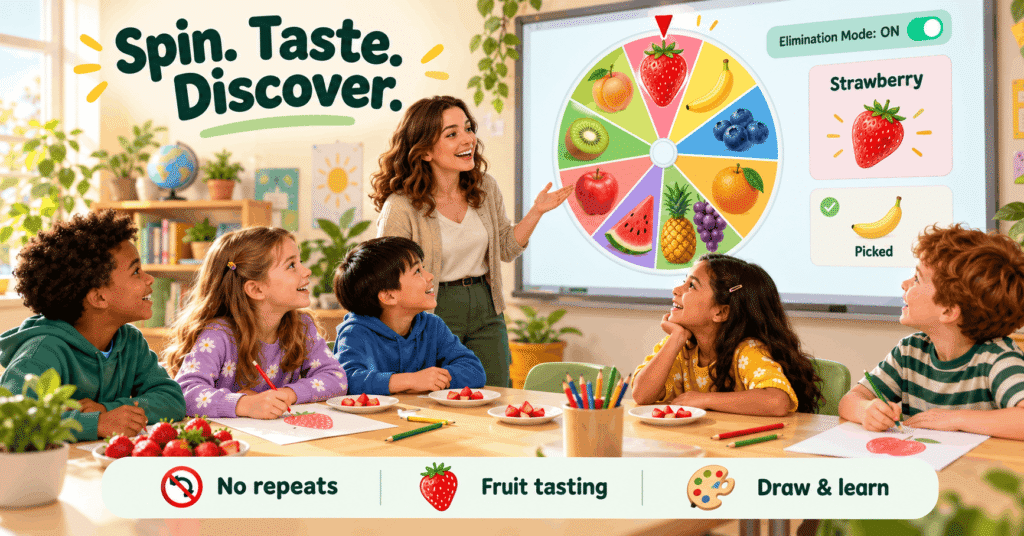
You use a fruit wheel with a group by projecting one wheel, agreeing the rules, and turning on a mode that drops each winner so nobody gets the same fruit twice. That setup turns the wheel into a classroom game in minutes.
A routine I have used with mixed kids and adults runs in this order:
- Elimination Mode goes on first, since it removes each winner and guarantees no repeats across the round.
- Tastings follow each spin, with one small piece per person for the fruit that landed.
- Educational activities close the round, such as a drawing or a short fact search on the fruit.
The wheel keeps games fair because nobody controls the result. In my experience, the group pays more attention when a spin decides who goes next than when the teacher does.
Can You Save a Fruit Wheel and Use It Again Later?
Yes, you can save a fruit wheel and reuse it, either by keeping it in your browser, by copying a link, or by cloning it into a new wheel. A saved wheel keeps its entries, odds and look.
The quickest route is to share the wheel: share its URL, or press the button that opens your share menu, which copies the result instead on devices that lack one. Clone Wheel makes an editable copy so you can change it without touching the original.
Saved public wheels also keep a record. One fruit wheel shows 177 lifetime spins and a total spin time of 25 minutes 53 seconds, which is a quick way to see whether a wheel is actually in use.
Which Fruits Come on a Fruit Wheel by Default?
The fruits that come on a fruit wheel by default are mostly familiar ones: one wheel is preloaded with 11 fruits such as grapes, pomegranate, blueberries, apple, orange, strawberries, Melon, pineapple, papaya, mango and cherries. Another wheel runs on 8 slices, each marked by an emoji.
Longer lists add citrus, berries and tropical fruits, and one list-style tool rotates through apricot, avocado, blackberry, boysenberry, cantaloupe, clementine, coconut and date. One public wheel even names a variety, the Florida Deep Red Grapefruit.
The table below gathers every fruit and alternate name from the source lists, grouped the way the largest tool groups them, so you can build or check your own wheel:
| Fruit | Group in the source lists | Also called |
|---|---|---|
| Apple | Everyday | — |
| Banana | Everyday | — |
| Orange | Everyday | — |
| Grapes | Everyday | — |
| Mango | Everyday | — |
| Pineapple | Everyday | — |
| Pear | Everyday | — |
| Peach | Everyday | — |
| Plum | Everyday | — |
| Cherry | Everyday | — |
| Kiwi | Everyday | — |
| Apricot | Everyday | — |
| Fig | Everyday | — |
| Pomegranate | Everyday | — |
| Nectarine | Everyday | — |
| Date | Everyday | — |
| Strawberry | Berries | — |
| Blueberry | Berries | — |
| Raspberry | Berries | — |
| Blackberry | Berries | — |
| Cranberry | Berries | — |
| Gooseberry | Berries | — |
| Elderberry | Berries | — |
| Boysenberry | Berries | — |
| Mulberry | Berries | — |
| Bilberry | Berries | — |
| Cloudberry | Berries | — |
| Sea Buckthorn | Berries | — |
| Rowan Berry | Berries | — |
| Camu Camu | Berries | — |
| Açaí | Berries | — |
| Goldenberry | Berries | — |
| Grumichama | Berries | — |
| Lemon | Citrus and Melons | — |
| Lime | Citrus and Melons | — |
| Mandarin | Citrus and Melons | — |
| Tangerine | Citrus and Melons | — |
| Grapefruit | Citrus and Melons | — |
| Watermelon | Citrus and Melons | — |
| Cantaloupe | Citrus and Melons | — |
| Honeydew | Citrus and Melons | — |
| Papaya | Tropical | — |
| Guava | Tropical | — |
| Coconut | Tropical | — |
| Dragon Fruit | Tropical | Pitaya, Pitahaya |
| Lychee | Tropical | — |
| Passion Fruit | Tropical | — |
| Jackfruit | Tropical | — |
| Rambutan | Tropical | — |
| Mangosteen | Tropical | — |
| Durian | Tropical | — |
| Longan | Tropical | — |
| Star Fruit | Tropical | Carambola |
| Soursop | Tropical | — |
| Sugar Apple | Tropical | Custard Apple |
| Sapodilla | Tropical | Chico Sapote |
| Tamarind | Tropical | — |
| Jabuticaba | Rare and Exotic | — |
| Miracle Fruit | Rare and Exotic | — |
| Ice Cream Bean | Rare and Exotic | — |
| Cupuaçu | Rare and Exotic | — |
| Canistel | Rare and Exotic | — |
| Mamey Sapote | Rare and Exotic | Yellow Sapote, Mamey Colorado |
| Abiu | Rare and Exotic | — |
| Santol | Rare and Exotic | — |
| Langsat | Rare and Exotic | — |
| Duku | Rare and Exotic | — |
| Bael | Rare and Exotic | Wood Apple |
| Baobab Fruit | Rare and Exotic | — |
| Noni | Rare and Exotic | — |
| Ackee | Rare and Exotic | — |
| Medlar | Rare and Exotic | — |
| Pawpaw | Rare and Exotic | — |
| Peumo | Rare and Exotic | — |
| Araza | Rare and Exotic | — |
| Lúcuma | Rare and Exotic | — |
| Mamoncillo | Rare and Exotic | — |
| Jocote | Rare and Exotic | — |
| Cacao | Rare and Exotic | — |
| Avocado | Other source lists | — |
| Clementine | Other source lists | — |
| Melon | Other source lists | — |
| Florida Deep Red Grapefruit | Other source lists | — |
| Persimmon | Other source lists | — |
| Feijoa | Other source lists | — |
| Cape Gooseberry | Other source lists | Goldenberry, Uvilla, Poha Berry |
| Rose Apple | Other source lists | — |
| Salak | Other source lists | — |
| Cherimoya | Other source lists | — |
| Java Apple | Other source lists | Wax Apple |
| Plantain | Other source lists | — |
| Quince | Other source lists | — |
| Breadfruit | Other source lists | — |
| Surinam Cherry | Other source lists | Pitanga |
| Mombin | Other source lists | Hog Plum |