What Does a Random Emotion Generator Do?
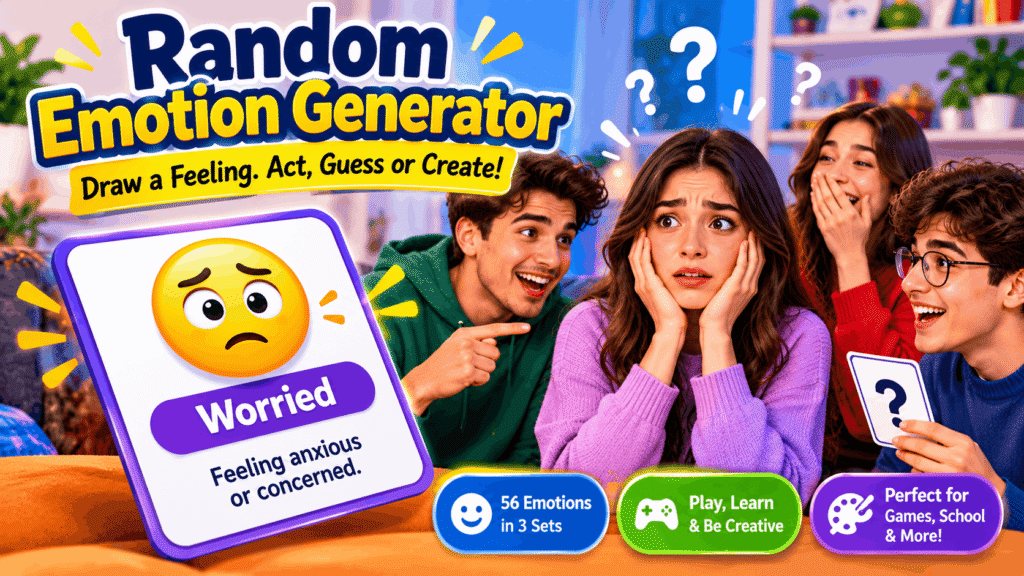
A random emotion generator picks a feeling at random and shows it to you, so you have a ready-made emotion to act out, draw, write about or talk about. On this page each card shows an emoji, the emotion’s name and a short, plain meaning, drawn from 56 emotions in three sets.
The idea sounds small, but it fixes a real habit. Asked to name a feeling on the spot, most people reach for the same few feeling words every time. A random card breaks that loop, which is why students, drama groups and writers working on character development all get something out of it.
The simplest game is also the best one: draw a card, show the face, and let the room guess while one player acts out the emotion without words. It sits somewhere between charades and a feelings lesson. People who only ever say “fine” end up showing apprehension or pride, because a neutral card gives them permission to try a feeling they would never pick for themselves.
The emoji on every card matters more than it looks. It shows the physical reactions that come with each feeling, a raised brow or a slumped mouth, so the card works even for players who can’t read yet. Writers use the same card differently: they hand it to their protagonist and see what happens. The three sets, Basic and Complex at either end with Everyday in the middle, let you pitch the game at the right level.
What Is an Emotion, Really?
An emotion is a short-lived reaction of body and mind to something that matters to you, and psychologists have tried for decades to sort these reactions into a few core types. The best-known attempt is Plutchik’s Wheel of Emotions.
Robert Plutchik drew his wheel in 1980 with eight categories of primary emotion: joy, trust, fear, surprise, sadness, disgust, anger and anticipation. He placed them in opposite pairs, so joy faces sadness and trust faces disgust. That layout is why emotion charts often look like a flower or a color wheel.
Plutchik also showed that each emotion comes in strengths. Serenity is a mild form of joy, and ecstasy is its most intense form, while rage sits at the far end of anger. Mixing neighboring petals gives blends he called dyads, and three-way mixes he called triads, which is how a short list of basics can describe a much wider range of feelings.
Every emotion also shows up in expressions. The face changes before we choose words, and those quick changes are what this page’s emojis try to capture. Shame lowers the eyes, fear widens them, and joy lifts the cheeks. The cards build on that link between a feeling and its face.
How Do You Use the Random Emotion Generator?
You use the random emotion generator by choosing a set, pressing New emotion, and reading the card that appears. Each press draws a new emotion from the set you chose, and the card pairs a word with a face and a one-line meaning.
- Pick a set: Basic (kids), Everyday feelings, Complex emotions or All emotions.
- Press New emotion.
- Read the emoji, the emotion and its meaning out loud.
- Act it out, draw it, or talk about a time you felt it.
- Press again for the next card.
The routine fits whatever you’re doing. In a lesson, it’s a quick way to help children identify what you’re feeling when the words won’t come. At a party it becomes a guessing game, and in a writing session it’s a prompt. Pick the set that fits the group and the rest takes care of itself.
The tool runs in the browser, so it works the same in Chrome, Firefox, Edge and Safari, on Windows, Mac or Linux. If several people are playing, open Add players and type the names. The card then says whose turn it is. For larger groups, spin the random name picker first to set the order.
Which Emotion Set Should You Pick?
The set you pick should match who is playing: Basic (kids) suits young children, Everyday feelings suits teens and adults, and Complex emotions suits writers, actors and older students. All emotions mixes the three for variety.
| Set | Emotions | Best for |
|---|---|---|
| Basic (kids) | 16 | Young children and first feelings lessons |
| Everyday feelings | 20 | Teens, adults and check-ins |
| Complex emotions | 20 | Writing, acting and older students |
| All emotions | 56 | Mixed groups and long games |
Basic (kids) covers the first feelings children learn, like happy, sad, angry and scared, plus a few useful extras such as proud, bored and worried. Each set acts as a filter by age and difficulty, so a seven-year-old never draws a card like ambivalence.
Everyday feelings lines up with the extras Paul Ekman added to his list in 1999, which included amusement, contempt, pride and relief. The set has relieved, grateful, frustrated and overwhelmed, the distinct words adults use in real life. Complex emotions stretches emotional intelligence furthest: bittersweet, nostalgic, melancholy and ambivalent are hard to define and harder to act. I tend to start a new group on Everyday feelings and move up once people are comfortable.
Where Do Emotion Categories Come From?
Emotion categories come from research that spans psychology, neuroscience, philosophy and linguistics, and there is still no single agreed list. Different models carve the same feelings up in different ways, which is why every emotion tool groups its cards a little differently.
The study of emotion is interdisciplinary by nature. Philosophers asked what feelings are long before psychologists measured them, and linguists point out that languages don’t even agree on which feelings deserve their own word. Researchers in cognition look at how thinking and feeling feed each other, while others use logic and data to test which groupings hold up.
The Wikipedia article on emotion classification sets out the main models side by side, from basic-emotion lists to emotion wheels and newer statistical maps. Reading it, the striking thing is how much the models overlap. Almost all of them include something like joy, sadness, anger and fear, and they disagree mostly about the blends.
For personal use, the theory matters less than the vocabulary. This page groups its sets by who is playing rather than by any one model, because a teacher with a class of eight-year-olds needs different cards from a novelist.
How Do Writers Use Random Emotions?
Writers use random emotions to decide how a character feels going into a scene, which gives the scene a clear direction before the first line is written. A card works as a quick constraint when the page is blank.
The trick is to draw a card and let it set the mood. If the card says resentful and the scene is a birthday party, the story already has tension. Some languages have single words for feelings that English needs a sentence for: saudade, from Portuguese, is a deep longing for something absent, schadenfreude, from German, is pleasure at someone else’s misfortune, and ennui is a heavy, restless boredom. None of these are on the cards, but they show how far emotion vocabulary can stretch.
Precise feelings make precise writing. A character who feels frisson at a concert, wistfulness at an old photo or quiet indignation in a meeting is more vivid than one who is simply sad. Awe, dread, elation and tenderness all give a scene a sharper edge than happy or angry.
Draw a few cards and pick the one that fits the plot, or take the first one as a challenge. For role-play scenarios and tabletop games, give each character a hidden card. The cards also double as journaling prompts. For full plots, the creative writing prompt generator supplies a situation to put the emotion into.
How Do Actors and Drama Teachers Use It?
Actors and drama teachers use random emotions for warm-ups and scene work, where a performer has to show a feeling the moment it’s called. Because nobody chooses the card, everyone gets pushed past their default reactions.
Acting is about the physical side of a feeling: posture, breath, voice and face. A card forces an actor to find that physical shape for an emotion they might never pick, like euphoria or remorse, jubilation or suspicion. Moving between alienation and joy in a short scene teaches control better than any lecture.
Intensity is the best way to stretch a single card. Play the emotion at a subtle level, then a moderate one, then at its most powerful. A self-conscious character played at three strengths becomes three different people. That range is what separates a flat performance from a believable one, because real feelings rarely arrive at full volume.
Group games work well too. Improv performers can draw two cards each and switch between them mid-scene, and roleplayers can keep a card hidden until the end. Watch for the instinctual response, the first expression an actor makes before they start thinking. It’s usually the most honest one, and it gives the next scene somewhere to start.
How Do Teachers Use It for Emotional Vocabulary?
Teachers use random emotions to build emotional vocabulary, giving children more precise words than happy, sad and fine. A child who can name a feeling accurately is better placed to talk about it.
A neat way into the lesson is the word itself. Emotion comes from the Latin emovere, which means to stir up, and children like the idea that a feeling is something stirring inside them. From there, the Basic (kids) set pairs each word with a face and a meaning, so younger children see what the feeling looks like.
Many teachers start with the six basic emotions from Paul Ekman’s 1992 study: anger, disgust, fear, happiness, sadness and surprise. Once children know those, the Everyday and Complex sets add the in-between words. Drama exercises help here too. Children working with partners can take turns showing a card and guessing it, which makes the word stick.
Ask students to describe a recent time they felt the emotion on their card, but keep it optional so nobody feels exposed. For quick breaks between lessons, a brain break wheel pairs well with an emotion round. You’ll find both on the classroom tools page, and the cards work across sessions without repeating until a set runs out.
Can Random Emotions Help With Journaling?
Random emotions can help with journaling by giving you a starting point: draw a card, then write about a time you felt that emotion. The randomness brings up feelings you might not choose to write about on your own.
For journal keepers, a card such as grateful or disappointed often leads to an entry you wouldn’t have planned. The aim isn’t to analyze yourself. It’s to notice a feeling, name it, and follow the thoughts and behaviors that came with it. That builds emotional awareness without any pressure to get it right, and expressive writing like this is a common classroom exercise too.
A card a day works as daily inspiration, and it’s a gentle way past creative blocks when you don’t know what to write. Everyday feelings is the set I’d use for this, because its cards match ordinary days. Over time you might notice a pattern, such as a quiet longing that keeps coming back.
The cards are not a mood tracker, and they don’t log moods, diagnose anything, give you a score or tell you what you should feel. For a wider set of questions to write about, the journal prompts page has prompts that don’t rely on emotions at all.
How Does Intensity Change an Emotion?
Intensity changes how strongly an emotion is felt without changing what kind of emotion it is: mild annoyance and full fury are both anger. Many emotion models rate feelings from weak to strong for this reason.
Emotions start with stimuli. Some are external, like a slammed door, and some are internal, like a sudden memory. The size of the trigger and your state at the time decide how strong the feeling gets. Apprehension before a test can grow into terror if the stakes feel high enough.
For actors, intensity is a training tool. Improv training often uses a ladder: the same emotion played at three or four strengths in a row. A cold-read exercise works the same way. Hand someone a script and a card, then ask for the start of a scene at a whisper and the end at full strength. Transition drills, where a performer moves between strengths on cue, build the control that keeps a performance from feeling forced.
This page doesn’t rate cards by strength, but the sets give a rough guide. Basic (kids) leans toward clear, strong feelings that are easy to show, while Complex emotions holds quieter mixed states that take more skill.
Why Learn the Rarer Emotions?
Rarer emotions are worth learning because they give names to feelings people have but rarely put into words. Having the word makes the feeling easier to share, and that’s where most of the value of a bigger emotion vocabulary lies.
Bittersweet, nostalgic and ambivalent all describe secondary blends, two feelings at once, and they’re the cards in the Complex set that start the best conversations. An emotion is a complex mental state, and naming the mix helps people make sense of days that don’t fit “good” or “bad”. Some tools go further and list more than 200 entries, including physical sensations and rarer states that simple charts leave out.
Writers know this already. The right word adds narrative depth and sharper emotional beats to a scene. In a classroom, rare words are good for vocabulary building and for a reflective entry at the end of a lesson. They give older students a reason to revisit feelings they assumed they understood.
Not every rare word needs a card. But knowing a handful changes how you notice your own reactions, and that alone is worth the effort.
Is a Random Emotion Generator Truly Random?
A random emotion generator is truly random when every card has an equal chance and the order is less predictable than any human choice. This page draws cards from a secure random source built into your browser, so no card is favored.
Every card here has unique names and meanings written in advance, so the randomness is in the order, not the content. That’s a deliberate trade-off. Tools that build prompts on the fly can produce near-endless combinations, but they can also produce phrases that don’t make sense.
Within a set, a single draw never repeats a card you’ve just seen. The set works like a shuffled deck, and only when the full pool has been dealt does it shuffle again. Each set is a filtered pool with its own shuffled deck, so switching sets doesn’t reset the others. You can see how the site tests its randomness on the randomness audit page.
How Many Emotions Are in the Generator?
This random emotion generator has 56 emotions: 16 in Basic (kids), 20 in Everyday feelings and 20 in Complex emotions. All emotions puts the three sets together in one deck.
Other tools vary a lot. One lists 57 common feelings, others claim more than 100, and some group their entries as positive, negative, social and mixed. Some build prompts from curated word lists and templates, and developers sometimes use emotion words as dummy data.
Researchers count differently again. In 2017, Alan Cowen and Dacher Keltner used 2,185 short videos to map 27 categories of emotion, including awe, boredom and nostalgia. For a game or a classroom, a smaller set of clear cards with good meanings works better than hundreds of near-duplicates.
Can I Filter Emotions by Category or Intensity?
You can filter by set on this page, but not by intensity: choose a category such as Basic (kids), Everyday feelings or Complex emotions, or All emotions to draw from everything.
Some other tools go further. They let you set the count to 5, 10, or 15, generate a batch at once, choose a quantity up to 50, refresh or reset the list, or show only emotions whose name starts with certain letters. Some add intensity levels of low, medium and high, or a scale of 1 to 5, and change what appears on the first load. Those options suit researchers and data work more than games. If you need a specific feeling for drawing characters or a scene, draw a few cards until one fits, pair it with the drawing prompt generator for a subject, or type your own list into the main spin the wheel page.
Is It a Therapy or Mood-Tracking Tool?
No, the random emotion generator is not a therapy or mood-tracking tool: it shows a word, a face and a short meaning, and nothing more. It’s meant for games, lessons and writing, not for assessing anyone’s wellbeing.
Some therapists use emotion cards in counseling sessions, but that’s part of a professional’s wider work, not something a card can do alone. Psychological research approaches feelings from many angles. Behavioral psychology looks at environmental triggers, reward and punishment, and operant conditioning, while cognitive psychology and neuroscience look at how thoughts and brain activity shape a feeling. A card touches none of that, though it can be a light start to self-reflection. If you’re struggling with how you feel, talk to someone you trust or a qualified professional.
Can the Same Emotion Come Up Twice?
The same emotion won’t come up twice until every card in the set has been drawn. After that, the set starts over in a new order.
Other tools handle this differently. Some never repeat inside one draw but reset each time, and some return the whole filtered pool, shuffled, when you ask for more words than it holds. Here, the counter under the card shows how many remain, which is useful for a forfeit game where each round needs a fresh card.
Can I Use the Emotions in My Own Projects?
Yes, you can use the emotions you draw in your own personal or commercial projects, such as stories, scripts, lesson plans or games. A single emotion word and its meaning isn’t something anyone owns.
The copy button under each card copies the emotion and its meaning in one go, so you can paste it into notes or a worksheet. Writers use cards as story prompts and for brainstorming, often pairing an emotion with a location and a genre for a complete starting point. The fantasy character name generator can then name the person feeling it.
Does It Work on Phones and Computers?
Yes, the random emotion generator works on phones, tablets and computers in any modern browser. There’s nothing to install, and you don’t need to click a button more than once to get started.
The cards resize to fit small screens, so you can hold up a phone for a group to see. Each card shows the emotion’s English name with an emoji, which helps in education settings where some children are still learning English. On a laptop connected to a projector, the card is large enough for a whole classroom.
Is the Random Emotion Generator Free?
Yes, the random emotion generator is free, with no signup and nothing to install. You open the page, pick a set and start drawing cards.
Each draw uses crypto.getRandomValues, a cryptographically secure random function, so the order has no repeating patterns. The cards are free to use in classroom, personal and commercial projects alike. You can share the page with friends or students, and it makes a good discussion starter for classroom icebreakers or warm-ups at the start of a meeting. Pair it with the icebreaker question generator when the group needs more than one round to settle in.